Earthstone Reports 'Decent' Q4

Chesapeake Released 2015 Q1
Earstone Earnings Report

Earthstone Energy executives announce they are looking for more investment opportunities in the Eagle Ford Shale after cutting staff expenses by 12% in 2015.

Related: Carrizo Oil & Gas Focuses on Eagle Ford

Earthstone Energy released its Q4 and full year 2015 results showing a net loss of $116.5 million for the quarter and $116.7 million loss for the year. During an earnings call on Monday, the company's CEO called it a 'decent' quarter, despite the downturn.

Executives also announced an annual savings associated with general administrative costs to be about $1.3 million, mostly from expenses related to personnel.

During 2015 (...) we cut virtually all of our long term contractors, some employees, rolled back salaries 10% and eliminated some benefits. We did what we had to do, however I am pleased to say that staff morale and determination to succeed is high.
— Frank Lodzinski, President and CEO

Eagle Ford Operations

In the fourth quarter, Earthstone drilled four-well Eagle Ford Boggs Unit in Karnes County and report that there are 12 wells that were waiting on completion by year's end. Looking to 2016, the company anticipates completing these wells in the second half of 2016.

  • One well with a lateral length of approximately 7,200 feet will be completed with 32 stages
  • Three wells with lateral lengths of approximately 6,500 feet will be completed with 30 stages
  • Completion costs are expected to be less than $100,000 per stage

Read more about Earthstone Energy in the Eagle Ford

Other 2015 Highlights

  • Q4: Average daily production of 3,872 Boepd, a 40% increase compared to the fourth quarter of 2014(2);
  • Q4: Revenues of $8.3 million
  • Full 2015: Average daily production of 3,936 barrels of oil equivalent per day ("Boepd"), a 63% increase compared to the full year 2014
  • Full 2015:Revenues of $49.4 million

Read more at earthstoneenergy.com

Eagle Ford County Roads a Mess

be safe. be smart.
Eagle Ford Roads a Mess

In small towns all across the Eagle Ford, decreased oil and gas activity has left a mess of the county roads system.

Related: Eagle Ford Boom Bad News for County Roads - Video

The South Texas roadway problems left in the wake of the shale boom will cost communities in the hundreds of millions of dollars for repairs.

Poor road conditions, increased traffic and heavy equipment brought on by the oil boom contribute to the unsafe conditions. Roads in the Eagle Ford Shale are under intense pressure from the huge volumes of truck traffic that are regularly running up and down South Texas highways – literally hundreds of trips per day in many cases. And, often, the counties have not been able to keep up with the problems caused by the increased volume.

The Texas Railroad Commission estimates that it will around $432 million to rebuild the roads in DeWitt County alone.

If it leads to a rig site, its bound to be a broken road. We’ve been able to raise locally and appropriate more than $78 million to the road effort in the last four years, and 80 percent of that money is money that is being taxed to companies like (BHP Billiton). So they are paying a huge price to be here.
— DeWitt County Judge Daryl Fowler

Carrizo Focuses on Eagle Ford

Chesapeake Released 2015 Q1
Carrizo Oil & Gas Earnings Report

Carrizo Oil and Gas, Inc. announced that their Eagle Ford assets maintained strong production through the Q4 and hinted they still look to the region for future development opportunities.

Related: EOG Highlights Eagle Ford Well Performance

During a recent earnings call, Carrizo executives announced a fourth quarter loss of $380.7 million, while also experiencing record oil production of 24,942 Bbls/d, 13% above the fourth quarter of 2014 .

Looking to 2016, Carrizo has a growth target of 8%production growth, which is driven by strong results from their Eagle Ford assets. They plan to spend $270-$290 million for drilling and completion projects, a decrease of nearly 45% over 2015.

Despite the substantial reduction in commodity prices from 2014 to 2015, the Company was still able to grow its proved reserves by 13% during the year. This speaks to the highly economical nature of our reserves in the Eagle Ford, where we currently believe that more than 80% of our drilling inventory is economical below $40/Bbl WTI.S.P.
— "Chip" Johnson, IV, Carrizo's President and CEO

Eagle Ford Operations

During the fourth quarter, Carrizo drilled 17 gross (16.8 net) operated wells  and completed 13 gross (12.8 net) wells in the Eagle Ford. Other highlights include:

  • Crude oil production from the play rose to more than 22,300 Bbls/d for the quarter, up from about 20,700 Bbls/d in the prior quarter.
  • At the end of the quarter, Carrizo had 29 gross (27.3 net) operated Eagle Ford wells waiting on completion, equating to net crude oil production potential of approximately 10,200 Bbls/d.
  • The Company is operating two rigs in the Eagle Ford and currently expects to drill approximately 49 gross (46 net) operated wells and complete 56 gross (53 net) operated wells in the play during 2016.
  • Carrizo is testing multiple initiatives aimed at significantly increasing its Lower Eagle Ford drilling inventory on its existing acreage position.
  • The Company continues to see encouraging results from its remaining 330 ft. downspacing tests, and currently has production online from three pads testing even tighter spacing through various stagger-stack configurations within the Lower Eagle Ford.
  • The stagger-stack pads are currently testing effective lateral spacing ranging from 165 ft. to 280 ft. which, if successful, could increase Carrizo's drilling inventory by 200 to more than 800 net locations relative to a single layer development plan at 330 ft. spacing. The pads have been online for periods ranging from three to four months, and to date, the Company has not seen any data that would indicate a stagger-stack development is not feasible. However, more production history is needed to determine optimal spacing. Carrizo plans to provide an update on the results of these initiatives later this year. During 2015, Carrizo also began production from its initial Upper Eagle Ford test. The well has been on production for 115 days, and had a 30-day peak rate of 395 Boe/d (93% oil). While the well experienced a lower initial production rate relative to the Company's Lower Eagle Ford wells, it has also exhibited a shallower decline.
  •  estimates that the Upper Eagle Ford could add approximately 50 net locations to its inventory count. While the Company does not currently expect to allocate much nearterm capital to the Upper Eagle Ford, Carrizo currently believes it is able to hold all of its Upper Eagle Ford rights with wells drilled in the Lower Eagle Ford.
  • The Company continues to improve its drilling efficiency in the Eagle Ford, with recent leading edge spud-to-total-depth drilling times now becoming more the norm as it has further optimized its drilling program using the two newbuild rigs it received in 2015.
  • As a result, the Company drilled approximately 2.8 long-lateral wells per rig per month in the fourth Total ($MM) Property acquisition costs Proved property acquisition costs $ — Unproved property acquisition costs 63.5 Total property acquisition costs 63.5 Exploration costs 117.2 Development costs 389.4 Total costs incurred (1) $570.1 quarter, up from approximately 2.4 in the prior quarter.

Read more about Carrizo in the Eagle Ford

Carrizo's position in the Eagle Ford remains in excess of 84,000 net acres. As the Company believes that the Eagle Ford is one of the lowest break-even cost plays in the U.S., Carrizo continues to look for opportunities to add to its acreage position in the current environment.

Read more at carrizo.com

Fracking Facts: A Healthier Alternative to Coal

Fracking healthier than coal

Hydraulic Fracturing (fracking) is enabling energy companies to provide a healthier alternative to coal, including one company in South Texas. 

Related: Fracking Facts: Cleaner than Coal

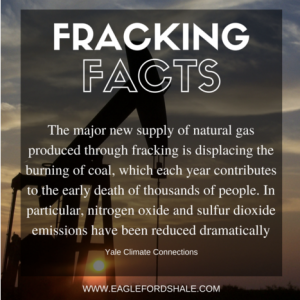
According to the U.S. Energy Administration, the state of Texas is the largest consumer of coal in the entire country, with it’s carbon dioxide and sulfur dioxide emissions also ranking among the highest in the nation. But coal is slowly losing it’s grip on energy production and is being replaced by the cleaner and healthier natural gas, a direct result of the recent 2008 fracking boom in the U.S.

How dangerous is coal to our health?

The World Health Organization (WHO) estimates that approximately 1,000,000 lives are shortened worldwide and 24,000 in the U.S annually as a direct result of coal particle pollution. Sulfur dioxide, mercury, particulate matter and nitrogen oxide are the four main coal emissions that can cause health problems ranging from chronic asthma and bronchitis to acid particles in the lungs and even death.

Natural gas, on the other hand, is the cleanest burning fossil fuel and provides significant benefits over coal. Here are a few health facts about using natural gas over coal:

  • “DOE (department of energy) analyses indicate that every 10,000 U.S. homes powered with natural gas instead of coal avoids the annual emissions of 1,900 tons of NOx, 3,900 tons of SO2, and 5,200 tons of particulates. (National Renewable Energy Laboratory. 1999)
  • Reductions in these emissions translate into public health benefits, as these pollutants have been linked with problems such as asthma, bronchitis, lung cancer, and heart disease for hundreds of thousands of Americans.” (California Environmental Protection Agency Air Resources Board. 2012)
  • Increasing reliance on natural gas, rather than coal, is indisputably creating widespread health benefits as the burning of natural gas produces fewer harmful particles in the air. (Yale Climate Connections)
  • Natural gas emits 50 to 60 percent less carbon dioxide (CO2) when combusted in a new, efficient natural gas power plant compared with emissions from a typical new coal plant. (National Energy Technology Laboratory (NETL). 2010)
  • When natural gas replaces coal as a fuel for generating electricity, the benefits to air quality include lower carbon dioxide emissions than coal and almost none of the mercury, sulfur dioxide or ash.

Since 2008, the use of coal for energy production has dropped 13% nationwide and the use of natural gas has risen 10%. Continuing to produce an affordable energy source like natural gas will not only keep our environment cleaner but will save thousands of lives within the United States each year.

Making the Switch

San Antonio-based CPS Energy has announced it will be shutting down its coal-fired J.T. Deely Station in 2018, making it the first publicly-owned coal plant in Texas to close. Ex-CEO Doyle Beneby began a strategy in 2011 to move way from coal in favor of using natural gas as a baseload power.

Baytex Reports Strong Q4

Chesapeake Released 2015 Q1
Baytex Energy Quarterly & Full 2015 Report

Baytex Energy reports strong performance in the Eagle Ford during the last quarter of 2015.

Related: Baytex Energy to Focus on Eagle Ford in 2016

In a recent earnings call, Baytex executives reported on the company's fourth quarter and full 2015 results. They also announced a reduction in their 2016 exploration and development spending to between $225 - $265 million.

Eagle Ford Shale Operations

The main theme throughout the call circled around the fantastic performance of the company's Eagle Ford assets.

The Eagle Ford generates the highest cash netbacks in our portfolio and has enhanced the quality of our production and reserves base. In 2015, 86% of our development activity was focused in the Eagle Ford, which contributed to strong reserves growth in our U.S. assets. The execution of our capital program has yielded impressive results as we advance the multi-zone development potential of our Eagle Ford acreage.
— James Bowzer, President and Chief Executive Officer

Highlights include:

  • Consistent pace of development, averaging six drilling rigs and two frac crews
  • Q4: Production averaged 40,284 boe/d (78% oil and NGL) compared to 38,941 boe/d in Q3/2015 and 39,548 boe/d in Q2/2015.
  • Q4: Capital expenditures totaled $132 million
  • Q4: Participated in drilling of 42 (12.6 net) wells in the Eagle Ford and commenced production from 61 (16.6 net) wells
  • Q4:36 (10.1 net) wells waiting on completion at the end of year
  • Full year 2015: drilled 188 (50.2 net)
    • 56% targeted the Lower Eagle Ford
    • 26% targeted the Austin Chalk
    • 11% targeted the Upper Eagle Ford
    • 7% targeted the upper portion of the Lower Eagle Ford.

2016 Forecast

In the Eagle Ford, we now anticipate a reduced pace of development in 2016 with approximately 4 to 5 rigs and 1 to 2 frac crews working on our lands. At this pace, we anticipate bringing approximately 30 net wells on production in 2016 as compared to our prior expectations of 35 to 40 net wells. In aggregate, we now anticipate the 2016 capital expenditures of CAD225 million to CAD265 million of which approximately 95% will be invested in the Eagle Ford

Read more at baytexenergy.com