Fracking & Water Safety: New Technology

Water Usage Increases in Eagle Ford
fracking water contamination

A new test will help monitor the risk of contamination of groundwater due to fracking activity.

Related: Fracking Facts: Is Our Water Supply at Risk?

As fracking has increased across America and around the world, so has the debate about the risks to the environment and our water supply. Numerous studies are presenting contradictory conclusions and making it hard to determine the truth about the safety of fracking.

Related: Is Fracking Safe?

Researchers from the UK have developed a new way to check for water contamination and could help monitor the safety of shale gas and coal bed methane extraction.

During the fracking process, shale rocks below ground are split with high-pressure fluids to release gas that is recovered for fuel and some claim that the process adversely affects ground water close by.

Creating this fingerprint test will enable gas exploration and extraction to be carried out responsibly and should help address public concerns over this technology. It is important that careful monitoring of methane levels in nearby waters is carried out when commercial extraction begins.
— Dr Stuart Gilfillan, University of Edinburgh's School of GeoSciences

These scientist plan to presenting their findings at the European Geosciences Union Conference in Vienna.

Other fracking studies:

  • Yale: measured well water near fracked wells concludes that ‘there was no evidence of association with deeper brines or long-range migration of these compounds to the shallow aquifers
  • EPA: claimed certain fracking activities that have the potential to impact drinking water resources but found no evidence that these activities have led to widespread, systemic impacts on drinking water in the United States.
  • John Hopkins : concluded possible adverse health outcomes associated with fracking

Read more at ScienceDaily.com

Pioneer Waiting on $50 Oil for Eagle Ford

Chesapeake Released 2015 Q1
Pioneer Earnings Report

Pioneer Natural Resources announces first quarter results and hints that they might restart Eagle Ford activity when crude hits $50.

Related: Pioneer Halts Eagle Ford Drilling

In February, Pioneer announced they were halting all drilling in the Eagle Ford due to severe downturn. But in an earnings call this week, executives gave some hints about their plans for their South Texas assets.

...so if WTI gets to $50 we would look at restarting Eagle Ford. We’ll have to make a decision at the time if we had 10 rigs for instance and 17, do we take two of those rigs and put them in the Eagle Ford? But, I could see us adding a couple of rigs in Eagle Ford.
— Scott Sheffield, Chairman and CEO commented

For the first quarter of 2016, Pioneer Natural Resources had an adjusted loss of $104 million alongside record production. Other Q1 highlights include:

  • Production: 222,000 barrels of oil equivalent per day. Oil production is up 10,000 barrels of oil per day or 9% versus the fourth quarter of 2015.
  • 55 horizontal wells on production in the Spraberry/Wolfcamp
  • Reduced combined production cost and G&A expense per barrel oil equivalent (BOE) by 15% compared to the fourth quarter of 2015
  • starting up the new Targa-operated Spraberry/Wolfcamp gas processing plant, which has a capacity of 200 million cubic feet per day (MMCFPD); and
  • increasing oil and gas derivative coverage for 2017.

Pioneer plans to keep capital expenditures at $2 billion for 2016, $1.5 billion for drilling and $150 million for vertical integration systems upgrades and field facilities.

Read more at pxd.com

Will Koch Restart Pipeline?

Japan Eyes Eagle Ford Natural Gas
Koch Considers Restarting Pipeline

Eagle Ford Midstream company considers a restart of existing pipeline system.

Related: Natural Gas Will be a Boom for Eagle Ford Companies

Koch Pipeline Company, L.P. (KPL) announced last week that it is evaluating whether it might restart an existing crude oil pipeline system in the northeastern section of the Eagle Ford Shale. The potential restart would start in 2016 an would include pipeline, storage and truck unloading stations in Burleson and Lee counties in Texas.

As a company we are always exploring ways to provide value for our customers. We are excited about the opportunity to possibly restart this pipeline to provide enhanced transportation alternatives to Eaglebine producers.
— Koch President, Steve Kromer


Koch operates about 540 miles of pipeline in South Texas and is one of the largest pipeline transporters of South Texas crude. Last year, the company restarted a 56-mile section of this system in Bastrop County, which included storage and a truck unloading facility.

Read more about 

Eagle Ford Shale

 Pipeline and Midstream Companies

In its latest,

Short Term Energy Outlook

, the Energy Information Administration (EIA) reported that in 2017, natural gas exports will surpass imports for the first time since 1955. With hundreds of miles of natural gas pipelines heading from the Eagle Ford and Permian Basin to the Gulf Coast, the liquefied natural gas industry is poised to deliver the majority of those exports.

With the current forecast for natural gas, the San Antonio Biz Journal recently highlighted five Eagle Ford companies that are positioned to take advantage of these markets in 2016.

  1. Howard Energy Partners: With acreage in Webb County, Howard plans to build a 200-mile pipeline to deliver 600 million cubic feet of natural gas per day to Mexico
  2. Lewis Energy: A top producer with positions inLa Salle, Webb and Dimmit Counties.
  3. Energy Transfer Partners: ETP already has natural gas export capabilities in Webb County and the Rio Grande Valley.
  4. Sanchez Energy: With tens of thousands of acres in the natural gas-rich lands of La Salle, Dimmit and Webb Counties, Sanchez entered a joint venture worth$115 million to bridge connections to Mexico.
  5. Flint Hills Resources: Has petitioned the federal government to ship LNG oversees.

Oil Import Quotas Proposed

Japan Eyes Eagle Ford Natural Gas
oil import

A grassroots movement in the Texas panhandle pushing back against OPEC by calling for quotas on oil and gas imports.

Related: Iranian Oil Will Add to Global Glut

Several pro-industry groups in the Texas panhandle have come together to create the Panhandle Import Reduction Initiative, an effort to propose a ban on shale oil imports from abroad. The group is working to gather signatures and raise $100,000 that will allow them to present the plan to the next president after the elections in 2017.

Supporters of the initiative are angry that oil-producing countries failed to reach an agreement to freeze oil production levels Sunday in Doha, Qatar and the announcement that OPEC will increase production again.

What we propose to the country and to the industry is a return to President Eisenhower in 1959, when he, by proclamation, established import quotas on foreign oil,” Fine said. “We will take care of Canada, our hemispheric ally. But OPEC, no. We’re going to rigorously put quotas on the import of oil.
— Oil and gas strategist, Daniel Fine commented

In 1959, President Eisenhower stablished a similar quota system that remained in effect for 14 years in order to sustain a healthy oil industry for national security purposes.

In January, the Obama Administration entered into an historic and controversial nuclear deal with Iran that includes lifting economic sanctions, which could add millions of barrels to the global glut.

Read more at PRnewswire.com

Abraxas: 20% Pay Cuts for Top Executives

Severance Tax Breaks for  Stripper Wells
Abraxas Pay Cuts

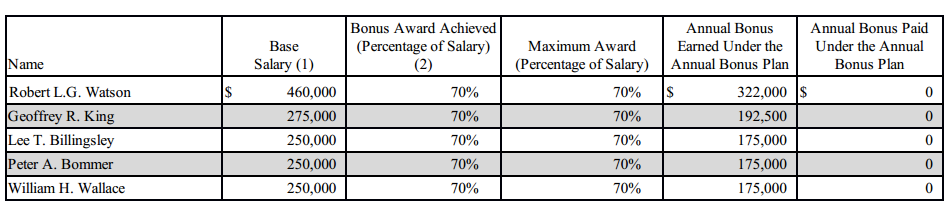
In the wake of a rough 2015, Abraxas Petroleum's top executives are taking serious measures to shore up the company's bottom line, including pay cuts and deferred bonuses of over $1 million

Related: Abraxas Chief Slashes Salary

According to a recent filing with the U.S. Securities & Exchange Commission, the leaders of this Eagle Ford producer are taking deep cuts in order to keep the company afloat.

At the end of 2014, CEO, Robert Watson anticipated a tumultuous 2015 and announced he would voluntarily cut his salary by 20 percent due to stressful market conditions. The recent filing confirms that Watson and the other executives all took 20 percent pay cuts.

Given the currently depressed nature of the oil and gas industry, as well as Abraxas’ 2015 stock price and operational performance, the Compensation Committee deferred its decision on paying 2015 bonuses. At this time the Compensation Committee does not expect that 2015 bonuses will be paid unless industry conditions materially improve.

For 2015, Abraxas reported the following highlights for its Eagle Ford operations:

  • Wells from Atascosa and McMullen Counties produced from 8,000 to 11,000 feet
  • Two Eagle Ford wells drilled and completed by the summer of 2015
  • Dropped 38 South Texas Eagle Ford proved undeveloped cases from our reserve report due to lack of economic viability at the lower commodity prices. (Approximately 7.8 MMBOE of net reserves
  • Average oil production 305,797 (Bbls)
  • Average Gas production 325,942 (Mcf)
Abraxas pay cuts
Abraxas pay cuts