Eagle Ford Gas Heads to Mexico in $3.6 Billion Pipeline Deal

TransCanada Expands Pipelines in Mexcio

TransCanada Expands Pipelines in Mexcio

Mexico’s demand for more electricity is creating a golden opportunity for Eagle Ford producers.

Related: Eagle Ford & Mexico- An Important Partnership

TransCanada and Spectra Energy are among producers who will receive $3.6 billion in contracts from Mexico’s state-owned Federal Electricity Commission to build 665 miles of pipelines to carry natural gas.

In 2014, Mexico passed historic energy reforms to boost the lagging production brought on by decades of inefficiency and diminished supply. This move set the stage for greater collaboration between businesses that operate in the Eagle Ford Shale and Mexico.

TransCanada was the first private company to construct and operate natural gas pipelines in Mexico and become a key player since the Mexican government made the expansion of the national gas pipeline a priority. In this latest deal, TransCanada will construct and operate a $2.1 billion natural gas pipeline in Mexico, which will ship natural gas from both U.S. shale plays and offshore sources.

By 2018, TransCanada will be operating seven major natural gas pipeline systems in Mexico representing approximately a US$5 billion investment. In addition to supplying natural gas to some areas of the country where it has never before been available, these projects contribute to strengthening local economies and provide significant employment opportunities, particularly during construction.

Spectra Energy was awarded a $1.5 billion contract to build a pipeline from Nueces County, Texas, to the Mexican border at Brownsville. The Texas portion of the pipeline is planned to be completed in 2018 and will transport up to 2.6 billion cubic feet of natural gas a day.

Read more about TransCanada in Mexico

EIA: Eagle Ford Production Decline to Surpass Other Shale Regions

Eagle Ford Production Expected to Decline

Eagle Ford Production Expected to Decline

The EIA (U.S. Energy Information Administration) is predicting that production in the Eagle Ford will experience a steep decline in July.

Related: Eagle Ford Counties Lead Production

Oil output in the biggest producing shale areas in the country is predicted to fall 4.7% by July 2016—compared to May 2016 levels, with the biggest drop happening in the Eagle Ford shale.

Output for the south Texas region is expected to shrink 58,000 b/d to 1.212 million b/d. Decreases in North Dakota will be 28,000 b/d and 1.024 million b/d in Wyoming’s Bakken shale,

The Eagle Ford would need 89 rigs operating to maintain current production, a long way from the 35 rigs currently running across the region.

Eagle Ford Counties still ranks highest in Texas production for crude oil, total gas and condensate, according to the Texas Railroad Commission. The agency reported that in March, production for was 77,702,710 barrels of crude oil and 638,377,189 mcf (thousand cubic feet) of total gas from oil and gas wells.

Five Eagle Ford counties were in the top ten crude oil producers for the month of March:

  1. Karnes County leads all Texas crude oil producing counties with 65,103,255 BBLS
  2. Dewitt County came in second with 5,265,583 BBLS
  3. La Salle County was third showing 4,776,538 BBLS
  4. McMullen County came in with 2,936,448 BBLS
  5. Gonzales County produced 2,690,702 BBLS

Read more at eia.gov

Karnes County Receives Gift to Repair Road

Eagle Ford Roads a Mess

Eagle Ford Roads a Mess

Karnes County receives generous gift to improve one of its county roads.

Related: TxDOT: $569 Million Needed for Eagle Ford Roads

Polk Operating, LLC, announced last week that is had donated recycled materials to rebuild a portion of County Road 240 in Karnes County.

Polk has a facility in Karnes that processes oilfield waste into products that can be repurposed. The company was able to create a recycled road base for the County Road 240 project, which eliminates the need to bury thousands of tons of natural resources into a landfill and potentially saved the county hundreds of thousands of dollars

This is an integral core aspect of Polk’s business philosophy that is predicated on ‘reduce, reuse, recycle,’” said Polk Managing Member, Mickey Polk. “Our customers do not have to sacrifice profitability for a green solution, which enables Polk to be an unparalleled and synergistically positive influence for all entities involved.

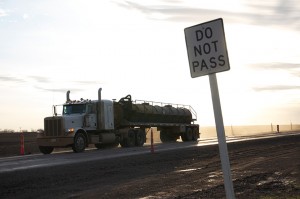
All across the Eagle Ford, oil and gas activity has left a mess of the county roads system. Poor road conditions, increased traffic and heavy equipment brought on by the oil boom have contributed to the unsafe conditions.

In March, TxDOT began a new initiative to address these issues state-wide in hopes to provide safety enhancements on roadways across the state’s energy regions. TxDOT says it needs to spend $569 million to improve Eagle Ford roadways, including:

  • Strengthening pavement structures
  • Adding shoulders to protect pavement edges
  • Adding turn lanes at key intersections
  • Constructing passing lanes on Super 2 corridors

Read more about Polk’s gift to Karnes

Sundance Energy Focuses on Eagle Ford

Sundance Acquiring More Eagle Ford Assets

Sundance Acquiring More Eagle Ford Assets

Australia’s Sundance Energy is gobbling up more of the Eagle Ford as a major focus of its growth strategy.

Related: Japanese Company Buys Eagle Ford Assets

Sundance Energy Australia Limited announced today that it has entered into an agreement to acquire approximately 5,050 net acres targeting the Eagle Ford in McMullen County, Texas.

The $16.0 million deal is the third venture for Sundance in the Eagle Ford. The company also operates Choke Canyon Reservoir located in McMullen, Live Oak and Atascosa Counties and the Redemption Project located in Dimmit County. Before the announcement of this purchase, Sundance reported on their website that they held ~40,000 net acres in the Eagle Ford.

This prolonged period of depressed commodity prices has tested the resilience of the oil and gas industry. However, the Board and Management of Sundance Energy has not wavered from their overall strategy of building a sustainable growth business and delivering superior shareholder returns in the medium to longer term. A major focus of this strategy is to expand and develop our valuable portfolio of Eagle Ford assets.

The acquisition should be complete by late July and includes the following:

  • 27 gross (9.6 net) wells
  • Total proved reserves of approximately 3.0 mmboe, 1.4 mmboe of which are attributed to producing wells
  • Expected 2016 fourth quarter production of 8,600 – 9,500 boepd

On Tuesday, Tokyo Gas Co. announced that they have closed on their acquisition of ~25% interest in Eagle Ford shale gas assets from the VirTex group. The 34,000 acre assets are located in the Webb and La Salle counties of south Texas.

Read more at SundanceEnergy.com

Some Eagle Ford Towns Thriving

Low oil prices and decreased production are not defining some Eagle Ford communities.

Related: UTSA: Eagle Ford Counties Must Diversify

Small towns and communities in the Eagle Ford Shale region of south Texas came alive with the oil boom of 2008 as populations exploded and new wealth flooded in. But as crude prices plunged throughout 2015, revenue streams to dried up and some Eagle Ford communities have fared better than others

Thomas Tunstall, the research director of the UTSA Institute for Economic Development, says that Eagle Ford towns who are now struggling can’t really blame the decline in oil and gas activity for their current economic woes. Back in 2015, Tunstall’s group released a study advising towns that long term planning and economic diversity were key to their survival.

Tunstall points to towns like Gonzales and Cotulla as great examples of towns who have worked to diversify.

Gonzales has reinvented itself as a tourist destination because it’s the birthplace of the Texas Revolution,” he said. “Cotulla is building sports facilities and working on being designated as a Free Trade Zone to attract truckers.

The UTSA Institute of Economic Development works to help towns develop strategies for growth and diversity. One of the agency’s initiatives is the Eagle Ford Shale Community Development Program, which trains local leaders how to think strategically. The program recently lost funding and is looking for ways to continue to help struggling Eagle Ford communities trying to make the transition to the new economy of lower crude prices.

Read more at utsa.edu