
Eagle Ford Shale Play Still Holds Great Value

Much has changed in the oil and gas industry over the past two years, but the Eagle Ford Shale Play still holds great value for investors and operators.

Related: Billions of Barrels Available in the Eagle Ford

Industry leaders gathered in San Antonio last week for the Hart Energy DUG Eagle Ford conference and exhibition, where conversation and presentations centered around the status of the Eagle Ford Shale outside of the boom.

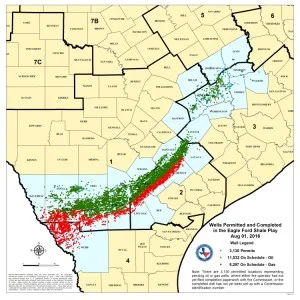
Activity in the Eagle Ford has slowed to its lowest point since 2010 with the Texas Railroad Commission (RRC) reporting last week that they issued 4,830 original drilling permits throughout the state of Texas from January-August. 642 of those permits are for operations in the Eagle Ford Shale. If the trend continues, the Eagle Ford will have fewer permits issued by the end of the year since before 2010.

Despite the massive shift since the glory days of the play, the Eagle Ford is still a prized space in the industry with many productive years ahead. Researchers from the UT’s Bureau of Economic Geology say that the 400-mile field has seen just a fraction of its ultimate activity and their new study predicts that another 100,000 wells can still be drilled.

The strategic value of the Eagle Ford stands the test of time, so even in the down cycle the values are still very strong.
— Mark Sooby, managing director at Bank of America Merrill Lynch

Richard Mason from Hart Energy summarized the key takeaways from the conference, with substantial technical progress topping the list. Eagle Ford operators are reducing costs and cycle time and improving recoveries. Operators are drilling longer laterals more quickly or doing the work of six rigs previously, only at lower costs. He also highlighted the huge potential available in Mexico and encouraged everyone to think of North America as an ‘integrated energy province’.

Eagle Ford Rig Count Unchanged

Eagle Ford Rig Count Unchanged

Eagle Ford Rig Count Unchanged

The Eagle Ford Shale rig count remained flat this week, making it the third week in a row ending with 44 rigs running across our coverage area.

In recent Eagle Ford news, UT’s Bureau of Economic Geology released new and unpublished research this week that shows Eagle Ford companies could potentially recover 10 billion barrels of oil at today’s prices.

Read more: Billions of Barrels Still Available in the Eagle Ford

A total of 505 oil and gas rigs were running across the United States this week, a decrease of 1 from last week of two.  89 rigs targeted natural gas (three less than the previous week) and 416 were targeting oil in the U.S. (two more than the previous week). The remainder were drilling service wells (e.g. disposal wells, injection wells, etc.) 244 of the rigs active in the U.S. were running in Texas.

Baker Hughes reports its own Eagle Ford Rig Count that covers the 14 core counties. The rig count published on EagleFordShale.com includes a 30 county area impacted by Eagle Ford development. A full list of the counties included can be found in the table below.

Eagle Ford Oil & Gas Rigs

5 rigs in the Eagle Ford region targeted natural gas this week with the commodity trading at $2.95/mmbtu.

The Eagle Ford rigs targeting oil were at 39 with WTI oil prices dipping $2.85 to $43.03 . 

A total of 38 rigs are drilling horizontal wells, one is drilling directional wells and five are vertical.

Karnes County continues to lead development this week with nine rigs in operation. See the full list below in the Eagle Ford Shale Drilling by County below.

Eagle Ford Shale Drilling by County

Eagle Ford Shale News

Eagle Ford Drilling & Completion Report

100 New Jobs for Texas Oil & Gas

Eagle Ford Operator Emerges from Bankruptcy

Billions of Barrels Still Available in the Eagle Ford

What is the Rig Count?

The Eagle Ford Shale Rig Count is an index of the total number of oil & gas drilling rigs running across a 30 county area in South Texas. The South Texas rigs referred to in this article are for ALL drilling reported by Baker Hughes and not solely wells targeting the Eagle Ford formation. All land rigs and onshore rig data shown here are based upon industry estimates provided by the Baker Hughes Rig Count.

Read more at bakerhughes.com

Eagle Ford Operator Emerges from Bankruptcy

Penn Virginia Emerges from Bakruptcy

Penn Virginia Emerges from Bakruptcy

Penn Virginia Corporation, who focuses on the Eagle Ford Shale Play, has emerged from bankruptcy

Related: Eagle Ford Companies Struggle as Bankruptcies Soar

Penn Virginia Corporation announced this week that it has satisfied the conditions of the bankruptcy court and reduced total long-term debt by approximately $1.1 billion.

Today begins a new chapter in the history of Penn Virginia. We have emerged from bankruptcy with a significantly de-leveraged balance sheet and committed financial support from our senior lenders and other stakeholders. With improved liquidity and a stronger capital structure, we are well-positioned to realize the full value of our excellent asset portfolio.
— Newly appointed chairman, Harry Quarls

The company plans to maintain their core position in the Eagle Ford and for the remainder of 2016, expects to utilize one operated drilling rig in the region. As of November of last year, Penn Virginia reported its position as approximately 100,000 net acres in the oil window of the Eagle Ford shale play in Gonzales and Lavaca Counties, Texas. According to the company website, Eagle Ford production was 14,188 BOEPD during the three months ended March 31, 2016, with oil comprising 10,504 BOPD, or 74 percent, and NGLs and natural gas comprising approximately 14 percent and 12 percent.

Texas has been hit specifically hard with industry bankruptcies. According to the law firm of Haynes and Boone, more that half (25) of the 2016 filing being initiated in Texas courts. The combined total Texas bankruptcy filings for 2015-16 is 43, representing approximately $29 billion in cumulative debt.

Read more at pennvirginia.com

Billions of Barrels Still Available in the Eagle Ford

Eagle Ford Holds Billions of Barrels of Oil

Eagle Ford Holds Billions of Barrels of Oil

New research from the University of Texas reveals there are still billions of barrels waiting to be drilled in the Eagle Ford.

Related: Eagle Ford Drilling & Completion Report

On the heels of the Eagle Ford’s lowest drilling activity since 2012, researchers from the UT’s Bureau of Economic Geology released new and unpublished research this week that shows companies could potentially recover 10 billion barrels of oil at today’s prices.

The university has conducted a broad study of shale gas production and reserves in the Eagle Ford Shale Play and the Bakken formation in North Dakota that analyzes energy prices, the cost of drilling and completing a well and the impact of regulations. The full results will be published in various peer-reviewed papers over the next six months.

Scientists were on hand at the recent DUG Conference in San Antonio to share some of their findings related to the potential of the Eagle Ford.

Scott Tinker, bureau director, and economist Svetlana Ikonnikova, shared that the 400-mile South Texas field has seen just a fraction of its ultimate activity. UT expects 100,000 wells in the Eagle Ford, far more than the 17,000 wells have been drilled so far, according to the Railroad Commission of Texas.

Other study highlights for the Eagle Ford:

  • The play holds an estimated 230 billion barrels of oil (only 10 billion can be recovered now)
  • The play has an estimated 462 trillion cubic feet of natural gas, with 34 trillion cubic feet recoverable.
  • At least 80,000 more wells will be drilled

Currently, activity in the Eagle Ford has slowed. The Texas Railroad Commission (RRC) reported this week that from January-August, they issued 4,830 original drilling permits throughout the state of Texas. 642 of those permits are for operations in the Eagle Ford Shale. Eight months into the year and the numbers don’t look good. If the trend continues, the Eagle Ford will have fewer permits issued by the end of the year since before 2010.

Read more at beg.utexas.edu

Eagle Ford Drilling & Completion Report

Eagle Ford Drilling Permits for 2016

Permits for drilling in the Eagle Ford Shale are being issued at their lowest rate since 2010.

Related: 100 New Jobs for Texas Oil & Gas

The Texas Railroad Commission (RRC) reported this week that from January-August, they issued 4,830 original drilling permits throughout the state of Texas.

642 of those permits are for operations in the Eagle Ford Shale. Eight months into the year and the numbers don’t look good. If the trend continues, the Eagle Ford will have fewer permits issued by the end of the year since before 2010.

August Drilling Permits

The Texas Railroad Commission of Texas (RRC) reported this week that it issued 660 original drilling permits in August 2016. This number was a decline from the 864 permits issued in August 2015. Permits include:

  • 512 permits to drill new oil or gas wells
  • Eight to re-enter plugged well bores
  • 140 for re-completions of existing well bores
  • Well types included 203 oil, 24 gas, 392 oil or gas, 26 injection, zero service and 15 other permits

August Well Completions

Well completions for August are also down compared to last year.

Total well completions for 2016 year to date are 8,107 down from 14,665 recorded during the same period in 2015.

The Eagle Ford Shale rig count remained flat this week, ending with 44 rigs running across our coverage area by midday Friday.The rig count in the Eagle Ford is back up to 44 after bottoming out at 32 in May. A total of 495 oil and gas rigs were running across the United States an increase of eight from last week with 241 of the rigs running in Texas.

Economist Karr Ingham of the Texas Alliance of Energy Producers says operators across the state have begin to add jobs back for the first time since 2015. Since the bottom began to fall out of the oil and gas industry 19 months ago, more than 102,000 jobs have been cut from every sector. The job loss rate slowed in June and in July, 100 jobs were added.

Read more at rrc.texas.gov