Eagle Ford Deal Value Leads the U.S. in 2013

Devon Energy Eagle Ford Acreage Map

Eagle Ford deal value led a down year for upstream exploration and production deals in the U.S. with almost $9 billion in activity in 2013.

A record was set in 2012 with almost $90 billion in mergers and acquisitions. The value of deals fell more than 42% to ~$52 billion in 2013. Worldwide total deal value fell from $271 billion in 2012 to $138 billion in 2013.

Of the almost $9 billion spent in the Eagle Ford, almost two-thirds was contributed by one deal - Devon Energy Acquiring Eagle Ford Assets From GeoSouthern for $6 Billion. Add oilfield service & pipeline deals and the Eagle Ford accounted for much more than $9 billion in activity.

You can read more on deals with regional relevance in 2013 by following the links below:

First Quarter 2013

Second Quarter 2013

Third Quarter 2013

Fourth Quarter 2013

Read the full PLS upstream deal activity report at plsx.com also find a full list of Eagle Ford Deals here.

Baker Hughes Reports Record Eagle Ford Well Spuds in Q4

Eagle Ford Well Spuds Q4 2013

Baker Hughes reported a record number of Eagle Ford well starts in the fourth quarter of 2014. The company's quarterly report shows ~1,171 wells were started over the three month period.

Rigs also drilled 0.5 wells more in the quarter than they did in the third quarter of 2013. That's an improvement of 40% or 1.5 more wells per quarter per rig than the industry was capable of in early 2012.

We consider the Baker Hughes well start estimate conservative since the company only considers a 14 county area in its Eagle Ford statistics. The numbers reported ignore areas like Brazos County where Eagle Ford activity is increasing.

Also Read -Eagle Ford Record Set for Well Spuds in Q3 (now a broken record)

By adding in the non-core Eagle Ford counties, well spuds easily eclipsed 1,200 wells in the fourth quarter.

Even though we reported this in the third quarter, it's also the first quarter in which well spuds eclipsed 1,100 in the 14-county area. The Baker Hughes reported well spuds were revised down in the third quarter from 1,131 to 1,096.

Read more:Did You Know Drilling Starts On Over 1,000 Eagle Ford Wells Each Quarter?

Watch for this record to be broken throughout 2014 if oil prices hold in the $90/bbl or higher range.

GE - Vess Oil Acquire Woodbine & Eagle Ford Acreage From Enervest - $108 Million

Vess Oil Operations Map

GE and Vess Oil have partnered to acquire 13,000 net acres in Brazos, Grimes, and Madison counties from EnerVest for $108 million.

The acreage is producing from the Woodbine and prospective for the Eagle Ford Shale.

This is the third partnership GE Energy Financial Services and Vess Oil have entered. Previous partnerships have acquired reserves in Brazos County, TX, and Kansas. A separate Vess Oil affiliate also operates Woodbine acreage in the Kurten Field adjacent to the assets acquired here.

“I am eager to launch our program and look forward to expansion opportunities predicated on demonstrable results.”
— Ronnie Nutt, COO of Vess Oil

Read the full release at businesswire.com

Eagle Ford Spending Could Reach $30 Billion in 2014

Eagle Ford Oil Production

Eagle Ford spending could stretch to new heights this year.

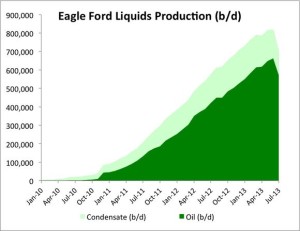
Eagle Ford oil production will surpass 1 million b/d early this year (combined oil and condensate production already has) and strong growth won't stop there.

GlobalData expects development spending could reach as high as $30 billion. If that happens, Eagle Ford oil production won't just reach 1 million b/d, it'll blow right past it. Other research organizations estimate spending somewhere in the $20-25 billion range.

If spending ends up closer to $20 billion, it will tie directly to cost savings the industry is capturing across the board and not necessarily due to less activity.

“With over 250 rigs operating in Eagle Ford, companies are expected to spend approximately $30 billion in capital this year, and nearly all of the major operators are projecting at least five years’ more drilling at the current rapid pace. The most efficient operators in sweet spots are achieving over 100% pre-tax Internal Rates of Return (IRR) with conservative pricing.”
— Taryn Slimm, GlobalData’s Lead Analyst covering US Onshore

Read more from globaldata.com

The Importance of Radio Communications Onsite & Wide-Area in the Eagle Ford - Press Release

Many energy related companies rely heavily on radio communications for coordination of personnel and assets on a site, across a region or both. They choose radio for many reasons:

  1. Dedicated communications for business. There is no possibility that an employee will be unavailable on a personal call when needed.
  2. Instant communications to one or many. Push to talk, no dialing multiple individuals or attempting to keep multiple cellphones connected for coordination of critical tasks.
  3. Rugged industrial grade devices with loud audio for noisy environments and high power transmitters for dependable remote talk back capability. Devices may be optioned as intrinsically safe for use in incendiary or hazardous environments.
  4. Simple service responsibility from regional communication firms. No waiting at retail stores or complex consumer type repair procedures. Service personnel repair and install onsite at customer locations on customer schedules.
  5. Easy billing. No complex cellular bills with numerous taxes and charges.
  6. Safe and legal. Two-way radios are fully compliant with Distracted Driver law and eliminate the potential for a cell phone related incident or fine.

Different Types of Two-Way Radios

When considering two-way radio one should be aware of the different types and configurations:

Mobile (vehicle mounted) Radios

Eagle Ford Shale Communications Network - A&B Communications

Permanently or semi-permanently mounted high power radio units connected to vehicle ignition and a very efficient vehicular antenna. Advantages are that mobile radios offer the greatest range due to high power transmitters and high mounted antennas generally on roofs, headache racks or mirrors. They are best suited for fleets where the drivers spend the majority of their time in the vehicle. Disadvantages are obviously that calls may be missed when away from the vehicle though many are equipped with wireless handheld extender devices for use within 1000 feet of the vehicle.

Portable (handheld) Radios

Small, battery operated rechargeable radio units. Advantages are that they may be used in / outdoors or vehicle. Disadvantages are that range is less than mobile radios due to lower power transmitter and less efficient antenna. Unlike cellular phones, portable two-way radios are industrial grade devices built to stand up under 24-hour duty cycles, harsh treatment and may be optioned to operate in explosive or hazardous environments.

Base Station (fixed) Radios

Permanently mounted office devices designed to be a central dispatch point. While is not necessary to have a base station, many firms see value in the fact that office personnel may communicate with outside personnel without the need to find a portable radio or to go to a company vehicle. Remote extensions of the base station may be placed in multiple locations within a field office allowing selected personnel to use the radio system without leaving their desk.

Configuration Options With Two-Way Radios

Onsite Configuration

All of the above radio units may be configured to operate unit-to-unit for limited range communications. Portable radios in this configuration may provide communications up to 2 miles, depending on topography and onsite structure. Mobiles and base stations will provide significantly greater range. Advantages of this configuration are that radios are not dependent on a tower network and do not have associated recurring usage fees. As a result they may be moved to other locations and used locally on other job sites.

Wide-area Communications

All of the above radio units may be configured to operate through a tower network for wide area communications. Portable radio performance is dramatically improved in this configuration and actual coverage and range may be custom designed based on user requirements. Advantages of this configuration are obviously extended coverage. Additionally all wide-area configured radios have the capability to change channel settings and operate in an onsite unit-to-unit configuration.

About A&B Communications

Headquartered in Corpus Christi, A&B Communications understands the unique needs of the oilfield fleet operator. The company specializes in safe, reliable, private communications systems and devices for petrochemical refining, oilfield, medical and public safety.

For more information, contact:

Patrick Russell [email protected] www.abcomm.net

The article above was published through EagleFordShale.com’s press release distribution service. Learn more about Eagle Ford Advertising Here.