Goodrich Petroleum Files for Chapter 11

Job Cuts Impact Eagle Ford
Goodrich Petroleum Files Chapter 11

The energy slump has claimed another victim as the Eagle Ford Producer, Goodrich Petroleum, files for bankruptcy.

Related: Goodrich Finalizes Eagle Ford Deal

Goodrich Petroleum announced this week that it was seeking to eliminate approximately $400 million in debt through a Chapter 11 restructuring plan.

In January, the struggling company was removed from the NYSE based on abnormally low price levels.

Has your oil & gas producer filed bankruptcy? Learn how to protect yourself.

Prior to the Chapter 11 filing, the Company attempted to restructure its balance sheet through voluntary exchange offers, with the latest effort unsuccessful due to the inability to get the necessary approvals from its common stockholders, preferred stockholders and unsecured noteholders.

In September, Goodrich announced it would sell much of its Eagle Ford Shale acreage to Houston-based EP Energy for $118 million and included property in LaSalle and Frio Counties, Texas. The sale was a last ditch effort by Goodrich to keep the itself afloat and pay off existing debt.

Other recent Eagle Ford bankruptcies include Magnum Hunter, Swift Energy and Sabine Oil & Gas. Last month a New York judge ruled in that Sabine Oil & Gas would be able to cancel the contracts it holds with midstream firms as part of its restructuring process during bankruptcy. Many are concerned that this decision will encourage other struggling producers to follow suite and file for bankruptcy if they know they can get out of such obligations.

Read more at GoodrichPetroleum.com

Phoenix Natural Resources to Focus on Eagle Ford

It's been a tough year in the oil and gas industry, but as the downturn continues to claim victims, some companies are still betting on the Eagle Ford.

Related: Clayton Williams Stops Eagle Ford Drilling

Phoenix Natural Resources, LLC , a newly-formed independent oil and gas company, just announced new plans to focus on development on the Eagle Ford after receiving a $250 million equity commitment from Kayne Anderson Energy Funds.

Headquartered in Houston, Texas, Phoenix will pursue acquisitions of oil and gas assets with scalable exploitation and development upside. The Company will consider acquisition and redevelopment opportunities throughout select North American basins with an initial focus on the Eagle Ford.

Phoenix isled by Russell Parker, CEO; Jim Mooney, CFO; Ray Ambrose, SVP of Engineering; Chad England, SVP of Operations; and Mark Hargis, SVP of Geology.  The management team brings their extensive technical and operational expertise into this new venture.

Other companies to receive equity commitments this year include:

  • Invictus Energy LLC :$150 million from Kayne Anderson
  • Percussion Petroleum LLC:$50 million from energyCarnelian Energy Capital Management LP
  • WaterBridge Resources LLC: $200 million from Five Point Capital Partners LLC

Several producers have pulled back their activity in the Eagle Ford. Earlier this year, Clayton Williams executives announced they had limited their drilling and completion activities to combat the downturn and expect to reduce capital spending further in 2016. Abraxas Petroleum Corp. announced they will focus the remainder of 2016 on their Bakken assets while scouting opportunities to sell Texas properties.

Read more at BusinessWire.com

Tax Breaks for Low Producing Wells

Severance Tax Breaks for  Stripper Wells
Severance Tax Breaks for Stripper Wells

The prolonged downturn means tax breaks for some producers.

Related: Eagle Ford School Districts Give Back Millions

In 2005, Texas lawmakers created a tax credit to bring relief to oil producers with low-producing wells. The tax break was set to trigger when oil prices dropped below a certain levels, a move designed to keep marginal wells in production during hard times.

Those hard times are now here and in February, the Texas Comptroller announced that low crude prices have triggered a 50% severance tax exemption on these 'stripper wells.

The Texas Tax Code classifies a ‘qualifying low-producing oil lease’ as an oil well that is part of a lease whose production during a 90-day period is less than 15 barrels of oil per day of production or five percent recoverable oil per barrel of produced water.

The amount of severance tax credit for qualified wells is tied to oil prices:

  • 25% credit: average taxable oil price were above $25 per barrel but not more than $30
  • 50% credit: if the price were above $22 per barrel but not more than $25.
  • 100% credit: tax credit if the price were $22 or less

Currently in Texas, the severance tax for oil production is 4.6% of the oil's market value. According to the Texas Comptroller’s Office, the state took in nearly $2.9 billion in oil production taxes in 2015, down 25.% from 2014.

well exemptions
well exemptions

Texas Oil & Gas Permits Drop

Eagle Ford Shale March 2016

Well permits and completions across Texas are at about 50% less than this time last year, according to the Texas Railroad Commission.

Related: Eagle Ford Counties Lead Production

Since the beginning of the year, the Texas Railroad Commission (RRC) has issued 1,594 permits for wells throughout Texas. This is in contrast to the 2,949 issued between January and March of 2015. For March alone, the agency issued a total of 511 original drilling permits that included 129 oil, 30 gas, 312 oil or gas, 30 injection and 10 other. This was a drop from 923 in March 2015.

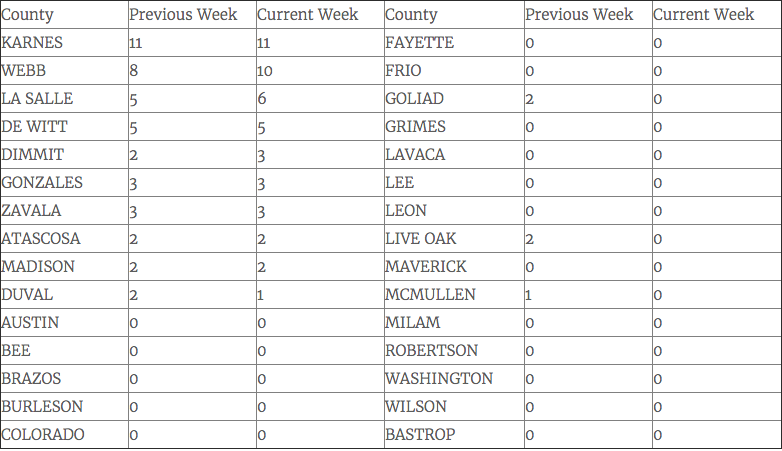
The Eagle Ford Shale rig count increased by one last week ending at 48 rigs running across our coverage area by midday Friday with Karnes County topping the list with 11 rigs.

2016-04-11_1553
2016-04-11_1553

Total well completions for 2016 year to date are 3,452 down from 5,946 recorded during the same period in 2015.

Read more at rrc.tx.gov

Texas Rig Count Falls Below 200

Eagle Ford Rig Count
Eagle Ford Rig Counts

The Eagle Ford Shale rig count decreased by two, ending the week with 46 rigs running across our coverage area by midday Friday.

In recent Eagle Ford news, NASA released new images that show the growth of the region and the total transformation of the landscape over the past few years.

Read more: The View of Eagle Ford Shale from Space

A total of 443 oil and gas rigs were running across the United States this week, which is a drop of seven over last week. 89 were targeting natural gas (one more than the previous week) and 354 were targeting oil in the U.S. (eight less than the previous week). The remainder were drilling service wells (e.g. disposal wells, injection wells, etc.)197 of the rigs active in the U.S. were running in Texas.

Baker Hughes reports its own Eagle Ford Rig Count that covers the 14 core counties. The rig count published on EagleFordShale.com includes a 30 county area impacted by Eagle Ford development. A full list of the counties included can be found in the table below.

Eagle Ford Oil & Gas Rigs

Natural gas rigs increased in the Eagle Ford fell to five this week as natural gas prices remained flat, trading at $1.99/mmbtu.

The Eagle Ford saw an increase in running oil rigs up this week to 41 with WTI oil prices remaining steady and ending the week at $36.79. A total of 43 rigs are drilling horizontal wells, zero are drilling directional wells, and three are vertical rigs.

Karnes County continues to lead the region in development with 11 running rigs. See the full list below in the Eagle Ford Shale Drilling by County below.

Eagle Ford Shale Drilling by County

Eagle Ford Shale News

Texas on Short List for Fracking-Induced Earthquakes

Fracking Facts: Is Our Water Supply at Risk?

Fracking Rules Tightened in North Texas

Eagle Ford Shale: the View from Space

What is the Rig Count?

The Eagle Ford Shale Rig Count is an index of the total number of oil & gas drilling rigs running across a 30 county area in South Texas. The South Texas rigs referred to in this article are for ALL drilling reported by Baker Hughes and not solely wells targeting the Eagle Ford formation. All land rigs and onshore rig data shown here are based upon industry estimates provided by the Baker Hughes Rig Count.

Read more at bakerhughes.com