Shale Production Booms and Foreign Oil Imports Decline

Shale plays, like the Eagle Ford, are contributing to U.S. production growth that has pushed imports of foreign oil below 50%. That's down from more than 60% just 5 years ago. While hydraulic fracturing is highly debated, its use combined with horizontal drilling has shifted the U.S. from a position of a majority consumer to a producer who supplies most of its oil needs. We're a long way from producing enough oil for the country, but at least we have a bargaining chip at the table. We can produce more oil and have untapped reserves in the ground. If you have a couple of minutes, this is a pretty good article from the LA Times. 

U.S. net petroleum imports have fallen to about 47% of the nation's consumption, down from a record 60.3% in 2005, Energy Information Administration statistics show. It's been 15 years since the nation's reliance on foreign oil has been this low.

Several factors figure into the import decline, but a big one is a little surprising: U.S. petroleum exploration is experiencing a quiet renaissance with the help of technology and new drilling techniques.

The number of oil rigs in production in the U.S. has reached a 24-year high, according to oil field services company Baker Hughes. In 2005, domestic production was 1.89 billion barrels. This year, experts say, production is expected to surpass 2 billion barrels.

Read the full news release at latimes.com

Eagle Ford Shale Drilling Rig Count - October 28, 2011

Drillingl rig
Drillingl Rig 5

The Eagle Ford Shale drilling rig count added five rigs jump to 245 active drilling rigs. That brings near the record of 247 set two weeks ago. Best estimates peg ~ 200 of the rigs targeting the Eagle Ford formation, while the remainder target other formations. The number of natural gas rigs working decreased 1 rig to 110. That's down 15 from just two weeks ago.  Seven oil rigs were added during the week to bring the total to 135. Webb County (35) jumped Karnes County (32) and leads the region in terms of active drilling.

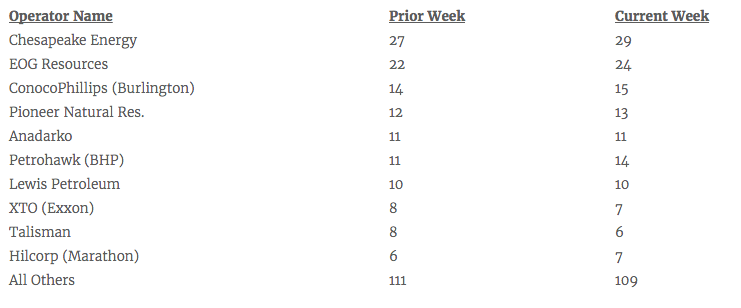
Chesapeake Energy (28) and EOG Resources (24) are the only operators with more than 20 rigs active in the play.  BHP (Petrohawk) made the biggest jump of any operator over the past week by adding three rigs to a total of 14.  That above BHP's average of 13 over the past few months.

Operators are now reporting earnings in full force.

Here's a recap of other news from this past week:

Stay tuned each week for an update on the South Texas rig count.

Drilling Rig Count by Operator

What is the Rig Count?

The Eagle Ford Shale Rig Count is an index of the total number of oil & gas drilling rigs running across a 30 county area in South Texas. The South Texas rigs referred to in this article are for ALL drilling reported by SmithBits and not solely wells targeting the Eagle Ford Shale. All land rigs and onshore rig data shown here are based upon industry estimates provided by the Baker Hughes Rig Count and/or Smith Service Co's (Schlumberger) Smith Rig Count.

Drilling Rigs by County

Eagle Ford Barges Taking Crude to Houston - New Orleans - Port Arthur

Barges are being utilized to move Eagle Ford crude oil to refining markets in Houston, New Orleans, and Port Arthur. Kirby Corp, a company that operates inland barges, said yesterday that as many as 140 barges across the U.S. are being used for crude oil. (That's in all areas and not just the Eagle Ford). The 140 represents a ten-fold increase from a decade ago. Moving oil on barges had become an almost non-existant business until plays like the Eagle Ford began producing oil in areas without spare pipeline capacity. Without pipelines, you begin looking for the next best thing. Utilization rates for trucks, tanks, and barges are at modern day highs.

Some of the Eagle Ford movements will be ultimately be kind of medium term" said Pyne, adding that pipelines under construction will eventually replace some of the barges as a means to carry crude from the Eagle Ford.

"But I do think that the the volume coming out of the Eagle Ford and Canadian crude that is being exported to Baton Rouge is sustainable."

Shale oil from the Eagle Ford deposit in southeast Texas has come on strong this year, rising to 272,000 barrels per day (bpd) in June from 70,000 bpd in April, according to energy consultancy Bentek. Some experts say it could top 400,000 bpd by 2013.

Read the full news release at reuters.com

Cabot Oil & Gas Q3 2011 Eagle Ford Operations Update

Cabot Oil & Gas had a good day as the company announced earnings . The stock jumped more than $10 per share or 17%. The company is largely focused on its core position in the Marcellus Shale of Northwest Pennsylvania, but Cabot did provide updates related to the Eagle Ford. In 2011, the company will participate in 25-30 net wells. Cabot is planning to operate one rig in the play throughout 2012. The company's last two wells in the Buckhorn area of Frio County produced almost 800 boe/d and over 900 boe/d.

In the Buckhorn area in the Eagle Ford, the company has drilled a total of 24 wells. Each well is 100% working-interest in Frio and La Salle County. 21 of these wells are on production with two wells completing, one well waiting on completion and one well drilling. The 2 most recently completed wells produced at initial 24-hour rates of 938 barrels of oil equivalent per day and 791 barrels of oil equivalent per day.


In our AMI with EOG, there are 6 wells currently on production in this 18,000-plus-acre area with 3 of these wells drilled and completed in the third quarter and the results are at anticipated levels. Gross production for both areas in the Eagle Ford is over 7,600 barrels of oil equivalent per day. Cabot intends to drill or participate in 25 to 30 net Eagle Ford wells in 2011.

Read the company's full press release at cabotog.com

ConocoPhillips 3Q Eagle Ford Growth - Truck Constraints and Well Costs

ConocoPhillips announced third quarter earnings yesterday (Oct. 26) and provided several Eagle Ford updates. The company averaged production of 31,000 boe/d with a 77% liquids cut. September production had risen to 36,000 boe/d, but included a loss of 10,000 to 12,000 boe/d related to third party trucking constraints. Without the constraints, production is approaching 50,000 boe/d. Conoco believes they will reach 100,000 boe/d by 2013.

In regards to the constraints:

There was a new trucking facility that was built in Eagle Ford...., but they really didn't move the needle that in terms of increasing capacity. We have talked about building pipeline gathering system, kind of a trunkline to get us to a liquid trading point out of Eagle Ford. We think that will be done the middle of next year. But we've got a lag of 10,000 to 15,000 a day of Eagle Ford that we can't get out just because of constraints.... That will continue until more infrastructure is built up in the area. So I guess it's a good problem to have, to be producing more and these wells to be more productive than what we thought they were, and we are investing in additional infrastructure in that area.

ConocoPhillips current backlog of wells isn't related to completions or fracking, but simply hooking the wells into gathering systems. The company has three dedicated frack crews that have been more than enough to keep up with the rig count. Trucking condensate is the major backlog in bringing wells to production.

The company operated 15 rigs in the quarter and plans to grow its Eagle Ford rig count to 16 by year end.

The average 30-day well rate is still running around 1,400 BOE. We've got -- we've initiated pad drilling. We've got some details on the -- let's say more of an E&P type of approach to Eagle Ford that we could probably run you through, but I don't have EURs or decline rates on Eagle Ford for you.

Well depth is somewhere between 16,000 and 19,000 feet. We're running 3,500 to 5,800 laterals. And on average, about 15 stage fracs. I think well cost that I've seen, drilling and completion are probably in the $6 million to $8 million per well range.

Read the company's press release at conocophillips.com