
Eagle Ford Crude is Pushing Out African Imports

Eagle Ford crude production is pushing out African imports. The Gulf Coast region alone is importing 400,000 barrels per day less than it did at this time in 2010. Domestic oil production is on the rise and foreign crude will continue to be displaced by locally sourced Bakken, Eagle Ford, and Permian crudes. Don't expect that trend to slow as the Bakken and Eagle Ford are on pace to produce 1 mmboe/d each in less than five years.

Don't underestimate the advantages of domestic crude. There are a lot more jobs on the upstream side of the business. It takes multiples more to drill and produce than it does to refine oil. The oil patch is a bright spot in what has been a rather dim jobs market over the past couple of years. As long as oil prices support development, this trend isn't going to change any time soon.

"Crude from Eagle Ford in Texas is coming through, and a rail terminal has opened, taking about 70,000 barrels of crude from North Dakota down to Louisiana," Jordan said.

Eagle Ford Formation

Marathon Petroleum Corp. is moving oil from the Eagle Ford shale-rock formation to its refinery at Texas City, according to the company. Daily production of crude and condensates at Eagle Ford has almost doubled this year from 2010, according to data from the Railroad Commission of Texas.

Refining margins in the U.S. Gulf have sunk to a loss of $0.42 a barrel Nov. 11 from a profit of $16.67 on May 10, the highest in more than 2 1/2 years, Bloomberg data show. The margin is calculated based on the return for turning three barrels of Light Louisiana Sweet crude into two barrels of gasoline and one of diesel. It has averaged $5.73 a barrel this year.

The U.S. imported an average 4.4 million barrels of crude a day to the Gulf Coast in the week ended Nov. 4, compared with 4.8 million in the same week last year, according to the Energy Department. Imports averaged 5 million barrels a day this year. Inventories in the U.S. Midwest are at the highest level for the time of the year in at least a decade, at 92.2 million barrels.

 

Unemployment Falling in San Antonio and Surrounding Areas

The Eagle Ford is contributing to a welcomed drop in unemployment across South Texas and we don't expect that to let up any time soon. The jobless rate in the San Antonio metropolitan area dropped from 8 to just 7.5% between September and October.  That compares favorably to a national rate of 9% in October.  The oil and gas industry has helped shield the Texas economy from the jobless rate extremes other parts of the nation have experienced. If you're looking for a career change, we have 100s of jobs listed at our Eagle Ford Jobs page.

San Antonio area employers added 1,400 non-agricultural jobs to their payrolls over the month and 8,100 jobs over the past 12 months. Officials with Workforce Solutions Alamo are attributing the reduction in unemployment, in large part, to job growth in the oil and gas industry.

Oil and gas industry jobs grew 17.7 percent over the past year in the Alamo region, the largest job growth rate for this industry since 2001. About 100 jobs were added between September and October and 600 jobs were added since this time last year.

Read the entire article at bizjournals.com

Eagle Ford Boasts Billions in Benefits - Stresses Infrastructure

The Eagle Ford Shale is providing billions in benefits to South Texas, but not without stressing South Texas infrastructure.  Eagle Ford drilling has eclipsed 200 rigs and the entire region has 264 rigs working.  That's roughly 14% of all active onshore rigs in the U.S. To put that in perspective, we had less than 20 rigs active in the play two years ago. With 100s of rigs active, billions of dollars are flooding into the region. In one of the most active areas, Karnes County's tax roll has increased from $500 million to $1.3 billion in a few short years.  Alice, TX, a town that isn't actually atop the shale, has far exceeded tax revenue estimates in 2011 and will likely be making improvements around the city without borrowing a dime. Add thousands of Eagle Ford jobs with royalties that are beginning to roll in and you've got an economic boom.

Along with all of the positives, streets weren't built for the amount of traffic running the roads these days. All those vehicles mean more people and people need places to live. Who could have guessed we'd have an Eagle Ford housing problem. There simply aren't enough beds for the number of oilfield employees who have moved to South Texas. 15+ RV parks will open in Bee County, TX, in 2011 alone.  That's hundreds of RV pads to provide temporary relief, and there's no doubt permanent housing will be needed as well.

Heavy trucks are damaging roads, kicking up dust and creating traffic where traffic never existed. Hotels and rental properties are full to bursting; new RV parks are dotting the landscape. "We have a lot of RV parks coming," Karnes County Judge Barbara Shaw said. "We're talking hundreds and hundreds of RV slots."

So instead of spending à la The Beverly Hillbillies on swimming pools and movie stars, much of the new tax money will go to mundane things, such as roadwork. Even school district budgets are evolving with the oil play.

In Yoakum, population 5,441, school superintendent Tom Kelley recently discovered his district will be considered rich when a gas processing plant is completed next year in his area. For the first time, Yoakum will be a "Robin Hood" district that must share its wealth with a poorer school one.

Read a full write up at the chron.com

16 Rigs Added To Set New Record - November 18, 2011

drilling rig
drilling rig 8

The Eagle Ford Shale drilling rig count jumped 16 rigs over the past week to reach 264 rigs. The previous week held the Eagle Ford era record and this past week beats the record by sixteen.  Approximately 210 rigs are targeting the Eagle Ford formation. The strength in drilling is the direct result of a resilient oil price, close to $100 per barrel and continued success across the play. While natural gas prices weakened throughout the week (<$3.50/mcf), we only lost one gas rig (101). Strength continued in the oil rig market with 17 rigs moving into the region. That's the single largest jump we've seen since Eagle Ford development began in earnest. Actually, two years ago at this time there were not 17 total rigs active in the entire play.

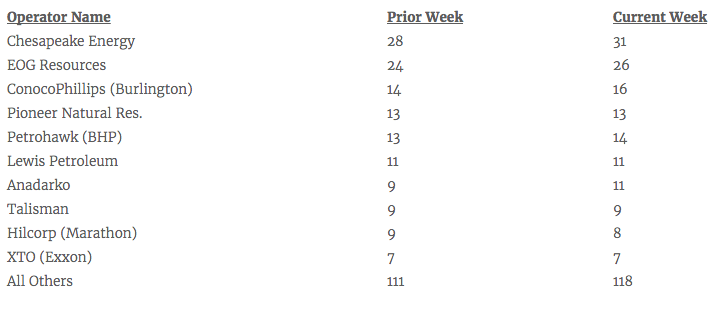
One rig continues to drill a Webb County disposal well. Webb (41) becomes the first county to eclipse 40 active rigs, while La Salle (36) , Karnes (30), DeWitt (22), Dimmit (20), and Gonzales (20) counties together account for more than 65% of Eagle Ford drilling. Chesapeake Energy (31) and EOG Resources (26) are 10 rigs are more ahead of the third most active driller.

News highlighted throughout the play this past week included:

Stay tuned each week for an update on the South Texas rig count.

Drilling Rig Count by Operator

What is the Rig Count?

The Eagle Ford Shale Rig Count is an index of the total number of oil & gas drilling rigs running across a 30 county area in South Texas. The South Texas rigs referred to in this article are for ALL drilling reported by SmithBits and not solely wells targeting the Eagle Ford formation. All land rigs and onshore rig data shown here are based upon industry estimates provided by the Baker Hughes Rig Count and/or Smith Service Co's (Schlumberger) Smith Rig Count.

Drilling Rigs by County

Copano Energy's Margins Grow With Eagle Ford Volumes

Copano Energy's margins are growing as the company expands its footprint in the Eagle Ford Shale. Higher NGL prices along with increased throughput are the primary drivers for the increase. Copano Energy is one of the most active midstream companies in the Eagle Ford Shale. The company operates assets and owns a 50% interest in an Eagle Ford Gathering Joint Venture with Kinder Morgan. In total, the company has plans to invest more than $500 million in more than 1 Bcf/d of pipeline and processing capacity. 

"We are making significant progress on our Eagle Ford Shale strategy as we complete and integrate the bulk of our 2011 projects, several of which have begun accepting volumes on a limited basis.

"We continue to see strong producer activity in the Eagle Ford Shale and when these projects are placed into full-service, they will have an immediate and positive impact on our distributable cash flow and distribution coverage," Northcutt added.

The year-over-year increase resulted primarily from (i) a 9% increase in realized margins on service throughput compared to the third quarter of 2010 ($0.63 per MMBtu in 2011 compared to $0.58 per MMBtu in 2010) reflecting higher NGL prices and (ii) an increase in pipeline throughput associated with fee-based contracts in the Eagle Ford Shale and the north Barnett Shale Combo plays. During the third quarter of 2011, throughput volumes for the Eagle Ford Shale and the north Barnett Shale Combo plays increased 25% and 41%, respectively, from the second quarter of 2011. During the third quarter of 2011, weighted-average NGL prices on the Mont Belvieu index, based on Copano's product mix for the period, were $59.43 per barrel compared to $40.16 per barrel during the third quarter of 2010, an increase of 48%. During the third quarter of 2011, natural gas prices on the Houston Ship Channel index averaged $4.23 per MMBtu compared to $4.33 per MMBtu during the third quarter of 2010, a decrease of 2%.

During the third quarter of 2011, the Texas segment provided gathering, transportation and processing services for an average of 765,744 MMBtu/d of natural gas compared to 590,116 MMBtu/d for the third quarter of 2010, an increase of 30%. The Texas segment gathered an average of 463,321 MMBtu/d of natural gas during the third quarter of 2011, an increase of 45% over last year's third quarter, primarily due to increased volumes from the Eagle Ford Shale and north Barnett Shale Combo plays.

Read the entire press release at copanoenergy.com