Bee County Passes $9,500 Well Permit Fee to Fund Road Repairs

Bee County Commissioners passed a resolution that will require Eagle Ford oil & gas operators to pay a $9,500 fee for each approved well permit.  The fee will be contributed to the Bee County Road and Bridge Fund and will be used to make needed repairs in areas of high traffic. Road repairs can cost as much as $50,000 per mile. There are 18 approved permits, from five companies, in the northern area of the county that will be affected by the new fee. $171,000 will be raised almost immediately.


This is the first required fee I've seen, but I know I've seen talk of others. Use the comments below if you know of other counties with similar permit fees. In Dewitt County, one operator is voluntarily donating $8,000 to the road fund for every well it drills.

Crimson Eagle Ford Shale - Woodbine Operations Update - February 2012

Crimson Exploration has South Texas operations targeting the Eagle Ford Shale (8,000 net acres) and the company is working to prove the potential of the Woodbine formation in Madison and Grimes Counties (17,000 net acres).   Crimson recently completed an Eagle Ford well in Karnes County that produced over 1,000 boe/d (89% liquids) and the company is currently drilling another well just a mile north.  The Littlepage McBride #7 well falls right in trend with the first seven wells in the area that came online at an average production rate of a little more than 1,000 boe/d. The company is targeting approximately 6,000 ft laterals with 18-20 stage completions in the area. A well in Dimmit (Beeler #1) and a well in Zavala County (KM Ranch #2) are also in various stages of completion. Noteably, the Dimmit County well has a more than 7,000 ft horizontal lateral.

In Madison County, Crimson is on schedule to begin completing the almost 17,000 ft Mosley #1H well in mid-February (now). The company anticipates fracking a 7,500 ft lateral with 20-24 stages. The rig will move just 1.5 miles north to begin the Grace Hall #1H once drilling is completed.

Crimson plans to keep a rig active targeting the Woodbine for all of 2012.

Read the full press release at crimsonexploration.com

Get a CDL in 10 Easy Steps - Start a Career in the Eagle Ford Oilfield

A Commercial Driver’s License (CDL) opens the door to a great career in the Eagle Ford Shale Play. You must have a CDL to drive many of the vehicles used in the oilfield industry such as:

  • a combination of vehicles weighing 26,001 pounds or more,
  • a single vehicle with a gross vehicle weight of 26, 001 pounds or more,
  • a single vehicle designed to transport more than 15 persons (including the driver) or
  • any size vehicle which requires hazardous material placards.

You must be at least 18 years old to drive intrastate and at least 21 years old to drive interstate. You'll have to obtain a Federal Motor Carrier Safety Administration medical certification. Federal regulations require you to show that you have the minimum knowledge and skill by taking tests. The state that will grant you your CDL will administer these tests.

It isn't hard to get a CDL, but it does take a little preparation.

1. License Application

Visit your state licensing agency office and learn about the application procedure. Many states post this information online. Gather all the documents that the agency requires, such as proof of residence, insurance and vehicle registration. Be prepared to pay any fees so that you can complete the application without repeated visits.

2. Prepare for the Knowledge Test

Before taking the written test, read the state CDL manual and answer the sample test questions. Find additional reference material and more practice questions at your public library, in a bookstore or online.

3. Take the Knowledge Test

You don’t usually need an appointment to take the Knowledge Test. Confirm this with your state licensing agency. Read the test instructions. Ask the examiner to explain anything you don’t understand about taking the test.

4. Get a Commercial Learner’s Permit (CLP)

You must have a learner’s permit to practice driving on public roads. Get a CLP from your state licensing agency. A CDL holder must accompany you during your practice sessions.

5. Practice Your Skills

You will take your skills tests in a vehicle that is representative of the vehicle for which you want to be licensed to drive. For example, if you want to be licensed to drive a tractor-trailer combination, you must take the skills tests in a tractor-trailer combination. (In most cases, a tractor with a van or flatbed trailer is all you need to take your CDL skills test.) Practice your skills in a representative vehicle.

6. Prepare for the Skills Test

Inspect your vehicle it to ensure that the equipment is safe, well maintained and meets federal and state safety standards. Know where all the controls are and how to operate them. Remember to bring to the testing site glasses or contacts that you need in order to see properly.

7. Take the Skills Test

Be calm and follow the examiner’s directions. Politely ask for an explanation of directions that you don’t understand. Don’t guess. During the road test, constantly check the view using your mirrors. Be aware of the traffic around you. Follow speed limits and all traffic control signals. Wear your seat belt.

8. Rally After a Mistake

If you do make a mistake, don’t panic! Show the examiner that you can stay calm and in control after a mistake.

9. Go Beyond the Basics

In addition to your CDL, you also need an Endorsement to:

  • drive a vehicle combination
  • pull double or triple trailers
  • pull a tank vehicle
  • operate a passenger vehicle in three different classes or
  • carry hazardous cargo.

You'll take additional tests to earn these Endorsements. You also must pass air brakes tests to be licensed to drive commercial motor vehicles with air brakes.

10. Think Safety

Stay calm, be confident and don’t rush. Always keep safety in mind both during the tests and throughout your driving career.

Eagle Ford Shale Drilling Rigs Moving - La Salle County Leads - February 10, 2012

drilling rig
Drilling Rig Sunset 6

The Eagle Ford Shale drilling rig count increased by 1 this past week and we're getting a lot of movement between counties. La Salle County added another rig to hit 40, while Karnes (35) and Webb (31) counties fell. The natural gas rig count fell 4 rigs to 79 this week, while we added 5 oil rigs (176). Natural gas prices remained flat at ~$2.50/mmbtu and the natural gas storage glut grew to more than 700 Bcf year over year.  It's hard to imaging gas prices improving substantially until a substantial number of natural gas rigs across the country are laid down.  March WTI oil prices increased to almost $99 per bbl. Horizontal wells account for activity from 237 rigs and we have 1 disposal well being drilling in Leon County (not a core Eagle Ford area).

La Salle County expanded its lead in drilling with 40 rigs running in the area. Karnes (35),Webb (31), DeWitt (25), McMullen (23),Gonzales (23), and Dimmit (18) set the bar as core development areas in the Eagle Ford.  This week, Live Oak County jumped to 10 rigs to join the pack of counties with double digit rig counts.

It was a busy week for news with a couple of major midstream announcements and several updates from operators:

Midstream News

Operator News

Come back weekly for updates on the South Texas drilling rig count.

Drilling Rig Count by Operator

What is the Rig Count?

The Eagle Ford Shale Rig Count is an index of the total number of oil & gas drilling rigs running across a 30 county area in South Texas. The South Texas rigs referred to in this article are for ALL drilling reported by SmithBits and not solely wells targeting the Eagle Ford formation. All land rigs and onshore rig data shown here are based upon industry estimates provided by the Baker Hughes Rig Count and/or Smith Service Co's (Schlumberger) Smith Rig Count.

Drilling Rigs by County

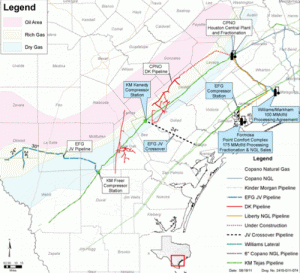
Copano Energy Expanding the Eagle Ford's DK Pipeline To McMullen County

Copano South Texas
Copano South Texas

Copano Energy announced an additional Eagle Ford pipeline and midstream expansion related to its DK Pipeline. The company is expanding the pipeline 65-miles southwest into McMullen County. The project will begin service in the first half of 2013 and will follow the same route as the Copano and Magellan Eagle Ford Condensate Pipeline.

Total costs are estimated at $120 million and the project is supported by a long-term fee based agreement with Petrohawk Energy, a subsidiary of BHP Billiton. Copano will provide midstream gathering and handling services in exchange for committed volumes of production from BHP in McMullen County. 

Read the full release at copanoenergy.com