Pioneer Natural Resources Acquires Brady Texas Frack Sand Mine - Carmeuse

Pioneer Natural Resources announced the acquisition of Carmeuse Holding S.A.'s industrial sands business in the U.S. for $297 million. The acquisition primarily adds a sand mine that is a great source of brown frack sand in Brady, TX. The acquisition is expected to save Pioneer $65-70 million per year. Here are a few important highlights from the press release:

  • By securing supply at below market prices, we expect to reduce annual capital spending by $65 million to $70 million based on our estimated sand requirements and current market prices.”
  • Pioneer’s primary source for brown sand is CIS’ Brady mine. Prior to the acquisition, the Company expected approximately 700 thousand tons, or 60%, of its forecasted 2013 brown sand requirements to be sourced from this location.
  • The supply of brown sand is expected to continue to be tight as a result of increasing shale play drilling, with the price of brown sand expected to escalate further as the growth in demand for this proppant outpaces new supplies.
  • Pioneer estimates that it will save $65 million to $70 million per year by acquiring CIS.
  • First, output from the Brady mine can be doubled from one million tons per year to two million tons per year
  • CIS has 23 million tons of white sand reserves in Wisconsin, where plans to develop a mine with a production capacity of up to one million tons per year are being progressed.

Read the entire press release at pioneernrc.com

Eagle Ford Shale - Professional Skills Needed - South Texas is Stepping Up

There are literally thousands of open Eagle Ford jobs in South Texas and the only thing holding the oil & gas industry back is skilled professionals. Many of the colleges in the area are developing specialized programs to help equip students with the skills needed to work in the oil & gas industry.  It's just a start, but local colleges will be instrumental in making sure the industry can fill the 70,000+ jobs that will be created over the next 10 years. If you are considering a change in career or might want to further your education, visit our Eagle Ford Shale Oil & Gas Training and Education page to find colleges and degree programs near you.

Everyone from accountants to IT professionals to scientists need advanced degrees. Even truck drivers need a commercial license gained through hours of class.

"This industry does not just need short term workers, they need long term workers and they need people that are educated and trained," said Castaneda.

So the solution for many lies in going back to school. Local programs are working with the industry to develop students qualified to work. Two years of schooling might seem like a lot, but Castaneda says the jobs will be there for a while.

Watch a short video at ksat.com

Eagle Ford Consortium Highlights

Just a few thoughts from the Eagle Ford Consortium Conference last week:

  • Production is outpacing expectations - Almost double early predictions from UTSA
  • Housing remains a concern, but investors are beginning to consider major multi-family developments
  • Peak drilling in the Eagle Ford is expected at 2,500-3,000 wells per year
  • The success/economics of downspacing will ultimately decide how far we go below the range of 65-130 acre spacing currently
  • More than 70,000 direct Eagle Ford Shale jobs will be created by 2020
  • Permits issued over the past three years in the Eagle Ford have gone 2009 - 94; 2010 > 1,000; 2011 > 3,000
  • In the most active counties, sales tax revenue increases have been as high as 500%
  • Oil prices remain the major risk to development

UTSA is currently working on an updated economic impact study and the expectation is for almost all figures to be revised upwards. The new study will be out in April.

Use the comments below to share your thoughts and notes from the conference. I only hit on the major themes I heard from talking to everyone in San Antonio.

Eagle Ford Drilling Record - 269 Rigs Working the Region - March 2, 2012

Drilling Rig
Drilling Rig 9

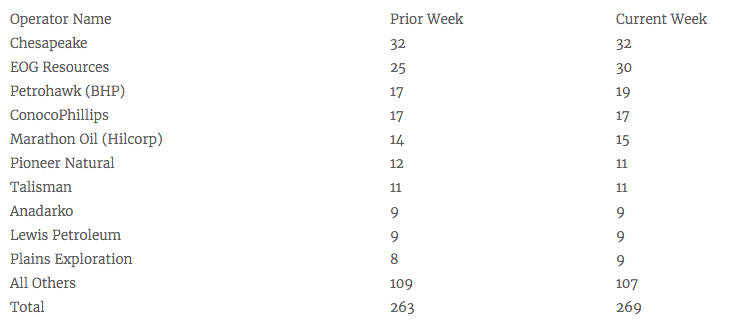
The Eagle Ford Shale drilling rig count jumped 6 rigs to 269 rigs active in the region. That's a record for the area with four more rigs than the 265 rig record we set in January. Even with operators cutting back capital budgets across the board, this shouldn't be the peak for rigs in the region. If oil prices simply stay in the same range, we'll likely see 10-20 more rigs enter the play over the next six months.

Eagle Ford Oil & Gas Rigs

The natural gas rig count fell 4 to 74 this week. We're now at the lowest gas rig count seen in the region in over a year. Many of the rigs in the area have simply been reclassified or moved to more oily portions of the play. The oil rig count jumped 11 rigs to offset the drop in gas rigs and drive us through the modern record. We now have 195 oil rigs working. That is 10 rigs above the previous oil rig count record in the play.

Commodity prices didn't move too much on the week. Natural gas traded around $2.50/mmbtu this week and oil fell a couple of dollars to $106 per barrel (WTI) at the end of the week. $100 plus oil prices are very attractive for Eagle Ford operators and is why we're confident this isn't the last record.

Horizontal wells account for activity from 251 rigs and we have no service wells being drilled. Karnes County took the drilling lead back with an increase of three rigs (41). La Salle (40),Webb (33), Gonzales (28), DeWitt (27), McMullen (21), Dimmit (17), and Live Oak (9) make up the top Eagle Ford counties.

The major news of the week was from a group led by Apollo Announcing Plans to Buy El Paso's E&P unit for $7.15 Billion. The end of the week was capped by the Eagle Ford Consortium's first meeting and other news included:

Devorah Fox also contributed an article on Personal Safety in the Eagle Ford Shale Oilfield. If you are operating in the area, it is a good refresher.

If you're traveling to San Antonio soon, be sure to visit our Eagle Ford Hotels page. We've negotiated discounted rates with hotels that are welcoming the Oil & Gas Industry.

Come back weekly for updates on the South Texas drilling rig count.

Drilling Rig Count by Operator

What is the Rig Count?

The Eagle Ford Shale Rig Count is an index of the total number of oil & gas drilling rigs running across a 30 county area in South Texas. The South Texas rigs referred to in this article are for ALL drilling reported by SmithBits and not solely wells targeting the Eagle Ford formation. All land rigs and onshore rig data shown here are based upon industry estimates provided by the Baker Hughes Rig Count and/or Smith Service Co's (Schlumberger) Smith Rig Count.

Drilling Rigs by County

Personal Safety in the Eagle Ford Oilfield

The Eagle Ford Oilfield is a busy workplace. The work itself can be hazardous, involving expensive heavy machinery and tools, all of which merit your undivided attention. Regulations of the federal Occupational Health and Safety Administration and company policies are designed to protect worker health and safety. However, the most important guardian of your personal safety in the workplace is YOU.

Personal Safety Tips

Here are some simple steps for personal safety around commercial motor vehicles. They'll help you to avoid non-driving motor vehicle-related accidents.

  • As you approach the vehicle, take a look around. Make sure it's secure. Don’t get under, in front of or behind a truck or piece of heavy equipment if there’s any chance at all that it could move.
  • Be aware of the condition of the vehicle. Now would be a better time to notice a defect than when you’re miles down the road or in the middle of a critical operation.
  • If this is an unfamiliar vehicle for you, look around and identify the location of all the controls. Make sure that there are no loose objects that could hit you if you start or stop abruptly. Adjust the seat so that you can reach the controls easily.
  • Do a little personal inventory. Are you fit to operate a heavy truck or piece heavy equipment? If you’re too fatigued, hung over, distracted or preoccupied to perform safely, you’re putting yourself as well as others at risk.
  • Fasten your safety belt.

Get in the habit of using the Three-Point Stance to enter and exit a vehicle safely. Have at least three points of contact. Use both hands and one foot, or both feet and one hand.

  1. As you approach the vehicle cab, eyeball the footholds. Dirt or grease could cause you to slip and fall.
  2. Enter the cab with one foot on the ground, one on the truck’s foothold and one hand on the handhold.
  3. Exit by climbing out backward, as if you were using a ladder. Never jump out of the cab.

Practice being safe around cargo. A load can shift while in transit, so use caution when you open cargo doors or release tiedowns. Open only one side of a van trailer and stand behind the other latched door. This will give you some protection from any falling cargo.

Use caution around forklifts. The only one who should be in or on a forklift is the forklift driver.

Don’t listen to music and don’t wear earbuds while you’re in the field. You should be listening for the sounds of moving and approaching equipment or instructions from team members and supervisors. Do follow your company policies regarding wearing hearing protection in the workplace.

Be Alert and Aware in the Workplace

A little extra awareness of yourself, your equipment and your environment can go a long way toward ensuring the personal safety of you and your coworkers around commercial motor vehicles.