Aurora Oil & Gas Testing 350 ft Eagle Ford Well Spacing

Aurora Oil Gas Eagle Ford Acreage Map

Aurora Oil & Gas provided an operations update announcing it will participate in 11 wells testing tighter spacing across the company's acreage. Wells in the gas-condensate window of the play will be tested at 500 ft (~60-acre) spacing and wells in the volatile oil window will be tested at 350 ft (~40-acre) spacing. If successful, a 40-acre spacing test means there could be potential for as many as 16 wells drilled targeting the Eagle Ford on the best sections in the volatile oil window.

Ultimate recoveries normally fall when operators downspace in a field, but we're still in the early stages of determining optimal well design across the Eagle Ford. The best case scenario is that test proves successful without lowering per well recoveries significantly.

Highlights from Aurora's second quarter activity includes:

  • Acquired an additional 6% working interest in the Sugarloaf AMI
  • Acquired 75% of the outstanding shares of Eureka Energy
  • Produced ~560,000 boe
  • Construction began on three central processing plants in the Sugarloaf AMI
  • 75% of Sugarkane Field acreage is now held by production
  • Havest 3 Rivers Pipeline came into service and Aurora is selling crude and condensate at the equivalent price of WTI+$6

Marathon Oil operates the majority of Aurora's acreage. You can read more about Aurora at aurora.com.au

How low do you think Eagle Ford acreage spacing will go? Share your thoughts in the comment section below.

Cabot Oil & Gas 400 ft (55-acre) Spacing Test Yields Best Well To Date

Cabot Oil Gas Eagle Ford Shale Map

Cabot Oil & Gas reported initial results from its two well 400' (55-acres) spacing test and plans to drill additional wells. The best of the two wells provided the highest initial IP rate of any of the company's 33 wells to date. The second well is trending higher than the average of the company's program to date.

Downspacing across the play is looking more and more viable in the volatile oil and the condensate trends of the play.

Cabot now plans to drill a second set wells utilizing 400 ft spacing to continue its evaluation. I suspect we'll know more by the end of the third quarter and we'll know if the company will shift its development program by early 2013.

Read the full quarterly press release at cabotog.com.

Eagle Ford Oil Prices Trade at a Premium to WTI - Condensate Weaker

Oil Drum
Oil Drum

Eagle Ford oil prices realize a nice premium to WTI and higher API condensates trade at a discount. One of the great advantages the Eagle Ford has over other shale plays is location, location, location. A short commute to the nation's petrochemical backbone means operators realize better oil prices than most areas of the U.S.

Eagle Ford Shale Oil Price Premium

Eagle Ford oil prices trade at a premium to WTI or a discount to LLS depending on who you talk to. Over the past two months, posted Eagle Ford prices have traded at a ~$6-8 premium to WTI and a ~$6 discount to LLS posted prices. That's after spending part of April and May at >$10 premium to WTI and almost parity with LLS.

Eagle Ford Condensate Prices Trade at a Discount to Crude Oil

In 2011, over 36% of reported liquids production from the Eagle Ford was considered condensate and as much as 50% of production today is estimated to be condensate. That's a significant portion of production, so it's important to understand its pricing. A recent article by RBN Energy provides more details in regards to condensate pricing.

....there are 3 principal markets for condensate: (a) sale as crude oil, (b) sale as diluent for heavy crude blending, and (c) processing in a splitter and sold as component products. Refiners find condensate less attractive as a crude oil blend because it produces less of the valuable middle distillate blends. The diluent market is attractive but requires shipment to Canada. Some of the Eagle Ford condensate is being shipped south to Corpus Christi by pipeline and then by barge up the Gulf Coast to St James LA and on up the Capline pipeline to Canada. Midstream players in the Eagle Ford are also developing condensate processing facilities. At the moment, however, we can see from Plains All American posted prices that refiners are paying less for Eagle Ford condensate than they do for crude and then applying a gravity adjustment factor to reduce the price they pay for condensate even further.

Using Plains All American posted crude oil and condensate prices, the RBN articles compares 60.1 API Eagle Ford condensate to crude with a 40-44.9 API:

The average posted condensate to crude discount this year was close to $17/Bbl.

You can read the full write up on crude and condensate prices at RBNEnergy.com

The discount for condensate from crude is ~$12/bbl now, but it has stretched over $20 at times in the first two quarters of the year. Putting both the crude and condensate price pieces together we have a better picture of what operators are being paid in South Texas. Crude oil is more marketable and can easily displace imports at refineries. Add optimal location and it receives a premium to WTI. Condensate with an API of 60+ has more limited use and is trading at a discount to crude and WTI. Overall, with an assumed 50/50 split of crude and condensate production in South Texas, operators are still realizing prices better than WTI. Consider the major operators who can negotiate crude prices pegged to LLS and South Texas liquids are fetching an even better premium to WTI.

Share your experience or thoughts in the comment section below.

Important Notes:

Condensate has an API gravity of 50+ and falls between natural gas liquids and crude oil on the hydrocarbon spectrum. Condensate is largely produced at the wellhead, but some volumes are captured in gathering systems. 

WTI prices are currently trading at a discount to comparable international benchmarks (Brent). That is the opposite of the historical norm. Cushing, Oklahoma, is lacking adequate infrastructure need to move oil to the Gulf Coast and other demand centers. When that problem is alleviated, we'll likely see a shift in WTI prices, which will change the discussed relationship of WTI and Eagle Ford crude.

Eagle Ford Oil Boom - Natural Gas Slump - EagleFordShale.com Quoted

Eagle Ford oil potential has kept drillers interested and even shifting capital to the play over the past year. Both oil and gas prices are up over the past few weeks, but comparatively $92/bbl is much better than $3/mcf. Read the entire article that details rig activity and production growth at chron.com

R.T. Dukes, a director at the website EagleFordShale.com, which posts news about the shale, said oil companies' budgets "are being pressured by natural gas prices, but drilling activity hasn't really slowed down in the Eagle Ford." However, if the price of oil should drop again and gas prices remain low, "you'll probably see some sort of slowdown in the second half of the year."

Yet Dukes remains bullish on the Eagle Ford.

"It's a first-class play in the United States," he said. "That usually doesn't change over short periods of time. On a relative basis, it's still better than most plays in the U.S.," he said.

Should natural gas prices go much higher, "you'll see additional capital come to the Eagle Ford," he said.

Eagle Ford Shale Regional Rig Count at 271 - July 20, 2012

Sanchez Energy Eagle Ford Shale Map

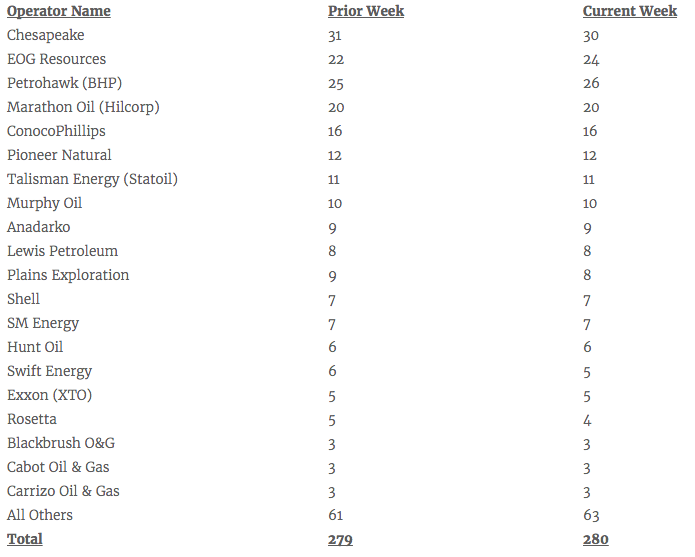
The Eagle Ford Shale drilling rig count fell to 271 this past week. That's a drop of nine rigs over the past week. ConocoPhillips accounted for five of the nine rig decline. Smithbits data shows the company dropped from 16 to 11 rigs week over week. The company has not voiced plans to slow down significantly, so this could very well be a blip in the rig census. My suspicion is Conoco's rig count will recover in the coming weeks.

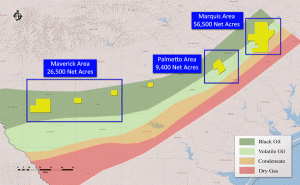
Eagle Ford operator Sanchez Energy provided an early second quarter operations update. The company increased its proved reserves estimate to 15 million barrels and expects total resource potential to reach 250-380 million barrels from 800-1,200 potential drilling locations. The company also plans to drill 3-4 additional vertical wells its Maverick Area in Zavala and Frio counties. The most recent vertical well produced more than 200 boe/d and vertical development just might provide superior economic returns in this area.

Eagle Ford Oil & Gas Rigs

The number of rigs targeting natural gas (Smithbits) slipped down to 63 this week, eight less than last week's count. The drop is also skewed by Smithbits reporting ConocoPhillip's drop in activity in La Salle and DeWitt counties. The only counties with over ten rigs targeting natural gas are Karnes and Webb.

Henry Hub futures were trading at just over $3.03 on Friday afternoon. It has been a while since gas prices traded above $3/mmbtu. Watch to see if prices hold at this level for long.

WTI was trading over $91/bbl Friday afternoon and is up almost $10/bbl over the past few weeks. LLS crude prices are just above $107/bbl. That's good news for Eagle Ford producers. Most oil and gas companies prepared for lower natural gas prices, but weren't expecting the sub-$3 we've had this summer. If oil prices were to go and stay much lower than $80/bbl, we would really start to see a pull back across the U.S.

There are 255 horizontal rigs running in the region as of Friday afternoon, down from last week's 263. There is one water well being drilled in McMullen County. The three counties leading development are Karnes at 40 rigs, and La Salle and McMullen at 33. Dimmit (29), Webb (25), DeWitt(17), Gonzales (17), Atascosa (12), and Live Oak (12) round out the top Eagle Ford counties.

News items this week included:

Come back weekly for updates or sign up for alerts.

Drilling Rig Count by Operator

What is the Rig Count?

The Eagle Ford Shale Rig Count is an index of the total number of oil & gas drilling rigs running across a 30 county area in South Texas. The South Texas rigs referred to in this article are for ALL drilling reported by SmithBits and not solely wells targeting the Eagle Ford formation. All land rigs and onshore rig data shown here are based upon industry estimates provided by the Baker Hughes Rig Count and/or Smith Service Co's (Schlumberger) Smith Rig Count.

Drilling Rigs by County