
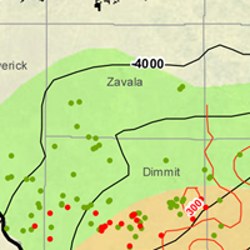
Longview Energy Wins Court Battle Over Zavala County Acreage

Zavala County Eagle Ford Shale Map

Longview Energy has won the largest court decision related to the Eagle Ford Shale to date. The company will be assigned all rights to 46,000 acres of leases in Zavala County that have a market value as high as half a billion dollars.

The case: Longview Energy Company v. The Huff Energy Fund L.P., WRH Energy Partners, LLC, Riley-Huff Energy Group, LLC, William R. “Bill” Huff, and Rick D’Angelo sided with Longview Energy based on breach of fiduciary duty, aiding and abetting claims.

The short version of the story is that Longview Energy is a private equity backed firm with less than ten employees. The Huff companies mentioned above are all related to one of Longview's main investors Huff Energy. That investor has two seats on the board. After Longview Energy determined opportunities in the Eagle Ford, the the two board members had Huff companies begin investing in the area through different entities. The Huff company also began leasing acreage before the Longview board ever voted whether or not to invest in the same area.

In the end, the court determined the two board members breached their fiduciary duties. The three Huff companies are required to pay over $95 million in prior revenues to Longview, all production since the June verdict, and a 5% annual post judgement interest rate.

Read more about the case at dallasnews.com

Enterprise Products Cryogenic Processing Expands by 300 mmcfd in Yoakum

Yoakum TX Map
Yoakum TX Map

Enterprise Products' second 300 mmcfd cryogenic processing train in Yoakum, in Lavaca County, has come online. Capacity is now 600 mmcfd at the plant and the company has the ability to extract 74,000 b/d of NGLs. The first Enterprise Yoakum processing train came online in May of 2012.

The latest announcement includes the second train and brings capacity to two-thirds of what is ultimately planned. When completed the facility will have total capacity of 900 mmcfd.

“Like the Eagle Ford Shale play itself, our Yoakum natural gas facility continues to exceed expectations and provide Enterprise with new growth opportunities,” said A.J. “Jim” Teague, executive vice president and chief operating officer of Enterprise’s general partner. “Based on the operating results we’ve seen from the first train which began service in May 2012, we expect the second and third trains to perform above their original design capacity, giving us the confidence to pursue additional processing commitments for all three plants.”

Read the full press release at enterpriseproducts.com

Eagle Ford Rig Count at 265 Sept 7, 2012

PXD Barnett Combo Map

The Eagle Ford Shale drilling rig count settled at 265 to end the week. Several rigs were reclassified to take the oil rig count down to 207 from the record 215 last week. The labor day holiday made the week short for most and the only major news was that Pioneer Natural Resources plans to sell its Barnett Shale assets to focus its efforts. The company will now "reallocate capital to higher-return, core assets in the Permian Basin and the Eagle Ford Shale". The capital raised will be used to pay down the company's credit facility. The data room opens in October and a deal is expected to close in the first quarter of next year.

Eagle Ford Oil & Gas Rigs

The number of natural gas rigs increased by 3 to 55 this week. The slight recovery is a bounce off the low of 52 last week. Rigs continue to shift from natural gas to oil targets in Webb County, but DeWitt County saw a jump of 3 rigs that offset the decline in Webb. There are 207 oil rigs working the region. That's eight off the record set last week, but still near prior records. One injection well is being drilled in Karnes County. Two disposal wells are being drilled - one in Karnes County and one in Leon County.

Henry Hub futures were trading at ~$2.68 on Friday afternoon. Spot prices on the other hand moved almost the same amount, but in a positive direction to $2.85.

WTI was trading at ~$96/bbl Friday afternoon. This is the fourth week in a row we've ended trading around that level. Eagle Ford crude priced at $104/bbl on September 6th and light crude and condensate traded at $92 and $91, respectively.

There are 249 horizontal rigs running in the region. The three counties leading development are Karnes with 43 rigs, La Salle with 33 and McMullen with 30. Dimmit (27), DeWitt (21), Webb (21), Gonzales (20), Atascosa (10), Frio (11), and Live Oak (10) round out the top Eagle Ford counties.

News items this week included:

Be sure to visit our South Texas Oilfield Job Listings to search openings and come back weekly for updates or sign up for alerts.

Eagle Ford Rig Count by Operator

What is the Rig Count?

The Eagle Ford Shale Rig Count is an index of the total number of oil & gas drilling rigs running across a 30 county area in South Texas. The South Texas rigs referred to in this article are for ALL drilling reported by SmithBits and not solely wells targeting the Eagle Ford formation. All land rigs and onshore rig data shown here are based upon industry estimates provided by the Baker Hughes Rig Count and/or Smith Service Co's (Schlumberger) Smith Rig Count.

Eagle Ford Shale Drilling by County

Pioneer's Barnett Shale Assets Will Be Sold to Fund Eagle Ford Development

PXD Barnett Combo Map

Pioneer Natural Resources plans to sell 155,000 gross acres in the Barnett Shale to fund development in the its West Texas Permian Basin and South Texas Eagle Ford Shale properties. Approximately two-thirds of the company's Barnett acres are deemed "Barnett Combo" acres that are prospective for liquids-rich shale gas.

Pioneer's current production is 7,000 boe/d with 55% attributed to oil/NGLs and 45% attributed to natural gas.

“The sale of our Barnett Shale properties will allow us to strategically reallocate capital to our higher-return, core assets in the Spraberry vertical play, the horizontal Wolfcamp Shale play and the Eagle Ford Shale. We plan to utilize the net proceeds from the divestiture to reduce indebtedness under Pioneer's credit facility.”

The data room will open in October and Pioneer plans to close the transaction in Q1 of 2013.

Read the full press release at pxd.com

Pulling Eagle Ford Trailers Safely - Crack the Whip!

Pulling Eagle Ford trailers safely is no task for the faint at heart. Combination vehicles are usually heavier, longer, and require more driving skill than single commercial vehicles. This means that drivers of a vehicle combination like a straight truck with a trailer need more knowledge and skill than drivers of single vehicles. These drivers also need a Combination Vehicle Endorsement on their CDL. To get one, you have to take a written test and a skills test. You’ll have to demonstrate that you know how to handle two characteristics of trailers that make driving a combination vehicle more of a challenge than driving a single vehicle. These are:

  • rearward amplification and
  • yaw instability.

Eagle Ford Trailers - Rearward Amplification

In the busy production-driven environment of the Eagle Ford Shale oilfield, “crack the whip” usually means, “get busy, get to work!” For drivers of tractor-trailers, however, “crack the whip” has a different meaning.

Federal Motor Safety Oversteer

Trucks with trailers have a dangerous crack-the-whip effect caused by rearward amplification. A quick lane change can cause the trailer to swing out, then swing back, like the tip of a whip. This effect is most severe in double and triple combinations. The last trailer in the combination will be affected the most. The result can be a rollover.

Steer gently and smoothly when pulling trailers. Maintain a generous following distance. Leave at least one second for each ten feet of your vehicle length, plus another second if you’re going over 40 miles per hour. Look far enough ahead to avoid having to make sudden movements. Drive slowly and make lane changes gradually. Keep plenty of space to the sides of the vehicle so you can enter or cross traffic smoothly.

Federal Motor Safety Understeer

Control your speed whether fully loaded or empty. When empty, large combination vehicles take longer to stop than fully loaded ones. When lightly loaded, the very stiff suspension springs and strong brakes give poor traction and make it very easy to lock up the wheels. The trailer can swing out and strike other vehicles.

A tractor can jackknife very quickly. Be careful about driving bobtail tractors which can be very hard to stop smoothly and which take longer to stop than a tractor-semitrailer loaded to maximum gross weight.

When the wheels of a trailer lock up, the trailer will tend to swing around in a trailer jackknife. This is more likely to happen when the trailer is empty or lightly loaded. Stay off the brake. Do not use the trailer hand brake while driving, it can cause a trailer skid.

Once the trailer wheels regain traction, the trailer will start to follow the tractor and straighten out.

Yaw Instability Can Cause a Rollover

“Yaw” means rotation around a vertical axis. In terms of trailers, this vertical axis is the kingpin and it’s where the trailer is joined to the tractor. This connection does not keep the trailer in a fixed, straight line behind the tractor. After all, the whole point of having an articulated vehicle is to create an angle between the tractor and the trailer. That allows the entire rig to take curves and corners.

However, this flexibility can cause problems called “yaw instability” or “snaking.” Sometimes this swaying, or oscillation, can cause a rollover. As the speed at which you’re traveling increases, your trailer or trailers will start to sway from side to side. A sudden steering maneuver can also lead to instability. Several factors can contribute to yaw instability such as:

  • the condition of your tires
  • the stiffness of the suspension
  • the placement of the fifth wheel
  • the distribution of cargo

Load cargo and pre-trip your rig with care. Use caution when passing vehicles on the highway or going around a sharp corner. Don’t understeer or oversteer.

If you have an interests in driving in the Eagle Ford, be sure to visit our South Texas Oilfield Jobs page and Devorah's website linked in her bio below.