Marathon Petroleum Buys BP's Texas City Refinery

Texas City Refinery
Texas City Refinery

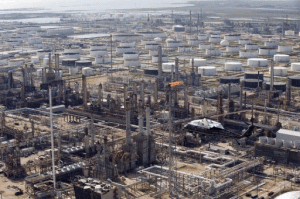
Marathon Petroleum has agreed to buy BP's Texas City Refinery and related marketing and logistics assets for as much as $2.5 billion. The refinery has a 451,000 b/d capacity and is positioned well to benefit from growing production in plays like the Eagle Ford.

The deal includes several related assets:

Texas City refinery, three intrastate NGL pipelines originating at the refinery, an allocation of BP's Colonial Pipeline Company shipper history, four terminals, retail marketing contract assignments for approximately 1,200 branded sites and a 1,040 megawatt cogeneration (cogen) facility. The base purchase price is $598 million, plus inventories estimated at $1.2 billion. The agreement also contains an earnout provision under which MPC could pay up to an additional $700 million over six years, subject to certain conditions. The transaction is expected to be accretive to earnings in the first year of operation. The acquisition is expected to be funded with cash on hand, and is anticipated to close early in 2013, subject to customary closing conditions and regulatory approvals.

Read more at marathonpetroleum.com

Tied Down: Load Securement in the Eagle Ford Shale Play

Cargo Load Securement

A few weeks ago, Land Line Magazine reported a story that caught our attention. A Texas truck driver waged a lawsuit against Dole Fresh Fruit Co. and Chevron over an injury that he sustained last year when a bungee cord on a Dole trailer snapped back into his eye.

Of course we felt badly for the injured driver. The matter of who was or was not at fault in this particular situation is not the subject of this post. The incident reminded us of the importance of cargo securement.

The suit maintained that Dole had responsibility for cargo securement, but ultimately load securement is the driver’s duty. As a commercial motor vehicle driver, you are responsible for all load securement. Federal Motor Carrier Safety Regulation 392.9 (b) states specifically that the driver must inspect the cargo and the devices used to secure the cargo prior and during the route to determine that is safe to be transported. Here are the highlights of the regulation.

Driver and Carrier Responsibilities

Both the driver and the carrier have cargo-securement responsibilities. A driver may not operate a commercial motor vehicle and a motor carrier may not require or permit a driver to operate a commercial motor vehicle unless:

  • the cargo is properly distributed and adequately secured
  • the tiedowns and other means of fastening the cargo are secured, and
  • the cargo or any other object does not obscure the driver's view ahead or to the right or left sides.

Driver Duties

According to the regulations, drivers of a truck or truck tractor must:

  • assure themselves that the responsibilities described above have been met before driving a commercial motor vehicle
  • inspect the cargo and the devices used to secure the cargo within the first 50 miles after beginning a trip and make necessary adjustments, including adding more securement devices, to ensure that cargo cannot shift on or within, or fall and
  • reexamine the cargo and its load securement devices during the route.

Cargo and cargo securement should be reinspected:

  • at a change of duty status
  • after driving the commercial vehicle for three hours or after driving the commercial vehicle for 150 miles, whichever comes first.

The only exception is for drivers hauling sealed loads that can’t be inspected.

Oilfield Operations Call for Extra Care

Much of the area in the Eagle Ford Shale Play consists of rough caliche roads miles off the highway. These roads take a beating from weather and heavy loads. The unevenness of the road surface alone can cause loads to shift. Drivers have to pay extra attention to the securement of their loads when entering and exiting these sites. Even traveling at low speeds on a bumpy road loads can reposition a load. Straps and chains can loosen.

Oilfield Cargo Is King

Sure, driving a heavy vehicle takes a lot of skill but in the end, truck driving isn’t about the truck or driving, it’s about hauling cargo. If freight isn’t being hauled, no one is making any money. For that reason alone you will rarely bobtail or pull an empty trailer. As important as deadlines and schedules are, what’s more important is to deliver the cargo undamaged while guarding your safety and the safety of those who share the road with you.

Almost 6 Million Barrels of Crude Moved Through the Port of Corpus Christi in August

Almost six million barrels moved through the Port of Corpus Christi in August. That's almost twice the amount of crude that moved through the port in all of 2011.

Through August, more than 15.8 million barrels have been sent out of the port bound for domestic markets in 2012. Even without complete figures for the year, the port's outbound crude oil movements so far this year are about 100 times the amount from five years ago.

Inland barges can carry 30,000 barrels and oceangoing barges carry up to 300,000. Future expansions of the port will allow it to handle larger oceangoing barges.

Read more about the port at caller.com


Eagle Ford Drilling at 280 Rigs - La Salle County Leads - Oct 5, 2012

Penn Virginia Eagle Ford Acreage Map

Eagle Ford Shale drilling jumped six rigs to 280 running in the region over the past week. If natural gas prices continue to rise throughout the winter, 2013 could prove to be another exciting year in the Eagle Ford. Over 80% of current activity is focused in oily portions of the play and most of the gas activity is in areas of high condensate and NGL yields. Higher natural gas prices will support activity in dry gas portions of the play that have been explored very little to date. While I'm not confident natural gas prices will get much better, I do believe we'll see more natural gas well records in the Eagle Ford fall if they do.

Penn Virginia had the biggest announcement of the week. The company acquired 4,100 net acres in what they call the "volatile oil" window in Gonzales and Lavaca counties for $10 million. You can read more in the article Penn Virginia Acquires Gonzales & Lavaca County Acreage for $10 million.

Eagle Ford Oil & Gas Rigs - New Oil Rig Count Record 217

Three natural gas rigs were added this week to reach a total of 46 running in the area.. That's a bounce off lows the past two weeks. The oil count blew through the previous record of 228 to reach 232 rigs targeting oil. Over 130 oil rigs have been added in the region since June of 2011.

One water well is being drilled in Bastrop County and one disposal well is being drilled in McMullen County.

Henry Hub futures were trading at ~$3.38 on Friday morning. A full week above $3 is welcomed by the industry. Spot prices began to catch up this week as well. Henry Hub spot prices were up a quarter, trading at $3.25.

WTI was trading at ~$90/bbl Friday. That's a level not seen since July. Eagle Ford crude priced at $100.68/bbl on the 4th of October. Light crude and condensate in the area traded at $88.25 and $87.25, respectively. Notice how Eagle Ford pricing is holding stronger than the rest of the country. Location near the Gulf Coast refinery complex and favorable oil characteristics provide a strategic advantage for the play.

There are 264 horizontal rigs running in the region. La Salle County took the lead in development with 41 rigs running. Karnes with 38 rigs, McMullen 29, Webb (26), Dimmit (24), Gonzales (23), DeWitt (20), Atascosa (15), and Frio (10) round out the top Eagle Ford counties.

News items this week included:

Be sure to visit our South Texas Oilfield Job Listings to search openings and come back weekly for updates or sign up for alerts.

Eagle Ford Rig Count by Operator

What is the Rig Count?

The Eagle Ford Shale Rig Count is an index of the total number of oil & gas drilling rigs running across a 30 county area in South Texas. The South Texas rigs referred to in this article are for ALL drilling reported by SmithBits and not solely wells targeting the Eagle Ford formation. All land rigs and onshore rig data shown here are based upon industry estimates provided by the Baker Hughes Rig Count and/or Smith Service Co's (Schlumberger) Smith Rig Count.

Eagle Ford Shale Drilling by County

How Long Will the Eagle Ford Shale Boom Last?

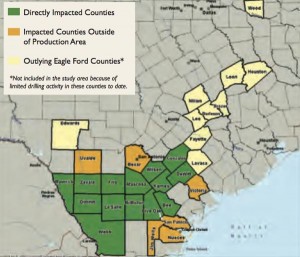
Eagle Ford Shale Impact Map

A Texas A&M economist met with business leaders to share his projections of how long the Eagle Ford shale boom will last. He expects the play will have a productive lifespan of 16 years. I'd like to see what is behind the 16 year number, but I believe the message was well delivered. This Eagle Ford development isn't going to fizzle out any time in the near future. The opportunity is too big. Billions of barrels of oil & gas resources mean billions and possibly trillions of dollars in economic development.

The economist speaking at the 2013 Executive Economic Outlook breakfast was simply conveying there is significant opportunity in South Texas. Most real estate developers are being cautious and not making commitments unless they can project a one-year payout. If the play has a lifespan of decades, more permanent developments are needed. South Texas will need every thing from grocery stores to home developments, gas stations and Wal-Marts.

Eagle Ford Shale's Lifespan

[ic-r]The Eagle Ford is still relatively young, so everyone is wondering if the play will go bust. The answer to that question lies in the future oil price. As long as oil prices hold steady at a level of more than $70, South Texans don't have much to worry about. The Eagle Ford returns more to operators than almost all plays in the country. Even if oil prices drop, it will still have the same relative position as the investment of choice in North America.

An old industry addage is "The easiest place to find hydrocarbons is where you've already found them". That will likely prove true in South Texas. We're actually seeing it play out today. Operators have new development plans in several other oil & gas plays including the Austin Chalk, Buda, Escondido, Olmos, and Pearsall Shale formations.

I wouldn't say never, but I'd place the probability of a bust in South Texas lower than anywhere else in the country.