This is a great time lapse video of a typical Eagle Ford well captured from start to finish by Marathon Oil. The video was shot over a period of a few months.
Thank you to Lee Warren from Marathon who forwarded the video our way.

Your Custom Text Here
This is a great time lapse video of a typical Eagle Ford well captured from start to finish by Marathon Oil. The video was shot over a period of a few months.
Thank you to Lee Warren from Marathon who forwarded the video our way.

The Texas Railroad Commission's Eagle Ford Shale well map was updated with the most recent data through December 11, 2012.
Since November 12th, the commission has issued 40 permits. That's much slower than the almost 5 permits per day during the previous four months, but a slow down is expected this time of year.
A total of 3,318 wells had been reported producing as of December 11. Over 200 wells were brought online in the past month. That's 176 more oil wells and 35 more gas wells than we had in November. Interestingly, that's a pace of more than 7 wells coming online per day.
Data from the RRC is always a little delayed, so the numbers reflected might not be 100% accurate. The RRC is at the mercy of companies reporting data in a timely fashion. I suspect we're closer to 4,000 wells producing by the end of the month.

Eagle Ford Shale regional drilling increased 8 rigs to 256 running the week before Christmas. La Salle and Dimmit counties were the big movers during the week. La Salle lost four rigs and Dimmit gained four rigs.
The story of the week was from a Wood Mackenzie press release discussing future development in the play. Eagle Ford Capital Spending makes the play the world's largest oil & gas development! Almost one-third of all upstream dollars spent in the US in 2013 will be allocated to developing the Eagle Ford. In less than four years, more than $100 billion will be spent developing the play.
Callan McMahon of Wood Mackenzie notes “Some of these numbers can be difficult to put into perspective, but $28 billion (2013) would put one at roughly the median country annual GDP.”
The natural gas rig count held flat at 46 as gas traded up to ~$3.45 on Friday. Colder weather forecasts are helping prices, but it's going to take a cold snap across the country to get prices back up near $4. In a follow up from last week, ethane rejection is estimated to have added 400-500 mmcfd of gas to the system in the past few weeks.
The oil rig count grew by 8 rigs to reach 208 running in the area. WTI crude futures traded above $90 per bbl, but had fallen to $89 per barrel on Friday afternoon. Eagle Ford crude priced at $100/bbl on the 21st of December. Eagle Ford light crude and condensate in the area traded at $85 and $84, respectively.
There are 247 horizontal rigs running in the region and one storage well is being drilled in Zavala County.
La Salle County leads development with 35 rigs running. Karnes with 30 rigs, McMullen (27), Dimmit (26), Webb (22), Gonzales (22), DeWitt (19), Live Oak (12), Fayette (8), Lavaca (8), Atascosa (7), Frio (7), Madison (7), and Wilson (7) round out the top counties in the region. [ic-c] South Texas Oil & Gas News:
Devorah Fox, of Mike Byrnes & Associates, penned an article discussing the need for Good CDL Drivers in South Texas. If you have drivers or are a driver in South Texas, it is a great read.
Be sure to visit our South Texas Oilfield Job Listings to search openings and come back weekly for updates.

The Eagle Ford Shale Rig Count is an index of the total number of oil & gas drilling rigs running across a 30 county area in South Texas. The South Texas rigs referred to in this article are for ALL drilling reported by SmithBits and not solely wells targeting the Eagle Ford formation. All land rigs and onshore rig data shown here are based upon industry estimates provided by the Baker Hughes Rig Count and/or Smith Service Co's (Schlumberger) Smith Rig Count.

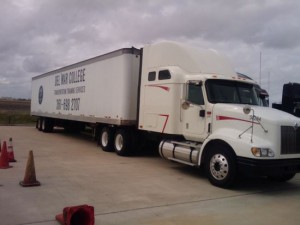
South Texas has had a huge CDL driver shortage even before Eagle Ford Shale. Currently there are 150,000 CDL drivers needed nationwide. The American Trucking Associations have predicted the driver shortage will jump to 300,000 by the year 2014. Many companies are finding it more and more challenging to attract experienced CDL drivers due to the huge demand. CDL holders are held to a much higher standard than regular licensed drivers and must keep their driving records in good standing.
Hiring good experienced drivers is very challenging because companies have to be especially strict about driving records, accidents and Department of Transportation violations. This is because of CSA (Compliance, Safety, Accountability) scores. CSA was established to keep accurate statistics of accidents, DOT violations, unsafe equipment and driving habits. CSA scores the safety performance of both the driver and the driver’s company. If a driver receives an unsatisfactory vehicle inspection and receives a violation, it will stay on the individual’s CSA score for three years and the company that employed the driver at the time for two years. Under CSA’s new system that score will travel with the driver to whatever company the driver may transfer to over those three years. Having a negative CSA score increases the chance of receiving a DOT audit and can be very costly to both the driver and the employer.
Many companies have resorted to hiring inexperienced drivers to try and keep up with the workload. Inexperienced drivers could be a high risk if they did not receive adequate training from a credible CDL training program that teaches them how to be a safe, law abiding driver. Unfortunately there are some instances where a company will offer to train inexperienced drivers. In many cases these individuals are not successful because they are taught only how to pass the CDL test given at their local Department of Public Safety. However, there’s more to know to be able to drive a truck safely and efficiently. For example, drivers must know hours-of-service regulations and have to maintain a log book. Since hours of service isn’t tested it’s a subject that’s rarely taught in a CDL-prep-only program, but it’s vital to being able to operate a heavy commercial motor vehicle safely and legally.
Drivers must follow many federal and state rules and regulations which undergo frequent updating and changes. Not understanding their responsibilities can ruin drivers’ CSA scores quickly making them unemployable. Transport companies are in the business of transporting items; they’re not educators. Schools and training programs specialize in and have the experience and tools to give people a thorough education consistent with current industry and government requirements. [ic-c]
When researching a credible CDL training program to attend here are a few things to watch out for:
Good training is an investment that lasts for a lifetime of safe and rewarding driving. Professional drivers get the best and most thorough training they can. They understand that they owe it to themselves, their employers and the people with whom they share the road.

NFR Energy is acquiring $736 million in properties and plans to change its company name. The deal includes the acquisition of 66,300 net acres and 6,500 boe/d of production in the Anadarko Basin and Eagle Ford of South Texas.
The company is spending $655 million for assets in the Anadarko Basin in North Texas and Oklahoma, along with $81 million for Eagle Ford assets. The Eagle Ford assets include 2,300 acres in what the company calls the "core of the core" in DeWitt County.

The graphic to the right highlights the company's 2,300 acre Sugarkane Project in DeWitt County, but, as you can see in the graphic at the top of the page, most of the company's acreage is in Lavaca County near the Lavaca-Fayette county line. The company estimates proven reserves across its Eagle Ford assets is more than 20 million boe. Production in the area is approximately 55% oil and NGLs.
NFR noted the following in regard to the Sugarkane project:
The acquisition adds another core area of development for the company in the Eagle Ford.
After the acquisition, the company's assets are broken down as follows:
David Sambrooks, NFR's CEO, stated, "These acquisitions immediately result in a large, well balanced company with three major producing and development basins and exposure to oil, gas and NGLs...."
First Reserve, an energy private equity company, backed NFR as a start up in partnership with Nabors Industries. First Reserve is now acquiring Nabor's equity interest in the company. Once the acquisition is complete, NFR Energy will change its name to Sabine Oil & Gas, LLC.
Read the full press release at nfrenergy.com
Quisque iaculis facilisis lacinia. Mauris euismod pellentesque tellus sit amet mollis.