Eagle Ford Regional Drilling at 252 Rigs - January 18, 2013

Onshore LNG Regas and Tanker

The Eagle Ford Shale drilling rig count increased by 3 rigs to top out at 252 running this past week.

In news, we touched on two developments regarding Eagle Ford completions over the past week. An Eagle Ford well was completed with a propane frack and a second well is planned to be completed with LNG powered frack pumps.

We sat down with a Ferus Oilfield Services rep, Jed Tallman, who provided details related to the Baker Hughes led LNG powered completion. Essentially, LNG is brought onsite in tanker trucks, regassed and injected through the air intake of the frack pumps. Diesel is still used and provides the spark for combustion, but substitution rates as high as 65% can be achieved. Add theeconomic savings of as much as $50,000 to the environmental benefits of cleaner burning natural gas and you get get a recipe for something you'll likely hear about again.

Eagle Ford Oil & Gas Rigs

[ic-r]The natural gas rig count fell two to 40 running this week. Gas prices, on the other hand, reversed weeks of declines to reach almost $3.60/mmbtu on Friday afternoon.

The oil rig count jumped five rigs to 209 running in the area. WTI crude futures were trading close to $95.50 per barrel to end the week. Eagle Ford crude priced at $108.53/bbl on the 17th of January. Eagle Ford light crude and condensate in the area traded at $92 and $91, respectively.

There are 233 horizontal rigs running in the region. A storage well is being drilled in Zavala County and disposal wells are being drilled in Frio County and Leon County.

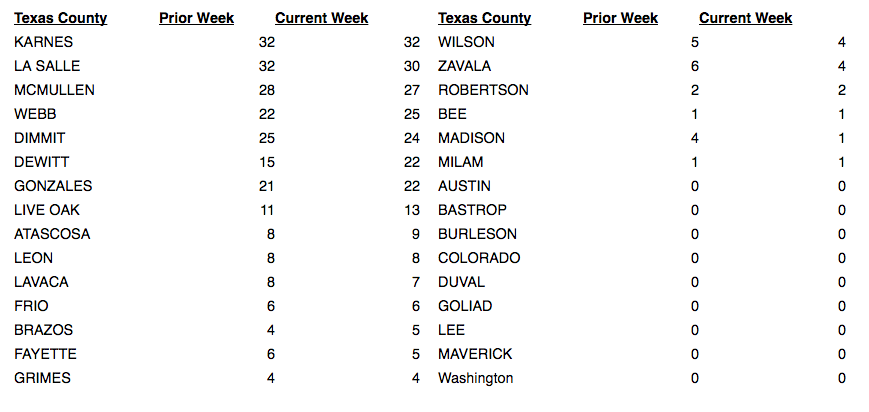
La Salle & Karnes counties lead development with 32 and 30 rigs running, respectively. McMullen (27), Webb (25), Dimmit (24), DeWitt (22), Gonzales (22), Live Oak (13), Atascosa (9), Leon (8), Lavaca (7), Frio (6) and Fayette (5) round out the top counties in the region.

South Texas Oil & Gas News:

Be sure to visit our South Texas Oilfield Job Listings to search openings and come back weekly for updates.

Eagle Ford Rig Count by Operator

What is the Rig Count?

The Eagle Ford Shale Rig Count is an index of the total number of oil & gas drilling rigs running across a 30 county area in South Texas. The South Texas rigs referred to in this article are for ALL drilling reported by SmithBits and not solely wells targeting the Eagle Ford formation. All land rigs and onshore rig data shown here are based upon industry estimates provided by the Baker Hughes Rig Count and/or Smith Service Co's (Schlumberger) Smith Rig Count.

Eagle Ford Shale Drilling by County
Valero Houston Refinery Expanding for Eagle Ford Crude

Valero Houston Refinery

Valero plans to boost Eagle Ford refining capability by adding a 90,000 b/d crude topper at its Houston refinery. The 160,000 b/d refinery is set up to refine the typical light, sweet crude, but the topper will allow the facility to process even greater volumes of lighter Eagle Ford Crude. As much as 40% of Eagle Ford crude production is consider condensate and has an API gravity of more than 50 degrees.

The topper will essentially separate components that are too light before they enter the crude unit.

William R. Klesse made the following comment just a few months prior: "So we have quite a study going on, for instance, at Corpus Christi and our Houston Refinery, where at the Houston Refinery we have a very large cat cracker and yet, we don't have a lot of crude capacity. So these are the things that tie to our whole strategy statement that I spoke about earlier where we look at things that continue to, in the essence, lower our overall cost to produce from the womb to the tomb."

The upgrade at the Houston Refinery will allow the company to refine greater volumes of domestic crude, which can be purchased at a lower cost than foreign crude. The upgrade will allow for greater production of gasoline and diesel from the refinery.

This announcement follows Flint Hills Resources' $250 million plan to upgrade its Corpus Christi Refinery. The Flint Hills plan was announced in August of 2012.

Gulf Coast refineries spent years readying for heavier crudes from South America, but the latest boom in domestic production has reversed the trend. Now, refineries like Valero and Flint Hills are preparing to refine more light crude.

Training to Drive Trucks in the Eagle Ford Shale

Tanker Truck on the Highway

Truck drivers with commercial driver’s licenses are in high demand in the Eagle Ford Shale Play. However, getting that CDL license could get much more difficult in the near future. If you’re planning on getting, or offering, training, you need to keep an eye on the proposed regulations for entry level driver training (ELDT).

The Federal Motor Carrier Safety Administration (FMCSA) has published a Notice of Proposed Rulemaking (NPRM) regarding ELDT. If this becomes a final rule, all CDL training programs will have to meet those standards.

Mandatory Standard Proposals Have a Long History

Mandatory standards for ELDT have been in several heated discussions for almost 38 years. Rich Clemente, Transportation Specialist for the FMCSA Driver/Carrier Operations summed up the highlights as follows::

1985 the Federal Highway Administration (FHWA) issued the “Model Curriculum for Training Tractor-Trailer Drivers” for voluntary adoption. The Model Curriculum was very well written and has been referenced in all discussions. (Our book, BUMPER TO BUMPER®, The Complete Guide to Tractor-Trailer Operations, follows this model curriculum.)

1986 The Commercial Motor Vehicle Safety Act of 1986 established the Commercial Driver’s License (CDL) program with tests for knowledge/skills, but required no specific training. The National Transportation Safety Board (NTSB) further recommended, as part of new “national driver license program for commercial drivers” that “a requirement for formal training should be included in the prerequisites for obtaining a national license.”

1991 The Motor Carrier Act of 1991 – the Intermodal Surface Efficient Act (ISTEA) Section 4007(a) ruled that the DOT “shall commence a rulemaking proceeding on the need to require training of all entry level drivers of commercial motor vehicles (CMVs).

1993 Advance Notice of Proposed Rulemaking (ANPRM) was published.

1996 A Federal Highway Safety 1995 report “Assessing the Adequacy of Commercial Motor Vehicle Driver Training” was transmitted to Congress. It drew two major conclusions:

  • Of the 3 private sectors (heavy trucks; motor coaches, and school buses), none is “effectively providing adequate training.”
  • No evidence was found of a relationship between adequacy of the training the driver reported receiving and his/her frequency of accidents.

2003/2004 Entry Level Driver Training (ELDT) NPRM (2003) & Final Rule (2004)

  • Writ of mandamus (2003) Public Citizen v. FMCSA for Agency to issue long overdue rulemakings – one was ELDT.
  • FMCSA published Final Rule (2004) intended to avoid duplication of topics in CDL testing; training provided through motor carrier. Topics covered included Driver Qualifications; Hours of Service; Driver Wellness; and Whistleblower Protection.

2005 Federal Court Decision: The U.S. Court of Appeals for D.C. Circuit remanded the existing training rule to FMCSA for further consideration (Decided 12/2/05). The Rule was not vacated. The FMCSA “inexplicably ignores the Adequacy Report and the regulatory prescriptions contained in that report… adequate must include ‘on street hours’ of training.” The Agency’s action was thus “arbitrary and capricious” under Administrative Procedure Act (APA).

2007 ELDT Notice of Proposed Rule Making (NPRM) was published  with these key provisions:

  • New interstate CDL holders;
  • Hours-based training approach;
  • Mandated curriculum;
  • Accredited schools; and
  • 3-year implementation from Final Rule publication.

What Does this Mean to Potential CDL Drivers?

What does this mean to you as a prospective licensed commercial truck driver, or as a professional involved in truck driver training? We’ll explore that next month in ELDT, Part Two.

Carrizo Oil & Gas Plans Big Spending in the Eagle Ford

Carrizo Eagle Ford and Pearsall Shale Map
Carrizo Eagle Ford and Pearsall Map

Carrizo Oil & Gas has allocated $385 million of its $500 million development budget to drilling & completing wells in the South Texas Eagle Ford. The company plans to keep three rigs running in the play throughout 2013.

The company will spend a total of $624 million in 2013. Spending will be allocated as follows:

  • $385 million - Eagle Ford
  • $124 million - Land, seismic, and related activities
  • $70 million - Marcellus Shale
  • $35 million - Niobrara Shale
  • $10 million - Other drilling activities

As of December 2012, Carrizo had drilled 91 horizontal wells and had brought 68 to production. To date, wells have produced a little over 500 bbls/d of oil in the first 30 days and  360 bbls/d of oil over the first 180 days. The company's oil production is also fetching a premium of almost $10 to WTI.

Also, the company has updated its latest figures related to well costs and completions referenced in the map above. Development well costs are now estimated at $6.5-7.5 million and will be completed with 20 frac stages.

Carrizo President and CEO, S. P. "Chip" Johnson, IV stated, "This 2013 plan allows us to maintain our current level of drilling activity plus the addition of a new rig working in the Niobrara Formation for the entirety of 2013. Our rig count will remain at three rigs running in the Eagle Ford Shale, one rig drilling in the Marcellus Shale and now two rigs running in the Niobrara Formation. This drilling activity supports our previously announced 2013 production forecast for approximately 28% annual growth in oil production and a natural gas production decline of approximately 3%.

Read the full press release from the company at crzo.net

Eagle Ford Well Completed With LNG Powered Frack Pumps

Onshore LNG Regas and Tanker

LNG powered frack pumps were used to complete an Eagle Ford well in late 2012. We sat down with Ferus' LNG rep Jed Tallman to learn more. This was the first time LNG has ever been used to fuel pumps fracking a well. Field gas has been used by Schlumberger in the Horn River Basin of Canada, but LNG has never been used before.

Ferus is an oilfield service company that supplies cryogenic liquids as part of its offering. The company worked with Baker Hughes to test natural gas conversion technology and yard tested 10 Cummins QSK50 powered pumps. After a successful test, the companies took the pumps into the field to complete an Eagle Ford well south of Pearsall.

Diesel fuel was used as the spark for combustion and LNG was regassed and brought in through the air intake.

Mr. Tallman stated, "This particular technology can achieve diesel substitution rates of 40-65%. An average of 50% substitution is expected.""

Only 6 LNG powered pumps were used on this particular job, but ten will be tested soon. A real determination of savings will be made when the LNG pumps are being fully utilized.

In simple economic terms, vaporized LNG is 20-40% cheaper than diesel fuel. Ifyou can substitute half that cost, you can save 10-20% on fuel costs alone. Build pumps fully powered by LNG and you might save 40%. Consider the average Eagle Ford well can consume as much as 25,000 gallons of diesel and the economics become attractive.

LNG Provides Environmental Benefits

There is also an environmental benefit to using LNG over diesel. Emissions for natural gas vs. diesel can drop as much as 30% for CO2, 75% drop for NOx, 90% drop in particulates, and a 99% drop is SOx emissions.

More LNG Powered Frack Jobs Are Coming

“Ferus is building one 50,000 gallon per day LNG plant in Western Canada and has plans for three more, each of which will have capacity for 87,000 to 100,000 gallons per day, consuming 8.5 mmbtu’s/day.”

Ferus is building one 50,000 gallon per day LNG plant in Western Canada and has plans for three more, each of which will have capacity for 87,000 to 100,000 gallons per day, consuming 8.5 mmbtu’s/day. Ferus is currently looking at areas of high demand and expects the Eagle Ford to top that list. The company committed to develop the plants a couple of years ago, so everything is in place to have a plant up and running in as little as 18 months.

This won't be the last time you hear about LNG being used in frack pumps. Apache will complete a well with 12 LNG powered frack pumps in January of 2013. The effort will be in partnership with Schlumberger and Halliburton. Apache expects fuel cost to fall from a little more than $120,000 to less than $75,000 when utilizing a duel fuel approach similar to that implemented by Baker Hughes and Ferus.

The real hope is to one day fuel the pumps with gas source directly from the field. If field gas were to replace diesel, the industry could save more than $1.5 billion per year. Sounds to me like Ferus should get to work on a new plant in South Texas.