
Kerrville is not situated in the producing area of the Eagle Ford, but the city is sending workers and oilfield products into the field. Alamo College has created a new vocational training facility that hopes to produce 135 welders per year. The Texas Workforce Commission is helping to fund the project that will hopefully fill more Eagle Ford jobs.
Eagle Ford Regional Rig Count at 244 - Feb 15, 2013

EOG Resources South Texas Eagle Ford Map
The Eagle Ford Shale drilling rig count fell 8 rigs to 244 running this past week and several producers reported earnings.
EOG detailed what is the largest Eagle Ford well ever drilled based on IP rate. The Burrow Unit #2H, which had an initial production rate of 6,330 b/d of oil with 713 b/d of NGLs and 4.1 mmcfd of natural gas, is the biggest well drilled to date. That's over 7,700 boe/d! An offset well in the same unit produced over 6,600 boe/d. There's a smiling royalty owner somewhere. Hopefully, Hawaii.
We also shared our thoughts on NAPE - Heard at Winter NAPE 2013.
Eagle Ford Oil & Gas Rigs
[ic-r]The natural gas rig count fell to 30 running this past week. That's an Eagle Ford record low. Gas prices fell a dime over the week and were trading near $3.16/mmbtu on Friday afternoon.
The oil rig count fell 1 unit to 212 running in the area. WTI crude futures were trading close to $96 per barrel to end the week. Eagle Ford crude prices were unchanged from the Friday before at $104.87/bbl on the 15th of February. Eagle Ford light crude and condensate in the area traded at $92.25 and $91.25, respectively.
There are 217 horizontal rigs running in the region. A disposal well is being drilled in Frio County and an injection well is being drilled in Karnes County.
La Salle County leads development with 36 rigs running. DeWitt (27), Karnes (24), Webb (23), Dimmit (22), Gonzales (22),McMullen (22), Live Oak (18), Atascosa (10), Leon (7), Lavaca (6), and Frio (5) round out the top counties in the region.
South Texas Oil & Gas News:
- Heard at Winter NAPE 2013
- EOG Adds Reserves & Reports a Record Well
- Pioneer's Pad Drilling Ops Expanding in 2013
- Training To Drive Trucks In the Eagle Ford- Part II by Devorah Fox
- Comstock's Eagle Ford Production Shut-In?
Be sure to visit our South Texas Oilfield Job Listings to search openings and come back weekly for updates.
Eagle Ford Rig Count by Operator

What is the Rig Count?
The Eagle Ford Shale Rig Count is an index of the total number of oil & gas drilling rigs running across a 30 county area in South Texas. The South Texas rigs referred to in this article are for ALL drilling reported by SmithBits and not solely wells targeting the Eagle Ford formation. All land rigs and onshore rig data shown here are based upon industry estimates provided by the Baker Hughes Rig Count and/or Smith Service Co's (Schlumberger) Smith Rig Count.
Eagle Ford Shale Drilling by County

Pioneer Natural Resources Expanding Use of Pad Drilling in 2013
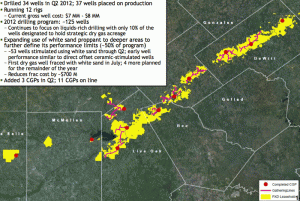
Pioneer Eagle Ford Update Map
Pioneer Natural Resources' (PXD) Eagle Ford drilling will come from centralized pads 80% of the time in 2013. That's up from 45% of the time in 2012 and will allow the company to drill 130 wells with just 10 rigs. Pioneer saves $600,00-700,000 per well when utilizing pads. Approximately 130 wells were drilled in 2012 with an average of 12 rigs running.
Pioneer plans to spend $575 million of its $3 billion 2013 capital budget in the Eagle Ford.
“Pioneer plans to spend $575 million of its $3 billion 2013 capital budget in the Eagle Ford.”
Pioneer will be using the savings from pad drilling to extend the lateral reach of its average well. Horizontal laterals averaged 5,700 ft in 2012, but PXD will be targeting 6,200 ft in 2013. The extra 500 ft of reservoir contact will cost about $500,000 to drill and complete. In general, longer laterals decrease the number of wells needed over the life of the play.
White sand completions will be tested in deeper areas of the Eagle Ford in 2013. PXD has been monitoring the use of white sand completions in shallow wells for the past two years and is now confident enough to test the practice in deeper areas with higher pressures. To date, the company has test 97 wells completed with white sand and has saved an average of $700,000 per well.
PXD has 11 central gathering plants in place and expects to bring one more online in late 2013.
Production grew from an average of 12 mboe/d in 2011 to 28 mboe/d in 2012. In 2013, the company has issued guidance of 38-42 mboe/d.
EOG Resources Adds Reserves & Reports Record Well
EOG Resources South Texas Eagle Ford Map
EOG Resources added 305 net Eagle Ford wells in 2012, while running an average of 23 wells throughout the year. With improving well results and successful downspacing test, EOG has increased its estimate for recoverable reserves from 1.6 billion boe to 2.2 billion boe (38% increase). At current activity levels, that provides a twelve year drilling inventory.
EOG expects its acreage in the east will be developed on 40-acre spacing, while acreage in the west will be developed on 65-acre spacing. Current reserve estimates indicate the company will recover 8% of the 26.4 billion boe net in place across its acreage.
The company's major oil assets are showing promise. A slide in the latest investor presentation shows the Bakken and Eagle Ford account for 82% of the oil produced from horizontal wells in the US.
"The Eagle Ford's potential reserves of 2.2 billion barrels of oil equivalent represent the largest domestic crude oil find net to one company in 40 years. Not only is 600 million net barrels a meaningful increase, this onshore U.S. oil field is readily accessible to premium markets," Papa said. "With both the technical acumen and high-quality assets, EOG is at the forefront in developing this world-class shale oil resource."
Record Eagle Ford Well Details
[ic-r]EOG's best Eagle Ford wells to date have been located in Gonzales County. The Burrow Unit #2H, which had an initial production rate of 6,330 b/d of oil with 713 b/d of NGLs and 4.1 mmcfd of natural gas, is the biggest well drilled to date. That's over 7,700 boe/d! The offsetting Burrow Unit #1H was completed to sales at a maximum rate of 5,424 b/d of oil with 600 b/d of NGLs and 3.5 mmcfd of natural gas. Two other prolific wells, the Boothe Unit #1H and #2H, began initial production at 5,380 and 3,810 b/d of oil with 625 and 525 b/d of NGLs and 3.6 and 3.0 mmcfd of natural gas.
In McMullen County, the Naylor Jones Unit 59 East #1H and West #4H had initial peak production rates of 1,670 and 1,150 b/d of oil with 225 and 138 b/d NGLs and 1.3 and 0.8 mmcfd of natural gas, respectively. The two wells were completed in January 2013.
EOG Plans in 2013
EOG plans to drill 400 net wells in 2013. That's almost 100 MORE wells than the company drilled in 2012.
"EOG's demonstrated ability to organically grow crude oil volumes should lead to strong 2013 returns," Papa said. "Until other commodity prices strengthen, we are directing EOG's capex dollars almost exclusively toward crude oil exploration and development.....With the most attractive drilling program in our history, EOG has the critical assets in place to make 2013 another outstanding year."
Training To Drive In The Eagle Ford - Part II

DMC Instructor & Student
Truck drivers with commercial driver’s licenses are in high demand in the Eagle Ford Shale Play. However, getting that CDL license could get much more difficult in the near future. If you’re planning on getting, or offering, training, you need to keep an eye on the proposed regulations for entry level driver training. (ELDT).
The Federal Motor Carrier Safety Administration (FMCSA) has published a Notice of Proposed Rulemaking (NPRM) regarding ELDT. If this becomes a final rule, all CDL training programs will have to meet those standards.
Last month we reviewed the long history of mandatory training standards proposals. What does the current NPRM mean for prospective drivers and for those in the training industry?
Must Complete Training
The proposed new rules will apply to
- Any person applying to a State for an interstate CDL for the first time, upgrading to a Class A CDL from a Class B, or from an intrastate to an interstate CDL (including school bus drivers)
- Any person not having completed the training who is reapplying for a CDL
- After revocation for highway safety reasons or after a lapse in CDL status for 4 years.
Proposed Minimum Training Hours For Drivers
Note that the proposed rules require that a specific number of hours be spent in different aspects of training: in the classroom and behind the wheel.

BTW indicates time spent Behind the Wheel. The proposed hours do not include training for endorsements.
Training Programs Will Need Accreditation
[ic-r]The proposed regulations will require that training programs and institutions be accredited. The accrediting agency would have to be recognized by the U.S. Department of Education (ED) or the Council on Higher Education Accreditation (CHEA). This is of course of vital concern to anyone who is now conducting training which will have to be accredited under the proposed rule.
The American Truck Associations raised the following concerns about the accreditation part of the proposal:
- There is a small (and shrinking) number of organizations that will actually accredit truck driving schools
- Length of the accreditation process
- After 3 year phase-in period, there is no ability to accredit a new school
- Accrediting body standards will restrict schools’ ability to advertise and potentially jeopardize guaranteed employment upon graduation.
- Would there be exemption for in-house training by motor carriers doing their own? (conflicting with a similar long-combination vehicle rule)
Mandatory accreditation would likely raise the cost of training.
Public Comment Period
The NPRM process includes an invitation to the public to file comments. In 2007 over 700 sets of comments were filed in response to the NPRM. Rich Clemente, Transportation Specialist for the FMCSA Driver/Carrier Operations notes that “most commenters do not oppose driver training but rather how the NPRM would be implemented is the contentious issue.”
Key concerns among the comments filed have been:
- the cost of implementing the proposed Rule
- the lack of quantitative safety benefit data from training
- the matter of accreditation
- a preference for a performance-based vs. minimum hours training approach
- the length and details of the curriculum
- a separate motor coach curriculum would be necessary
- the availability of training in certain geographic areas
- the effect on the supply of new drivers
- an intrastate exclusion.
Click on the linkto view a video of the January 7, 2013 listening session that was held to hear comments.
What’s Next For Drivers?
FMCSA has to provide the court a new rule by September 2014 for evaluation. Should the regulation go into effect as proposed, the changes to driver training will be dramatic.
Quisque iaculis facilisis lacinia. Mauris euismod pellentesque tellus sit amet mollis.