Eagle Ford Workers Living In Shipping Container Apartments

Eagle Ford Shipping Container Apartments

Eagle Ford housing is being addressed by yet another creative solution. Local developer David Monnich is using shipping containers to construct three story apartments in South Texas.

The demand for housing has simply outstripped supply.  Modular homes can be deployed very quickly and we've seen several modular developments across the region. Mr. Monnich's development is different in that he is constructing modular apartments using common shipping containers.

“They were insulated, framed and prewired before we brought them down here and put them together,” Monnich said.

Rent will run from $800-1,200 per month for the shipping container based units. The concept is popular in Europe and leasing will begin in July at the Encinal, TX, location.

Eagle Ford Shipping Container Apartments Rear

The upside to using shipping containers is that they can be easily moved as permanent housing is developed.

Mr. Monnich is one of our readers and graciously allowed us to use the photos included above. Thank you Mr. Monnich.

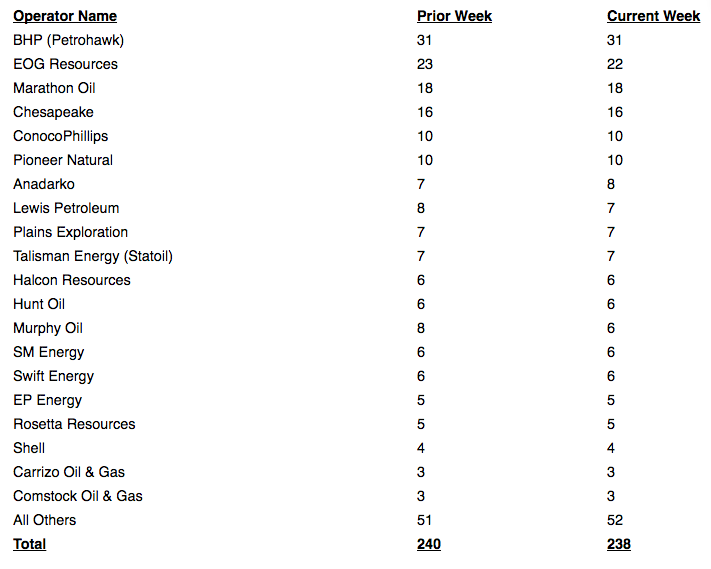
Eagle Ford Regional Rig Count at 238 on March 29, 2013

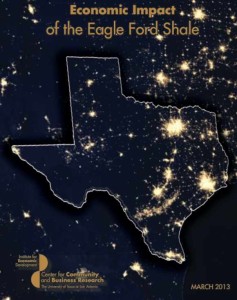
Economic Impact of the Eagle Ford Shale

The Eagle Ford Shale drilling rig count fell two rigs to 238 units running this past week. The region had an average of 247 rigs running throughout the first quarter. 252 were running in January, 249 in February, and an average of 241 ran throughout March.

Happy Easter! He is risen, he is risen indeed.

The highlight of the week was from a new economic impact study released by UTSA. You can read more about the study in our article UTSA Eagle Ford Study Touts Oil & Gas Benefits. A few highlights from 2012 include:

  • $61 Billion economic impact
  • 116,000 jobs supported
  • Almost $5 Billion paid in salaries last year
  • $3 Billion paid in royalties

Eagle Ford Oil & Gas Rigs

[ic-l]The natural gas rig count fell three to a new low of 20 running this past week. Natural gas prices traded up during the week to more than $4/mmbtu. That's a significant milestone and one that will be welcomed by operators with significant natural gas production. Note the natural gas rig count continues to fall even though prices are improving. Remember, capital budgets are set annually and it will take a few months for operators to respond to improving prices.

A total of 217 oil rigs are running in the region. That's one more than last week. WTI crude futures were up almost $4 to more than ~$97/bbl Friday afternoon. Eagle Ford light traded at $93.75/bbl on March 28th.

There are 205 horizontal rigs running in the region. An injection well is being drilled in Webb County.

La Salle County continues to lead development with 31 rigs running. See the full list of drilling by county at the bottom of the page.

South Texas Oil & Gas News:

Be sure to visit our South Texas Oilfield Job Listings to search openings and come back weekly for updates.

Eagle Ford Rig Count by Operator

What is the Rig Count?

The Eagle Ford Shale Rig Count is an index of the total number of oil & gas drilling rigs running across a 30 county area in South Texas. The South Texas rigs referred to in this article are for ALL drilling reported by SmithBits and not solely wells targeting the Eagle Ford formation. All land rigs and onshore rig data shown here are based upon industry estimates provided by the Baker Hughes Rig Count and/or Smith Service Co's (Schlumberger) Smith Rig Count.

Eagle Ford Shale Drilling by County

Captura de pantalla 2016-08-17 a las 3.12.31 PM.png

UTSA Eagle Ford Study Touts Oil & Gas Benefits

UTSA Eagle Ford Study

The latest report from UTSA that measures the impact of the Eagle Ford in South Texas includes impressive numbers. Tom Tunstall's group has done a great job keeping us up to date on the magnitude of the South Texas oil and gas boom.

"It is our hope that this research helps state and local officials make informed decisions as the economic growth of this region continues to expand," said Bob McKinley, UTSA associate vice president for economic development.

The full report is 76 pages and can be accessed HERE.

Highlights include the following:

  • Eagle Ford Shale Ranks as the largest oil & gas development in the world based on capital expenses
  • $61 billion economic impact in the 20 county area affected by the play
  • 116,000 jobs supported by the play with $4.69 billion paid in salaries
  • $1.01 billion paid to local governments in 2012
  • $1.24 billion paid to the state government in 2012
  • $72 million paid to landowners for leases in 2012
  • Estimated $3 billion was paid in the form of royalties to landowners
  • Anadarko led the number of gas wells and EOG led the number of oil wells drilled in 2012
  • In 2022, the economic impact is estimated at $89 billion and
  • 127,000 jobs will be supported in the area in ten years

For our regular readers, it's no surprise. The Eagle Ford is blessing South Texas with an economic impact no one ever imagined.

Share your thoughts on the study in the comment section below.

Eagle Ford Oil Production Up 70% in January 2013

EagleFordMaps-300x250-C

Initial reports for Eagle Ford production from the Texas RRC show the play produced more than 370,000 b/d of oil in January. Initial estimates have been consistently revised by 40,000 to 50,000 b/d over the past six months, so we believe actual oil production was more than 420,000 b/d. That represents growth of approximately 70% over the past twelve months.

Production in January 2012 was just 248,000 b/d. For reference, the state of Texas is producing about 2 million b/d. The Eagle Ford represents over 20% of the state's oil production. That's impressive for a play that was only discovered four years ago.

Initial reports from December 2012 have been revised from 385,000 b/d to 417,000 b/d.

Economic Impact of the Eagle Ford Hits $61 Billion in 2012 - UTSA - Press Release

Economic Impact of the Eagle Ford Shale

Development of oil and natural gas in the Eagle Ford Shale added more than $61 billion in total economic impact during 2012, according to a study released today by the Center for Community and Business Research in The University of Texas at San Antonio Institute for Economic Development. In addition, the region supported 116,000 full-time jobs for workers in oil and gas, drilling, support operations, pipeline construction, refineries and petrochemicals.

Fiscal impacts to the State of Texas are significant. The Eagle Ford added more than two billion dollars in state and local revenue to government coffers in 2012. The continued robust activity in the Eagle Ford stems in large measure from the play’s ability to produce not only natural gas, but also oil and condensate.

“In 2008, we saw very little activity in the Eagle Ford shale. Today, it has become one of the most significant oil and gas plays in the country and has generated a tremendous amount of wealth for Texas,” said Thomas Tunstall, director of the UTSA Center for Business and Community Research, and the study’s principal investigator. “Over the next 10 years, the annual revenue generated and jobs created will continue the steady progress upward, helping to ensure environmental and economic goals can be realized together. The goal is to create sustainable growth for the region.”

Highlights of the UTSA study concluded that shale development:

  • generated $61 billion and 116,000 jobs for the 20-county region in 2012
  • will generate $89 billion and 127,000 jobs for the 20-county region in 2022;
  • added more than $1 billion in total local government revenue in 2012;
  • provided $1.2 billion in estimated State revenue in 2012.

UTSA scholars examined the region’s 14 oil and natural gas-producing counties (Atascosa, Bee, DeWitt, Dimmit, Frio, Gonzales, Karnes, La Salle, Live Oak, Maverick, McMullen, Webb, Wilson and Zavala) and the six surrounding counties which serve as staging areas for the oil and gas play. The latter include Bexar and Uvalde Counties as well as Victoria, Jim Wells, Nueces and San Patricio Counties. These supporting counties have seen significant employment growth. For example, Bexar County jobs supported by the shale now exceed 20,000, up from less than 5,000 in 2011.

The study reflects a major surge in Eagle Ford related activity in 2012 as previously announced investments came on line for production, regional headquarter operations, pipelines, rail, supply, services, housing and logistics infrastructure. Early movers continue to consolidate their positions for the long term, notably along the Gulf Coast with new refining and manufacturing investments. The versatility of Eagle Ford was also demonstrated in response to commodity prices, with significant shifts from gas to oil while maintaining high output growth.

About the Center for Community and Business Research at UTSA

The Center for Community and Business Research in the UTSA Institute for Economic Development conducts primary research on community and business development in South Texas and the border region. In addition to the study released today, the Center has published Economic Impact of the Eagle Ford Shale (May 2012), Strategic Housing Analysis (July 2012, in partnership with the UTSA College of Architecture and UTSA Center for Urban and Regional Planning Research), Eagle Ford Shale Impact for Counties with Active Drilling (October 2012) and its Workforce Analysis for the Eagle Ford Shale (October 2012).

"The research conducted at UTSA provides us with valuable information, findings and recommendations related to the Eagle Ford Shale and its impact on Texas' economy," said Senator Judith Zaffirini, D-Laredo. "This research is a wonderful resource not only for state policymakers and business leaders, but also for all stakeholders who are working to create sustainable communities throughout the shale region. Equally important, it underscores the critical role of the higher education community in public service and economic development."

For more information about the Center, visit www.ccbr.iedtexas.org. The full study will be available to the public at 3 p.m. on March 28th. Join the conversation on Twitter (#utsaeagleford).

About UTSA

The University of Texas at San Antonio is one of the largest of nine academic universities and six health institutions in the UT System. As a multicultural institution of access and excellence, UTSA aims to be a national research university providing access to educational excellence and preparing citizen leaders for the global environment.

UTSA serves nearly 31,000 students in more than 135 degree programs in the colleges of Architecture, Business, Education and Human Development, Engineering, Liberal and Fine Arts, Public Policy, Sciences and the Honors College, University College and Graduate School. Founded in 1969, UTSA is an intellectual and creative resource center and a socioeconomic development catalyst for Texas and beyond. Learn more at www.utsa.edu.

The article above was published through EagleFordShale.com’s press release distribution service. Learn more about Eagle Ford Advertising Here.