Eagle Ford Shale Regional Rig Count 261 June 14, 2013

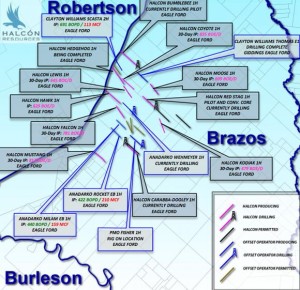
Halcon Eagle Ford Activity Map

The Eagle Ford Shale drilling rig count fell five rigs to 261 running over the last week. That is two below the average of 263 rigs we've seen work throughout the first six months of the year.

The U.S. rig count is up six to 1,771 rigs running, of which 846 are running in Texas. A total of 353 rigs are targeting natural gas and 1,413 are targeting oil. The remainder are drilling service wells (e.g. disposal wells, injection wells, etc.).

The biggest news of the week in the South Texas oil patch was Halcon announcing the company plans to spend more developing its Brazos County Eagle Ford acreage. The company had planned to have three rigs running in the area, but already has five. Current indications point to the company spending two to three times more than the $100 million that was initially planned. You can read more in the article Halcon Allocating More Capital To Its Brazos County Eagle Ford Development

*Note* Now quoting Baker Hughes. Baker Hughes also releases its own Eagle Ford Rig Count that covers the 14 core counties (~230 rigs). Our numbers cover a 30 county area impacted by Eagle Ford development. A full list of the counties included can be found in the table at the bottom of this article.

Eagle Ford Oil & Gas Rigs

[ic-l]The natural gas rig count in the region fell three to a total of 30 running to end the week. Natural gas prices dropped further on the week and were trading near $3.75/mmbtu on Friday afternoon.

Two fewer rigs were drilling for oil and a total of 230 oil rigs are running in the region. WTI futures increased again this week and were trading near $98/bbl on Friday. Eagle Ford light crude traded at $93.25/bbl on June 13th.

Karnes and McMullen counties lead development with 36 and 32 rigs running, respectively. See the full list of drilling by county below.

South Texas Oil & Gas News:

Be sure to visit our South Texas Oilfield Job Listings to search openings and come back weekly for updates.

Eagle Ford Shale Drilling by County

What is the Rig Count?

The Eagle Ford Shale Rig Count is an index of the total number of oil & gas drilling rigs running across a 30 county area in South Texas. The South Texas rigs referred to in this article are for ALL drilling reported by Baker Hughes and not solely wells targeting the Eagle Ford formation. All land rigs and onshore rig data shown here are based upon industry estimates provided by the Baker Hughes Rig Count and/or Smith Service Co's (Schlumberger) Smith Rig Count.

Riding the Hours of Service “Merry Go Round”

Running Clock
Running Clock

In December of 2011, the Federal Motor Carrier Safety Administration published a final rule for hours of service (HOS) that is scheduled to go into effect on July 1st 2013 regardless of a pending lawsuit that was submitted by American Trucking Associations.

This is not the first time the FMCSA has changed HOS regulations and it’s not likely to be the last. How long drivers should work before taking a break is a bone of contention among several parties. Safety activists want shorter work periods and longer, more frequent rest breaks while those in the industry want to make the most of their time on the road. In an effort to arrive at the best solution, regulations have been changed only to be changed back.

The HOS “Merry Go Round” has been a thorn in trucking’s side for years and has cost the industry millions of dollars to update paperwork, policies and conduct training workshops so employees will be in compliance. As publishers of training materials, we at Mike Byrnes and Associates, Inc., scramble to bring our publications current.

Opinions will vary about the latest HOS changes but in the end we all have to comply with the regulations in force.

Here’s a summary of the changes that go into effect July 1st, 2013:

Limitations on minimum "34-hour restarts"

  • Current rule states:
    • there are no limits on how many 34-hour restarts you can use in a 7 day work week.
    • The new rule states:
      • Must include two periods between 1 a.m. - 5 a.m. home terminal time.
      • May only be used once per week.

Rest breaks

  • Current rule states:
    • there are none except as limited by other rule provisions
    • The new rule states:
      • May drive only if 8 hours or less have passed since end of driver's last off-duty period of at least 30 minutes. [HM 397.5 mandatory "in attendance" time may be included in break if no other duties performed]

Here’s also a summary of the changes that went into effect February 27th, 2012:

On-duty time

  • Current rule states:
    • anytime a driver is in Commercial Motor Vehicle, except sleeper-berth.
    • The new rule states:
      • Does not include any time resting in a parked vehicle (also applies to passenger-carrying drivers). In a moving property-carrying CMV, does not include up to 2 hours in passenger seat immediately before or after 8 consecutive hours in sleeper-berth.

Penalties

  • Current rule states:
    • "Egregious" hours of service violations not specifically defined.
    • The new rule states:
      • Driving (or allowing a driver to drive) more than 3 hours beyond the driving-time limit may be considered an egregious violation and subject to the maximum civil penalties. Also applies to passenger-carrying drivers.

Oilfield exemption

  • Current rule states:
    • "Waiting time" for certain drivers at oilfields (which is off-duty but does extend 14-hour duty period) must be recorded and available to FMCSA, but no method or details are specified for the record keeping.
    • The new rule states:
      • "Waiting time" for certain drivers at oilfields must be shown on logbook or electronic equivalent as off duty and identified by annotations in "remarks" or a separate line added to "grid."

Making It Work

Next month, in Part Two, we’ll take a look at how to manage the new hours of service regulations.

Quick Reference HOS Regulations

HOURS-OF-SERVICE RULES

Property-Carrying CMV Drivers (Valid Until July 1, 2013)

Passenger-Carrying CMV Drivers

11-Hour Driving Limit

May drive a maximum of 11 hours after 10 consecutive hours off duty.

10-Hour Driving Limit

May drive a maximum of 10 hours after 8 consecutive hours off duty.

14-Hour Limit

May not drive beyond the 14th consecutive hour after coming on duty,   following 10 consecutive hours off duty. Off-duty time does not extend the   14-hour period.

15-Hour On-Duty Limit

May not drive after having been on duty for 15 hours, following 8 consecutive   hours off duty. Off-duty time is not included in the 15-hour period.

60/70-Hour On-Duty Limit

May not drive after 60/70 hours on duty in 7/8 consecutive days. A driver may   restart a 7/8 consecutive day period after taking 34 or more consecutive hours   off duty.

60/70-Hour On-Duty Limit

May not drive after 60/70 hours on duty in 7/8 consecutive days.

Sleeper Berth Provision

Drivers using the

sleeper berth provision

must take at least 8 consecutive hours in the sleeper   berth, plus a separate 2 consecutive hours either in the sleeper berth, off   duty, or any combination of the two.

Sleeper Berth Provision

Drivers using a

sleeper berth

  must take at least 8 hours in the sleeper berth, and may split the   sleeper-berth time into two periods provided neither is less than 2 hours.

BP Review of World Energy Trends - Highlights Video

BP has published its annual statistical review of world energy trends for over 60 years. This year's report is as interesting as ever. A short video presentation and our takeaways are included below.

  • Global energy consumption growth slowed to just 1.8% in 2012
  • Energy efficiency improved at rates not seen in 30 years
  • Energy consumption in developed countries has fallen for 5 straight years
  • Saudi Arabia, UAE, and Qatar produced record levels of oil in 2012
  • US saw the largest increase in oil production in the country's history
  • China consumed the majority of the world's coal for the first time
  • Nuclear power declined by more than 6% in 2012 (largest drop ever)
  • China increased hydroelectric power generation by more than 22%
  • Biofuels output declined globally
  • Solar output grew by more than 50%, but renewables only county for 2% of energy

P.S. The Eagle Ford played a big part in helping grow U.S. oil production. Oil production reported to the Texas Railroad Commission has increased from ~200,000 b/d at the beginning of 2012 to estimates of almost 600,000 b/d in June of 2013.

If you are a stats junky, you might enjoy the "in depth" interview. It is a little longer - 9 minutes.

Rosetta's Growth & Quarterly Beat Driven By The Eagle Ford

Rosetta Resources Eagle Ford Midstream Map

Rosetta Resources' performance in the first quarter beat consensus estimates from analyst due to better price realizations and hedges in the Eagle Ford.

It didn't hurt that Eagle Ford production grew 54% over the previous year or that oil production from the play had grown 70%. Company-wide production grew 6% over the fourth quarter and set a record at 47,000 boe/d.

“Rosetta’s first quarter results reflect a strong start in 2013 with record levels of production. We will continue to focus on efficient operational execution as we further expand the development of our Eagle Ford program.”
— Jim Craddock, Rosetta's CEO.

Rosetta also began adding stabilizers to the company's condensate gathering facilities. The company is heating the condensate to vaporize the lighter ends of the barrel. This allows the condensate to meet pipeline specifications. As a result the company's condensate production shrinks a bit and NGL production grows.

In the first quarter, Rosetta spent $161 million to drill 24 gross wells and complete 17 wells. The company operated 5-6 rigs in the Eagle Ford area during the quarter. At the end of the quarter, 38 wells that had been drilled were awaiting completion.

Four well pads have become the choice for development, but the company is testing five and six well pads. Well costs should fall even further with more wells from a single pad.


Crimson Woodbine Well In Madison County Impresses

Crimson Woodbine Acreage Map

Crimson's latest Woodbine well came online at an impressive rate of production.

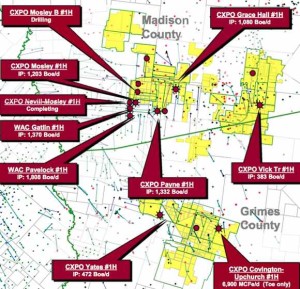
The Nevill-Mosley #1H came online at 1,164 boe/d or 1,021 b/d of oil and 77 b/d of NGLs, and 392 mcfd. The well was drilled 15,192 ft, including a 6,041 ft lateral, and was completed with a 22-stage fracture completion.

Allan D. Keel, CEO, commented, “The initial success of the Nevill-Mosley further validates the quality of assets Crimson holds in the Woodbine formation.

Crimson has approximately 19,000 net acres in in Madison and Grimes counties targeting the Woodbine. The company estimates more than 490 remaining drilling locations remain. Wells have estimated EURs of 300-550 mmboe, with production weighted 75% or more to oil and NGLs. Average well costs are estimated at $7-7.5 million.

Crimson is also drilling a well, the Beeler #2H, in Dimmit County that is targeting the Buda formation.The well is being drilled to a total measured depth of more than 11,100 ft and will include approximately 4,000 ft of horizontal lateral. Production results are expected in May.

In late April, Crimson & Contango Oil & Gas announced a merger agreement. The new company will be known as Contango Oil & Gas

Read the full press release at crimsonexploration.com