Comstock Doubles Its Eagle Ford Rig Count In the Second Quarter

Comstock Eagle Ford Drilling Plans 2013

Comstock Resources ran three rigs in the Eagle Ford in the first quarter 2013 and ramped up to six rigs running at the end of the second quarter. The increase in activity is no surprise. Comstock will drill as many wells this year (72 gross) as the company had drilled in the previous three years combined.

Since the beginning of the year, Comstock has completed 25 gross (15.4 net) wells in the Eagle Ford. The average well has come online with an initial production rate of 796 boe/d. Four wells in McMullen County have come online at more than 1,100 boe/d, while wells in Atascosa County have come online at rates of less than 500 boe/d.

Eagle Ford production grew 26% from 4,500 boe/d in the first quarter to 5,800 boe/d in the second quarter. Expect much of the production growth to carry over into 2014. Comstock plans to complete ~30 wells in the second half of the year, but 12 of the wells will come online as part of multi-well pads that will not be completed until December.

Well costs continue to fall in the play. The average Eagle Ford well for Comstock cost $11.4 million in 2010 and the equivalent well is estimated to have a $7.7 million cost today. The cost savings has come even though Comstock has increased the lateral length utilized from almost 4,600 ft to over 6,800 ft over and increased the amount of proppant used in each completion from 4.4 to 8.9 million pounds.

Comstock also closed the sale of West Texas assets to Rosetta Resources in the second quarter for $823 million.

Read the full press release at comstockresources.com

Protecting Workers From Unforeseen Hazards - MSA Safety - Press Release

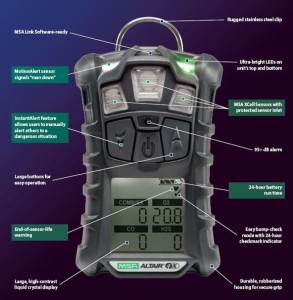
MSA Altair
MSA Altair

Workers cannot rely on their sense of smell to alert them to odorless hazards in the workplace. Exposure to excessive levels of toxic gas or an oxygen-deficient environment can cause workers serious illness and even death. Combustible gas can lead to explosions that can be catastrophic, injuring or killing personnel and destroying property.[1]Enter the need for gas detectors. Gas monitoring instruments are designed to protect workers from unforeseen dangers by measuring, monitoring and indicating the concentration of certain gases in the atmosphere.

Gas detectors are produced as either portable or stationary devices. We will be focusing on portable gas detectors; these are hand held devices designed to detect the presence of various combustible, flammable and toxic gases, and oxygen depletion within an area. When dangerous levels of gas vapors are detected, portable gas detectors transmit audible and visiblewarning signals such as alarms and flashing lights to warn workers that a leak is occurring, giving them the opportunity to safely exit the area.

One of the most dangerous hazards occurs when the detector’s alarms are being triggered and people assume there is an instrument malfunction.  Ignoring the alarms, and worse, turning off the device, will simply lead to tragedy. When an alarm is activated, ALWAYS err on the side of caution and evacuate the area.

The Importance of Calibration and Bump Testing

It is vital to worker safety that these instruments are maintained and calibrated properly. In addition, performance of a daily bump test is  a best practice because it is the only method by which the entire system:  instrument, sensors, flow path, power source, alarms, and all electronics can be checked to ensure that it is functioning properly. However, recently, there has been much discussion among safety professionals and users of gas detection regarding the frequency of bump testing. Best practice and most manufacturer instructions recommend a daily bump test prior to operation of gas detectors.

As products continue to evolve, durability and advancements in sensor technology continue to improve detector performance and reliability.  This provided some users with a basis for abandoning the practice of daily bump tests and has resulted in some deviation from historical guidance provided by most manufacturers. MSA remains in support of a daily bump check as the best practice to ensure daily readiness of detectors.

Instrument inaccuracy due to improper or irregular calibration can lead to serious accidents. Over time, the accuracy of gas detection instruments can diverge from their calibration settings in several ways. According to OSHA Safety and Health Information Bulletin 05-04-2004 following are the potential failure modes which can be identified during a bump test.

  1. Gradual chemical degradation of sensors and drift in electronic components that occur naturally over time.
  2. Chronic exposures to, and use in, extreme environmental conditions, such as high/low temperature and humidity, and high levels of airborne particulates.
  3. Exposure to high (over-range) concentrations of the target gases and vapors.
  4. Chronic or acute exposure of catalytic hot-bead LEL sensors to poisons and inhibitors. These include: volatile silicones, hydride gases, halogenated hydrocarbons, and sulfide gases.
  5. Chronic or acute exposure of electrochemical toxic gas sensors to solvent vapors and highly corrosive gases.
  6. Harsh storage and operating conditions, such as when an instrument is dropped onto a hard surface or submerged in liquid. Normal handling/jostling of the equipment can create enough vibration or shock over time to affect electronic components & circuitry.
  7. In addition to these, any general component failure

In addition to good maintenance practices, safety practices also need to be reinforced regularly.  Far too often, as previously mentioned, gas alarms are viewed as a nuisance or an error and are ignored by workers.  It is critical that workers comprehend that the detector is utilized for their safety.  Following safety protocol when alarms are triggered is a vital safety practice and could prove to be lifesaving.

More About MSA

MSA, is a maker of sophisticated safety products that help protect workers who may be exposed to a variety of hazardous conditions. MSA was started in 1914 and in the decades that have come and gone, MSA has continued to lead the charge for workplace safety. We’ve led the way with small first-aid kits and portable methane detectors, and harnessed new technologies to produce state-of-the-art thermal imaging cameras, ballistic helmets, and leading edge systems for gas and flame detection.

For more information contact: Amy C. Puff Office Phone: 724-776-8738 Mobile Phone: 724-719-7175 MSA - The Safety Company 1000 Cranberry Woods Drive Cranberry Twp, PA 16066

[1] U. S. Department of Labor, Occupational Safety and Health Administration, Verification Of Calibration for Direct-Reading Portable Gas Monitors, (05-04-2004), www.osha.gov/dts/shib/shib050404.html

The article above was published through EagleFordShale.com’s press release distribution service. Learn more about Eagle Ford Advertising Here.

Anadarko Starts 96 Eagle Ford Wells In The Second Quarter

Anadarko EagleFord Production Graph Q213

Anadarko Petroleum released second quarter results and updated us on the company's Eagle Ford operations. The company spud 96 wells in the second quarter and plans to drill a total of 325 wells in 2013.

Eagle Ford production increased 13% over the first quarter to 48,000 boe/d. Liquids production accounted for almost 32,000 b/d or approximately two-thirds of the company's production in the region. That's up over 60% from the second quarter of 2012.

The company ran an average of nine rigs in the second quarter and invested a total of $35 million. Spud to rig release fell to 8.1 days from 9.5 days in the first quarter.

Much of Anadarko's Eagle Ford investment is carried as part of its JV with KNOC. The agreement called for KNOC to carry 90% of development costs up to $1.55 billion. The carry is expected to be exhausted by year-end 2013.

On the midstream side of the business, Anadarko brought on the 200 mmcfd Brasada natural gas processing plant in La Salle County, TX. The facility can recover up to 30,000 b/d of NGLs, which will add value to the company's production stream.

Anadarko also plans to bring on additional compression in the third quarter.

Read the company's full press release at anadarko.com

Did You Know Drilling Starts On Over 1,000 Eagle Ford Wells Per Quarter?

Eagle Ford Well Count Q2 2013

Did you know that drilling rigs spud more than 1,000 Eagle Ford wells per quarter in South Texas? To top it off, that is a conservative estimate.

Baker Hughes is known for publishing weekly rig count estimates and the company is now publishing well count estimates in many of the major plays across the U.S.

The third quarter of 2012 was the first quarter that well starts in the Eagle Ford eclipsed 1,000. The number of wells spud fell below 1,000 in the fourth quarter and rose back above that level in both the first and second quarter of 2013.

Since the beginning of 2012, rigs have spud approximately:

  • Q1 2012 - 876 wells
  • Q2 2012 - 932 wells
  • Q3 2012 - 1,024 wells
  • Q4 2012 - 974 wells
  • Q1 2013 - 1,044 wells
  • Q2 2013 - 1,050 wells

We consider these conservative estimates because Baker Hughes only considers a 14 county area in its Eagle Ford statistics. That leaves out areas like Brazos County, where Halcon is ramping up development of the Eagle Ford. Considering all data points, it's likely well spuds surpassed 1,100 in the second quarter of 2013.

Eagle Ford Drilling Crews Are Getting More Efficient

It's no secret that drilling is speeding up as operators and crews gain experience in the Eagle Ford. When the Baker data begins in the first quarter of 2012, the average rig in the play was drilling 3.74 wells. The average rig drilled 4.56 wells in the second quarter of 2013. That's a 22% improvement or, more impressively, almost one more well per rig per quarter. I'd say that's pretty good improvement in just a little over a year.

With almost 250 of the 270+ rigs in the region targeting the Eagle Ford, it looks like we'll see 1,000 wells drilled per quarter for the foreseeable future.

The Permian Basin of West Texas is the only basin or region with more activity than the Eagle Ford. Operators target multiple plays across in the Permian and the area has almost twice as many rigs running.

Eagle Ford Regional Rig Count 273 - July 26, 2013

EOG Eagle Ford Oil Well Record Production

The Eagle Ford Shale drilling rig count grew by two to average 273 rigs over the past week. That's a 2013 high and the highest number since the first week of December 2012. Oil drilling levels fell off the high set last week to settle at 240 rigs running.

The U.S. rig count is up 6 to 1,776, of which 848 are running in Texas. A total of 369 rigs are targeting natural gas and 1,401 are targeting oil in the U.S. The remainder are drilling service wells (e.g. disposal wells, injection wells, etc.).

The week was highlighted by a completion report filed by EOG Resources. The well produced more than 8,600 boe/d broken down as 7,513 barrels of oil and over 6.8 mmcfd of natural gas. You can read more in the article: EOG Well Sets Eagle Ford Production Record

*Note* Now quoting Baker Hughes. Baker Hughes also releases its own Eagle Ford Rig Count that covers the 14 core counties (~237 rigs). Our numbers cover a 30 county area impacted by Eagle Ford development. A full list of the counties included can be found in the table at the bottom of this article.

Eagle Ford Oil & Gas Rigs

[ic-l]The natural gas rig count in the region added three rigs to bring the total to 33. Natural gas futures were trading near $3.56/mmbtu on Friday afternoon. This marks the first week in the past month that the commodity will end below $3.60/mmbtu.

One fewer or 240 oil rigs are running in the region this week. WTI prices have held above $100 per barrel over the past three weeks. The oil benchmark was trading over $104/bbl on Friday. Eagle Ford light crude traded at $102/bbl on July 24th.

A total of 214 rigs are drilling horizontal wells and just 13 rigs are drilling true vertical wells. McMullen & Karnes counties lead development with 35 and 32 rigs running, respectively. See the full list of drilling by county below.

South Texas Oil & Gas News:

Be sure to visit our South Texas Oilfield Job Listings to search openings and come back weekly for updates.

Eagle Ford Shale Drilling by County

Eagle Ford Operated Rig Count By Company

SmithBits no longer reports its operated rig count, but we'll have updated number for you from a new source soon. Until then, you can reference our numbers from mid-April. There has not been a significant change in the overall rig count since this date:

What is the Rig Count?

The Eagle Ford Shale Rig Count is an index of the total number of oil & gas drilling rigs running across a 30 county area in South Texas. The South Texas rigs referred to in this article are for ALL drilling reported by Baker Hughes and not solely wells targeting the Eagle Ford formation. All land rigs and onshore rig data shown here are based upon industry estimates provided by the Baker Hughes Rig Count and/or Smith Service Co's (Schlumberger) Smith Rig Count.