
Eagle Ford Regional Rig Count 267 - Area Tops For Deals - Sept 6, 2013

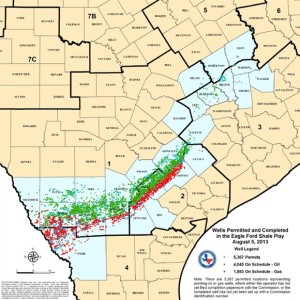
Eagle Ford Shale Well Map

The Eagle Ford Shale rig count decreased by two rigs to average 267 running over the past week. Operators largely have development plans in place through the remainder of the year, but don't be surprised to see additional rigs from companies who benefit from $110 oil.

We also highlighted news this week the Eagle Ford came out on top in another list. PWC ranked the Eagle Ford as the most active area for deals in the second quarter. The deal market has been slower across the board, but assets are still changing hands in South Texas. Read more in the article Eagle Ford Region Most Active For Deals. PWC ranked the Eagle Ford, Bakken, and Marcellus as the top three areas for deals.

The U.S. rig count fell nine rigs to 1,767 and more rigs moved to drilling natural gas. A total of 394 rigs are targeting natural gas and 1,365 are targeting oil in the U.S. The remainder are drilling service wells (e.g. disposal wells, injection wells, etc.). 838 rigs are running in Texas.

Baker Hughes rig count is quoted here. Baker Hughes also releases its own Eagle Ford Rig Count that covers the 14 core counties (~231 rigs). The rig count published on EagleFordShale.com includes a 30 county area impacted by Eagle Ford development. A full list of the counties included can be found in the table near the bottom of this article.

Eagle Ford Oil & Gas Rigs

[ic-l]The natural gas rig count decreased by 1 to 43 rigs. With the spread of oil prices to natural gas widening, I don't expect to see a big jump in natural gas activity in the $3.50/mcf price range. Natural gas futures were trading around $3.50/mmbtu on Friday afternoon.

The oil rig count decreased by one rig to 223 running in the region. WTI oil prices were trading above $110/bbl and have held above $100 for nine weeks. Oil prices have been above $100 long enough we'll likely begin seeing operators react to higher cash flow. Generally, there's a lag of 60-90 days before operators react to significant commodity price changes. Expect to see operators add rigs in the region or pay down debt. Eagle Ford light crude traded at $104.75/bbl on Sept 5th.

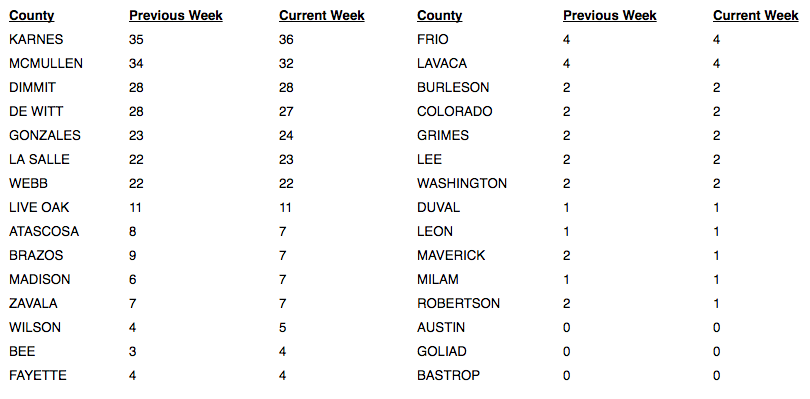
A total of 220 rigs are drilling horizontal wells, 32 rigs are drilling directional wells, and 15 rigs are drilling true vertical wells. Karnes and McMullen counties lead development with 36 and 32 rigs running, respectively. See the full list of drilling by county below.

South Texas Oil & Gas News:

Be sure to visit our South Texas Oilfield Job Listings to search openings and come back weekly for updates or sign up for alerts - Daily or Weekly Email Alerts

Eagle Ford Shale Drilling by County
Eagle Ford Operated Rig Count By Company

SmithBits no longer reports its operated rig count, but we'll have updated number for you from a new source soon. Until then, you can reference our numbers from mid-April. There has not been a significant change in the overall rig count since this date:

What is the Rig Count?

The Eagle Ford Shale Rig Count is an index of the total number of oil & gas drilling rigs running across a 30 county area in South Texas. The South Texas rigs referred to in this article are for ALL drilling reported by Baker Hughes and not solely wells targeting the Eagle Ford formation. All land rigs and onshore rig data shown here are based upon industry estimates provided by the Baker Hughes Rig Count and/or Smith Service Co's (Schlumberger) Smith Rig Count.

Eagle Ford Operator EP Energy Preparing For IPO

EP Energy Eagle Ford Acreage Map

EP Energy (EPE) has filed to go public. The company was El Paso Corporation's upstream subsidiary and was sold to private investors prior to the Kinder Morgan acquisition of El Paso.

Read more in the article Apollo Buys El Paso's E&P Unit - $7.15 Billion.

EP Energy's primary operations are located in the Eagle Ford, Permian Basin, and Uinta Basin in Utah.

EP Energy has 93,000 net acres and operates 167 wells (as of March '13) in the Eagle Ford. The company is running six rigs in the region and plans to drill 100+ wells in 2013. Eagle Ford production has grown from near zero before 2010 to more than 30,000 boe/d as of the second quarter.

Led by the Eagle Ford, oil production across the company's portfolio has grown almost three-fold since the beginning of 2011.

The company has yet to release much in regard to its IPO. The filing process has started and company has said it will raise as much as $100 million. That means it will stay under the control of its private equity owners. Watch for more information from the company in the coming weeks.

Matador Resources Issues Stock To Fund Eagle Ford Acquisitions & Capital Budget

Matador Resources Eagle Ford Map | Click to Enlarge

Matador Resources priced a public offering of 8.5 million shares at $15.25/share or for total proceeds of near $130 million on September 4, 2013. The capital raised will be used to fund the company's capital budget and acreage acquisitions in its core operating areas.

Approximately 78% of Matador's 2013 capital budget is allocated to the Eagle Ford. Two rigs will run in the region throughout 2013 and one rig will be added in the Permian Basin of West Texas.

Matador also intends to use net proceeds from this offering to fund the acquisition of additional acreage in the Eagle Ford shale, the Permian Basin and the Haynesville shale and for other general working capital needs.

Read the full press release at matadorresources.com

Give Me Some Space! Trucks Need More Room

In July of 2013, the Houston Chronicle reported that 12 people had died in Eagle Ford Shale area traffic accidents, an increase of 12 times the number of fatalities reported to the Texas Department of Transportation. This past spring, the San Antonio Express reported that Texas Department of Transportation data showed a 40 percent increase in fatal traffic accidents in the Eagle Ford Shale region last year. There’s no question that the shale play roads are busy and congested. This makes it more important than ever for drivers to know how to share the road. While the biggest jump in fatal traffic accidents has involved commercial vehicles, recent data shows that the majority of fatalities from collisions involving large commercial trucks are not the result of the truck driver’s actions but of the other driver’s actions. Sharing the road with large commercial vehicles means all drivers must always be aware of their surroundings.

The National Safety Council has a definition for a Preventable Accident. The NSC states further the expectations of professional drivers, that “every accident in which a driver is involved shall be considered preventable unless there was no action, which the driver could have reasonably taken to avoid the accident and that, his actions in no way contributed to the occurrence of the accident. The driver must drive in such a way that he commits no errors himself and so controls his vehicle to make due allowance for the condition of the road, the weather or the traffic, and so that mistakes of other drivers do not involve him in any accident.”

Road-Sharing Tips

[ic-r]Share the road and be safe by giving yourself plenty of room to maneuver. You need plenty of time, too, so maintain a safe speed. Here are some common sources of trouble and how to avoid them whether you’re behind the wheel of a large or small vehicle, courtesy of Del Mar College Transportation Training and Shell:

Blind Spots - Avoid tailgating a large vehicle. Remember, if you can’t see the driver’s face in the side view mirror, the driver can’t see you.

Cut-offs - Don’t try to sneak into a small gap in traffic ahead of a truck. Trucks take as much as three times the distance to stop as the average car.

Rolling back - Leave plenty of room if you are stopped behind a large vehicle. When the driver releases the brakes after being stopped, the vehicle may roll back.

Buckle your belts - Always buckle your seat belt. If you get into an accident with a large vehicle such as a truck, seat belts are your best protection. Trucks require a greater stopping distance and can seriously hurt you if your car is struck from behind.

Aggressive drivers - Aggressive drivers can be dangerous drivers. Pulling in front of trucks too quickly when passing and making frequent lane changes, especially in the blind spots of trucks can create dangerous and potentially fatal situations.

Wide turns - If a large vehicle in front of you is making a right turn, do not move up into the space that opens up in the right lane. You are putting yourself into a very dangerous position.

Turbulence - Due to various factors such as air pressure and airflow, a large vehicle can create heavy air turbulence. This may affect your ability to control your vehicle when passing a large vehicle.

Avoid distractions - Keep your cell phone and other electronic devices out of reach and silence them while driving.

Keep your eyes moving - You should be checking your mirrors, gauges and surroundings every 3 to 5 seconds.

Look Ahead - Be sure to look 5 to 10 seconds ahead of you to anticipate potential hazards.

Staying safe while driving in the Eagle Ford Shale play calls for planning, patience and attention. Aim to give yourself plenty of time to get to your destination so you’re not tempted to speed or chance risky maneuvers. Look out for other drivers, and yourself.

NGL Energy Acquires Eagle Ford Disposal Assets In Coastal Plains Deal - $116 Million

High Sierra Water Disposal Facility

NGL Energy Partners has acquired Coastal Plains #1, LLC, a subsidiary of WinCo Development, for $109.5 million in cash and approximately $6.8 million in stock (~$116 million total). The water disposal facilities will be added to NGL Energy partner's existing business in the area - High Sierra Water-Eagle Ford, LLC.

The deal adds three water disposal facilities to High Sierra's existing water gathering and treatment portfolio. The deal includes the option to acquire two permits and a fourth water disposal facility that is under construction. Costal Plains #1's 40 employees will now work for High Sierra Water.

“With the addition of the Coastal Plains assets and employees, NGL is uniquely positioned to serve the needs of producers in the Eagle Ford through our High Sierra business. We are also looking forward to applying our extensive technical expertise in water treatment as demand for the recycling of oilfield waste water increases.”
— Jim Winter, SVP, High Sierra - Water.

High Sierra's Eagle Ford footprint includes 240,000 b/d of water disposal capacity, water & crude oil transportation assets, a crude oil marketing segment, and mobile on-site solids processing equipment.

The deal follows NGL Energy's Acquisition of Crescent Terminals and Cierra Marine in July.

NGL Energy's business segments provide crude oil logistics, NGL logistics, and water treatment services in the Gulf Coast region. Overall, High Sierra expects the assets improve their operations in many ways.

The company's VP of investor relations stated:

"We are now able to offer reliable, high quality and safe disposal services to producers operating throughout the region. Having multiple large capacity facilities allows us to balance utilization, reducing wait times, trucking miles and ultimately costs. In addition, we are evaluating a number of projects to bring our industry leading recycling technology to the play."