
Is the Eagle Ford on Its Way to 2 Million Barrels Per Day of Oil Production?

Eagle Ford Production

Eagle Ford Production has outpaced expectations for five years and it should be no surprise if the area eventually produces more than 2 million barrels of oil per day.

It's hard to comprehend the full context of the previous statement, so let me state it another way. If the Eagle Ford eventually produces between two and three million barrels of oil per day, the play by itself could land in the list of the top 10 oil producing countries in the world. The entire world produces just under 90 million barrels of oil per day.

Most research organizations predict production will reach between 1.6 and 2 million b/d sometime between 2017 and 2020. Recent results in the Buda and Austin Chalk make it easy to see how the area could produce much more if other formations prove commercial. Add the Permian Basin, where Texas is experiencing similar growth, and the state is closing in on Mexico as the third largest producer in North America (behind the U.S. and Canada)

Eagle Ford Oil Production Expected to Eclipse 1 Million b/d in 2014

EIA Eagle Ford Oil Graph

Eagle Ford oil production is nearing 700,000 b/d and Eagle Ford condensate production measured at the wellhead has surpassed 200,000 b/d. Add condensate that falls out further downstream and the play is close to reaching 1 million b/d of total oil and condensate production.

The EIA's most recent drilling productivity report proclaimed the Eagle Ford has already surpassed 1 million b/d of oil production, but the agency is counting both oil and condensate from the entire region. Most analysts are predicting the play will reach the million barrel benchmark for oil only sometime in 2014.

If the whispers we're hearing about capital budgets in 2014 are true, the play will likely surpass the 1 million b/d mark in the first half of the year.

North America Is Becoming More Important in the Global Oil Market

Watch the video depicting North America oil production over the past 30 years below. There's not a whole lot of change until the last few years and that has been magnified in 2013. The Bakken and Eagle Ford are nearing 1 million b/d and the Permian Basin has already surpassed that mark.

The Eagle Ford Influences the Natural Gas Market

Eagle Ford natural gas production is approximately 3 Bcf/d or 5% of onshore production in the contiguous states. That's no small feat for an oil play. Natural gas prone portions of the play provide additional opportunity if prices improve to more than $4/mcf in the coming years.

The Eagle Ford is best in class when it comes to shale plays. Great economics combined with access to the Gulf Coast industrial complex provide a strategic advantage not matched by any play in the world. Watch for the Eagle Ford to continue driving the economy in South Texas even if oil prices drop as much as 20%.
260 Rigs Running in the Eagle Ford - Operators Reporting Earnings - Nov 1, 2013

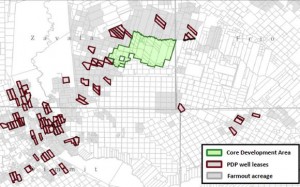
EXCO Eagle Ford Map
EXCO Eagle Ford Map

The Eagle Ford Shale rig count increased by three rigs from 257 to 260 running this past week.

Several Eagle Ford operators began reporting earnings and giving operational updates. Sanchez is seeing record production, EXCO expects to speed up development in the coming months, and Swift Energy is testing completion methods that utilize much more fluid and proppant. You can read articles on all three in the South Texas Oil & Gas News section below.

The U.S. rig count increased 4 rigs from 1,738 to 1,742 running over the past week. A total of 360 rigs are targeting natural gas (16 less than last week) and 1,376 (19 more than last week) are targeting oil in the U.S. The remainder are drilling service wells (e.g. disposal wells, injection wells, etc.). 821 or 47% of rigs active in the U.S. are running in Texas.

Baker Hughes rig count is quoted here. Baker Hughes also releases its own Eagle Ford Rig Count that covers the 14 core counties (226 rigs). The rig count published on EagleFordShale.com includes a 30 county area impacted by Eagle Ford development. A full list of the counties included can be found in the table near the bottom of this article.

Eagle Ford Oil & Gas Rigs

[ic-l]The natural gas rig count fell to 33 rigs running over the past week. Natural gas prices fell 5% over the past few days and were trading around $3.50/mmbtu on Friday.

The oil rig count increased by four rigs from 222 to 226. WTI oil prices were trading around $95/bbl to end the week. Oil prices have been falling for two weeks. Eagle Ford light crude traded at $93.00/bbl on Oct 31st.

A total of 229 rigs are drilling horizontal wells, 18 rigs are drilling directional wells, and 13 rigs are drilling true vertical wells. DeWitt, Karnes, Gonzales, La Salle, and McMullen counties all have between 25 and 32 rigs running. See the full list of drilling by county below.

South Texas Oil & Gas News:

Be sure to visit our South Texas Oilfield Job Listings to search openings and come back weekly for updates or sign up for alerts - Daily or Weekly Email Alerts

Eagle Ford Shale Drilling by County

Eagle Ford Operated Rig Count By Company

SmithBits no longer reports its operated rig count, but we'll have updated number for you from a new source soon. Until then, you can reference our numbers from mid-April. There has not been a significant change in the overall rig count since this date:

What is the Rig Count?

The Eagle Ford Shale Rig Count is an index of the total number of oil & gas drilling rigs running across a 30 county area in South Texas. The South Texas rigs referred to in this article are for ALL drilling reported by Baker Hughes and not solely wells targeting the Eagle Ford formation. All land rigs and onshore rig data shown here are based upon industry estimates provided by the Baker Hughes Rig Count and/or Smith Service Co's (Schlumberger) Smith Rig Count.

Port of Corpus Christi Booms on the Back of Eagle Ford Growth

Oil Tanker Leaving Port of Corpus Christi

We spent part of the week at the Fall Eagle Ford Consortium Conference and were able to attend a tour of the Port of Corpus Christi. In the past, oil was arriving on a regular basis, but Eagle Ford exports to other parts of the U.S. are outpacing imports for the first time. The Port is booming.

More than $3.8 billion in projects are under construction and another $10.7 billion are in some phase of permitting at the Port. The largest project being considered is a $10 billion natural gas liquefaction plant that has been proposed by Cheniere Energy.

“We would get excited about $10 million projects in the past and now we have $10 billion projects proposed”
— John LaRue of the Port of Corpus
Frac Sand Super Sacks

The Cheniere site was formerly a proposed regasification site, but the need to import gas has been minimized by the abundance of shale gas in the U.S. If construction of the export terminal goes forward, as much as 2 bcf/d could be exported from the site.

While the LNG export facility is the biggest project, construction has yet to start and all of the activity seen around the area is related to other projects. A few of the largest projects include:

  • Nueces River Rail Yard - $46 million
  • M&G PET Resin Plant - Resin used in plastic packaging - $900 million
  • Trafigura Crude Oil Terminal - $500 million
  • Tianjin Pipe Corp - Seamless Pipe Plant - $1.3 billion
  • Oxy's Ingleside Energy Center - LPG Export - $1 billion

Other Takeaways from the Eagle Ford Consortium Conference

  • Federal funding is needed to help deepen the port to 52 ft
  • Math problem means funding hasn't caught up to Eagle Ford roads and some will be converted to gravel until oil and gas development subsides
  • Harbor Bridge in Corpus Christi will have a $800 million price tag
  • CNG is becoming more popular with transit authorities
  • One company using LNG in its oilfield service trucks expects a pay out in less than two years

Watch for more information in the coming months related to the Annual Eagle Ford Consortium Conference that is held in San Antonio in the spring of each year.

Swift Energy Is Pumping More Fluid & Proppant in Eagle Ford Completions

Swift Eagle Ford Acreage Map

Swift Energy is testing higher volumes of fluid and proppant in Eagle Ford well completions. The company's number of Eagle Ford completions actually slowed to nine in the third quarter, but production grew due to better well performance.

The company's best well on a boe basis in the third quarter produced over 2,300 boe/d. The completion method utilized on the well included 25% more fluid and proppant. Completion testing didn't stop there.

In a well completed in the fourth quarter, the company tested tighter frac stage intervals and perforation clusters along with fluid and proppant volumes that were double Swift's standard completion. The well performed better than previous wells in the area (~1,600 boe/d at 2,250 PSI), so watch for Swift to begin using a completion design that looks more like what we've seen from EOG.

Swift is now targeting a lower interval of the Eagle Ford and is logging the horizontal section of every well to place completions in the most optimal portions of the wellbore.

“Further, we are optimizing our completion designs with longer lateral lengths, increases in frac stages and the volume of frac sand to increase initial production rates and cumulative production of Eagle Ford shale horizontal wells. We expect continued performance and efficiency improvements as we exploit these relationships in our drilling program.”
— Terry Swift, CEO

Swift grew company-wide production by ~10% in the quarter and continues to deploy approximately 80% of its development capital in the Eagle Ford. The company is also marketing assets in Central Louisiana to fund aggressive development plans in South Texas.


EXCO's Eagle Ford Results Are Meeting Expectations - Manufacturing Mode Coming

EXCO Eagle Ford Map
EXCO Eagle Ford Map

EXCO Resources completed the acquisition of Eagle Ford assets in the third quarter and ended September producing approximately 7,600 boe/d from the play.

Immediately following the Chesapeake deal, the company sold a 50% interest in the undeveloped portion of acquired assets to KKR for $131 million, so the two are partners with CNOOC in the Eagle Ford.

EXCO, as the operator, plans to run 4-5 rigs in full development mode and expects to drive down costs by leveraging what the company has learned through its "manufacturing" approach in other shale plays.

“Our acquisitions in the Haynesville and Eagle Ford shales support our strategy to grow in our core areas, add to our oil production, and use our outstanding operating expertise. We have begun our development program in the Eagle Ford through the drilling partnership with KKR. Our early drilling and completion results are meeting our expectations, and we plan to quickly implement a manufacturing program on both the Eagle Ford and Haynesville assets.”
— Douglas H. Miller, CEO

EXCO acquired 55,000 net acres from Chesapeake in July and entered a farm out agreement on another 147,00 acres.

EXCO then sold a 50% interest in the undeveloped acreage to KKR for $131 million. KKR owns half of the acquired interest in undeveloped properties and EXCO will assign half of its remaining interest to the company as each well is drilled. KKR will fund and own up to 75% of each well and EXCO will fund and own 25%. EXCO then has the right to purchase wells in batches from KKR starting in the first quarter of 2015.

Read the full press release at excoresources.com