
Don't Let Eagle Ford Drivers Be Put “Out-of-Service”

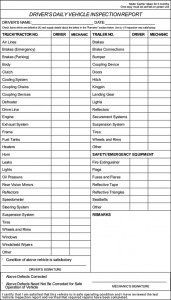
Drivers Daily Vehicle Inspection Report

In trucking, “out-of-service” criteria define a set of physical conditions under which a commercial motor vehicle (CMV) or commercial driver may be prohibited from operating. An out-of-service violation removes the driver and CMV from the roadway until the violation is corrected, which obviously means no work gets done and no one gets paid. In addition, out of service violations are sometimes punishable by fines.

The Federal Motor Carrier Safety Administration is serious about getting unsafe trucks off our roads and penalizing drivers and owners who fail to follow the regulations. In recent years, there have been more trucking companies and passenger bus companies placed out of service than ever before. The MAP-21 highway funding law that went into effect doubled most fines for serious violations.

Sharing the Blame

New rules that went into effect Oct. 1, 2013, allows the agency to place an entire carrier out of service for operating vehicles “without or beyond the scope of registration,” according to the regulation, whereas previously only the unregistered vehicle itself could be placed out of service. Now both the carrier as well as the vehicle can be penalized. Carriers and drivers who fail to comply with the state and federal regulations can be more easily be prevented from operating.

You can imagine this puts an even greater emphasis on thorough vehicle inspections and preventive maintenance which would catch potential risks to safety before they can cause accidents. A diligently-performed daily vehicle inspection will disclose such potential problems as faulty brake systems and bald tires.

Out-of-service penalties can also be levied against drivers without proper licensing and training. A CMV driver without a CDL or one that has expired can be just a serious a safety liability as brakes that won’t hold or tires ready to blow.

Activity in the Eagle Ford Shale in South Texas has increased truck traffic tremendously and statistics show trucking related accidents are up 41 percent.

Keep Eagle Ford Roadways Safe

[ic-l]In November, 2013, Sergeant Villarreal with Corpus Christi Department of Public Safety (DPS) spoke at the National Association for Publicly Funded Schools Region 4 “Keeping Our Roadways Safe” Conference at Del Mar College in Corpus Christi. Sergeant Villarreal indicated that the top three violations DPS officers see when pulling a commercial vehicle over in the Eagle Ford Shale are:

  1. Vehicle Inspections performed improperly or not at all
  2. Log Book Violations
  3. Driving a truck without a valid CDL license.

Keep Eagle Ford Drivers Trucking

Now that carriers as well as vehicles can be put out of service, here are five tips to help keep drivers “in service” and safely on the road:

  • Repair broken equipment.
  • Hire qualified drivers that have been properly trained with a valid CDL.
  • Have a strict pre/post trip vehicle inspection policy and hold drivers responsible for conducting and reporting them.
  • Have a no tolerance policy on faulty log book violations.
  • Conduct weekly or monthly safety meetings and reward employees for good audit results and discipline drivers that do not.

ZaZa Energy Signs Eagle Ford JV In DeWitt County

ZaZa Energy Sweet Home DeWitt County Eagle Ford Acreage

ZaZa Energy has agreed to a joint venture (JV) with a private operator on "non-core" acreage in DeWitt County.

The private company will receive a 75% net revenue interest in 7,600 net acres and has committed to carry ZaZa's costs for drilling two horizontal wells before April 15, 2014. The property includes 12 "high graded" development units in an area where ZaZa has ~23,000 net acres.

Additionally, ZaZa receives a credit of $750,000 for infrastructure expenses and a $300,000 credit for lease upkeep from its JV partner.

“During the third quarter, we continued to execute on our strategy as we consummated a new JV on a 7,600 acre portion of our Sweet Home acreage in DeWitt and Lavaca Counties with a proven operator who is actively running multiple rigs nearby.”
— Todd A. Brooks, CEO

ZaZa Is Active in Deals Across the Eagle Ford and Eaglebine

ZaZa is also participating in a JV in the Eaglebine. EOG, ZaZa's partner, recently opted into phase two of the JV agreement and accelerated development in the area.

During the third quarter, ZaZa sold 10,000 acres in Fayette, Gonzales, and Lavaca counties for ~$29 million.

The two joint ventures combined with asset sales are providing the liquidity needed for ZaZa to develop its assets more aggressively.

Todd A. Brooks, CEO, stated, "In addition, we closed on the sale of our remaining Eagle Ford Moulton acreage in Gonzales and Fayette Counties, and we made significant progress as it relates to our JV partnership in the Eaglebine/Eagle Ford East.”

Read the full release at zazaenergy.com

Cheniere Energy's Port of Corpus Christi LNG Plant Will Cost $12 Billion

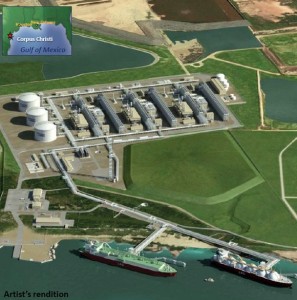
Cheniere's Corpus Christi Liquefaction Project

Cheniere Energy is closer to making a decision on final investment in its Corpus Christi Liquefaction project.

Cheniere received a turnkey construction commitment priced at $800/tonne of liquefaction. The engineering and construction company Bechtel submitted the contract in September.

Cheniere has plans for up to six trains with 4.5 mtpa capacity each in Corpus Christi, but initial plans call for three trains with capacity of 13.5 mtpa (~1.8 Bcf/d).

At $800/tonne, the construction costs will be $800 x 13,500,000 tonnes = $10.8 billion. Add financing costs and the price tag will easily reach $12 billion.

Read:Port of Corpus Christi Booms on the Back of Eagle Ford Growth

Construction contracts are negotiated early in the process, but a final investment decision will be made by year-end 2014. The decision will come after commercial export contracts are agreed, all regulatory approvals are received, and financing is in order.

Read the company's full third quarter press release at cheniere.com

Cheniere Energy is based in Houston and is further along in buildinga LNG export terminal at Sabine Pass.

Bechtel is a worldwide engineering, construction, and project management firm based in San Francisco. The company has participated in the development of LNG projects in Australia, Equatorial Guinea, Russia, and Trinidad.

Energy Transfer Will Convert an Eagle Ford Gas Pipeline to Liquids to Supply Trafigura Terminal in Corpus Christi

Trafigura Terminals Eagle Ford Port in Corpus Christi

Energy Transfer has reached an agreement with Trafigura for liquids capacity that supports the development of a pipeline supplying the Port of Corpus Christi.

Energy Transfer will utilize existing infrastructure to construct an 82-mile, 100,000 b/d pipeline system from McMullen County to the Port of Corpus Christi.

Leveraging underutilized natural gas pipelines allows Energy Transfer to have the pipeline running in 9-12 months.

“This pipeline combined with our deep-water terminal enables Trafigura to offer a complete solution to producers who seek to take Eagle Ford to the broader market.”
— Jeff Kopp, Trafigura's Director of Oil for North America.
Oil Tanker Leaving Port of Corpus Christi

The pipeline will deliver crude to Trafigura's Port of Corpus Christi Terminal, where a $500 million construction project is underway on a second deep-water dock that is 850 ft long and has a draft of 45 ft. Once complete, the terminal will be able to handle Aframax vessels (245 meters or ~800 ft long). Aframax ships are medium-sized oil tankers with capacity of approximately 750,000 barrels.

Trafigura states the facility will be able to handle three medium range tankers and two inland barges at one time.


Eagle Ford Helps Anadarko Achieve Record Onshore Production

Anadarko Southern and Appalachia Sales Volumes Q3 2013

Anadarko set a new record for onshore U.S. sales volumes with 590,000 boe/d of production in the third quarter. The record was achieved through growth in areas like the Eagle Ford.

Anadarko's Eagle Ford production grew 4% from the previous period to 50,000 boe/d in the third quarter. More impressively, the company has grown production from the play by 38% over this time in 2012.

Anadarko operated nine rigs in the quarter and spud 97 wells. With the average drilling time coming in at less than ten days, the company expects to drill ~325 wells in 2013.

“We continue to demonstrate our commitment to value acceleration and portfolio management.”
— Al Walker, CEO

During the second half of the year, Anadarko's midstream infrastructure has expanded significantly:

  • Commissioned 3 oil stabilization trains with 75,000 b/d of capacity
  • Reached start up on an expanded gas gathering facility (500 mmcfd)
  • Added gas compression
  • Expects to add more compression and another 25,000 b/d oil stabilization train in the fourth quarter

Additional midstream infrastructure will allow for more predictable growth and allows the company to maximize the value of the liquids it produces.

Anadarko will likely spend more in the Eagle Ford in 2014 than the company spent in 2013.

Anadarko reached record production in the Wattenberg field, the Eagle Ford, East Texas Haynesville, the Greater Natural Buttes area in Utah, and the Marcellus Shale. Read the full release at anadarko.com