Koch Expands its Eagle Ford Crude Oil Pipeline System

Pipeline Photo
Pipeline Photo

In May of 2014, Koch Pipeline Company announced it will expand its Eagle Ford crude oil pipeline system. The installation includes an additional 24-mile, 16-inch pipeline in San Patricio County, which is located near the Texas Gulf Coast, next to Corpus Christi, TX. Company officials say the new pipeline will have an expected initial capacity of approximately 200,000 b/d.

“We are seeing additional opportunities with the Eagle Ford shale play and this new pipeline will help us move domestic crude to the U.S. market more efficiently by using a combination of new and existing pipeline infrastructure,” said Bob O’Hair, EVP of Koch Pipeline. “South Texas is an important area for Koch Pipeline and we’ll continue to invest in it to ensure we have a system that meets the shippers’ needs in terms of capacity and reliability.”

In 2012, the company completed a 20-inch crude oil pipeline between Pettus, TX in Bee County and Corpus Christi, TX. The installation at its onset transported approximately 250,000 b/d of Karnes County area Eagle Ford production.

Read more: Koch Eagle Ford Shale Pipeline Going Forward

Koch's Proposed Bakken Shale Pipeline Cancelled

Koch, which has both Northern and Southern operations, recently attempted to gain a foothold in another major play, but was unsuccessful. In January of 2014, the company withdrew its proposal to build a 250,000 b/d crude oil pipeline in the Bakken Shale, in North Dakota, after not being able to secure enough commitments. The cancellation of this pipeline was surprising because more than 500,000 b/d currently moves out of the Bakken area  by rail.

Read more: Koch Cancels Proposed Bakken Pipeline - "Dakota Express Pipeline"

The company currently operates a 304-mile pipeline owned by Minnesota Pipe Line Company, LLC that delivers Canadian and Rockies crude oil, including Bakken, from Clearbrook, Minn., to refineries in the Twin Cities. In Texas, Koch operates about 540 miles of active crude oil transportation lines. The new Eagle Ford crude oil pipeline expansion is expected to come online in the second quarter of 2014.

Read more at kochpipeline.com

Cabot Oil & Gas To Expand Eagle Ford Drilling Program

Cabot Oil & Gas Drilling Program

After seeing positive results in the Eagle Ford over the past six months, Cabot Oil & Gas plans on expanding its Ealge Ford drilling program in the third-quarter of this year. Company officials cite continued improvements in production and cost savings as the primary reasons for the decision to expand their drilling program.

Like may other Eagle Ford operators, Cabot is seeing positive results from pad drilling. In the first quarter, the company completed its first six well pad with an average lateral length of 6,658'. The wells achieved an average peak 24-hour initial production (IP) rate of 1,045 boe/d per well (89% oil) during their first ten days online. Currently, the company is drilling a five-well pad with a planned average lateral length of over 8,500'.

“We have been very pleased with the strides our Eagle Ford team has made over the last six months. Based on the continued improvement in production rates and realized cost savings, which have resulted in higher rates of return, we are adding a third rig to our Eagle Ford program beginning in the third quarter. This additional rig will be focused on multi-well pads and is expected to have minimal impact on 2014 production but will materially impact our estimated 2015 oil production volumes.”
— Cabot CEO, Dan Dinges

Read more: Cabot Completing First Six-Well Pad in Eagle Ford in 2014

Cabot's Eagle Ford First-Quarter Update

During the first quarter of 2014, Cabot netted 7,271 boe/d, a 42% increase compared to the same reporting period last year. Total net production included 6,839 bbl/d of liquids, which represented a 49% increase. Also during the first quarter, Cabot added approximately 4,000 net acres to its Eagle Ford position through its leasing efforts.

In April of 2014, the company revealed that it intends to increase its position in the play. Before the end of the year, the company will almost assuredly strike a deal for more Eagle Ford acreage. Currently, Cabot has ~66,000 net acre across the play, with properties principally located in Atascosa, Frio, La Salle and Zavala Counties, Texas.

Read more at cabtog.com

Eagle Ford Shale Rig Count Stays Flat at 269

Forest Oil Eagle Ford Acreage Map Year-end 2013

The Eagle Ford Shale rig count stayed flat at 269 rigs running across our coverage area by the end of last week.

In recent Eagle Ford news, Houston-based Sabine Oil and Gas and Denver-based Forest Oil Corp announced in May of 2014 the two companies will merge in an all-stock transaction. At closing, which is expected some time during the fourth quarter, Sabine investors will hold 73.5% of the combined company's stock.

Read more: Sabine Oil & Gas Merger with Forest Oil Corporation

The U.S. rig count increased by 6 to 1,861 rigs running by the end of last week. A total of 326 rigs were targeting natural gas (3 more than the previous week) and 1,531 were targeting oil in the U.S. (3 more than the previous week). The remainder were drilling service wells (e.g. disposal wells, injection wells, etc.). 891or ~48% of rigs active in the U.S. were running in Texas.

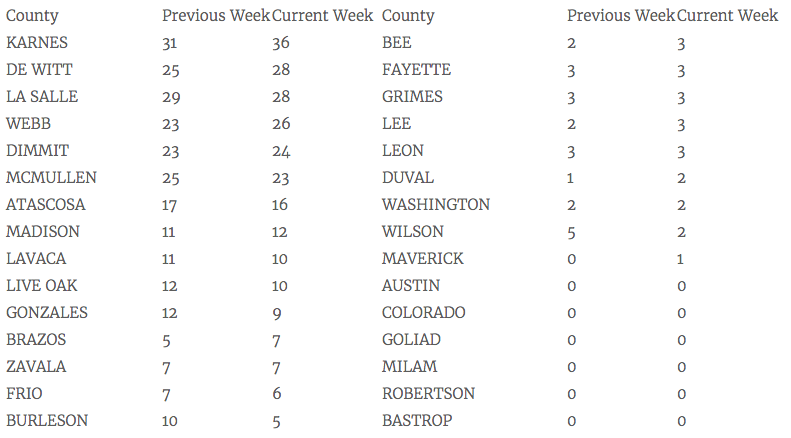
Baker Hughes rig count is quoted here. Baker Hughes also releases its own Eagle Ford Rig Count that covers the 14 core counties (219 rigs). The rig count published on EagleFordShale.com includes a 30 county area impacted by Eagle Ford development. A full list of the counties included can be found in the table near the bottom of this article.

Eagle Ford Oil & Gas Rigs

The natural gas rig count stayed flat at 14 rigs running by the end of last week. Average rig counts for natural gas production in 2012 were around 82 and then dropped to around 41 in 2013. Natural gas prices stayed relatively flat from the previous week at $4.42/mmbtu on Friday afternoon.

The oil rig count increased stayed flat at 255 rigs running by the end of last week. WTI oil prices increased by $2, trading at $102.16/bbl on Friday afternoon. Eagle Ford light crude traded at $98.50/bbl on May 16th.

A total of 238 rigs are drilling horizontal wells, 16 rigs are drilling directional wells, and 15 rigs are drilling vertical wells. Karnes, La Salle, De Witt, and Webb counties each have at minimum 26 rigs running. Karnes County has the highest rig count this week at 36. See the full list below in the Eagle Ford Shale Drilling by County below

South Texas Oil & Gas News:

Be sure to visit our South Texas Oilfield Job Listings to search openings and come back weekly for updates.

Eagle Ford Shale Drilling by County

What is the Rig Count?

The Eagle Ford Shale Rig Count is an index of the total number of oil & gas drilling rigs running across a 30 county area in South Texas. The South Texas rigs referred to in this article are for ALL drilling reported by Baker Hughes and not solely wells targeting the Eagle Ford formation. All land rigs and onshore rig data shown here are based upon industry estimates provided by the Baker Hughes Rig Count and/or Smith Service Co's (Schlumberger) Smith Rig Count.

Panhandle Oil and Gas Acquires Interest in Eagle Ford Acreage for $80 Million

Eagle Ford Satellite Image

In May of 2014, Oklahoma City-based Panhandle Oil & Gas Inc. signed an agreement with private sellers to acquire a 16% non-operated working interest in 11,100 gross Eagle Ford acres (1,775 net) for just over $80-million.

The properties are located in the core Eagle Ford oil window in La Salle and Frio counties.

The acreage block is held by production, with 52 Eagle Ford wells producing, and six awaiting completion. Five Pearsall wells and one Buda Limestone well are also producing. According to the company, the entire acreage has a drilling inventory of 113 undeveloped Eagle Ford locations.

“We are very pleased to be in a position to add this package of properties in the Eagle Ford Shale to Panhandle’s asset base. These properties produced an average of 733 net equivalent barrels of oil per day (80% oil, 10% NGL and 10% natural gas) during the first calendar quarter of 2014. Production volumes included two new Eagle Ford wells, which only produced the last 15 days of the quarter at a combined rate of 1,166 boe/d gross or 139 boe/d net. Another six new Eagle Ford wells have been drilled and are expected to begin producing this month at a first 30-day average gross rate of approximately 500 boe/day per well or a total of approximately 350 boe/day of additional net production. This transaction will significantly increase Panhandle’s current oil production, which is approximately 720 bbl/d.”
— Panhandle CEO, Michael Coffman

Panhandle estimates net proved developed reserves are approximately 1.72-million bbls oil, 1.73-million mcf gas and 297,000 bbls NGLs.  Reserves for the 113 undeveloped locations, which are projected to have an average effective lateral length of approximately 7000', are estimated to be 5.57-million bbls oil, 4.58-million mcf of gas and 789,000 bbls NGLs.

Currently, the property is being developed with a one drilling rig program. The operator is Oklahoma City-based Cheyenne Petroleum Company.

The transaction is projected to close by mid-June of 2014, with an effective date of April 1, 2014.

Read more at panhandleoilandgas.com

Sabine Oil & Gas Merger with Forest Oil Corporation

Forest Oil Eagle Ford Acreage Map Year-end 2013

Houston-based Sabine Oil and Gas and Denver-based Forest Oil Corp will merge in an all-stock transaction.

At closing, which is expected some time during the fourth quarter, Sabine investors will hold 73.5% of the combined company's stock. The announcement of the merger was revealed by both companies in early May of 2014.

“Forest’s asset portfolio is an excellent complement with Sabine’s asset portfolio and we have confidence that Sabine’s management team is equipped to deliver exceptional shareholder value through the enhanced opportunities that are embedded in Forest’s assets.”
— Forest CEO, Patrick McDonald

The combined company, which is expected to be listed on the NYSE as "SABO", will hold a 207,000 net acreage position in East Texas, and a 65,000 net acreage position in the Eagle Ford. Estimated proved reserves from the combined company's assets are 1.5 trillion cubic feet equivalent (71% gas) (as of December 31, 2013), and estimated daily production of 345 million cubic feet equivalent (65% gas) for 2014.

Forest Oil Was in Trouble

The merger comes on the heels of multiple asset divestitures by Forest over the past several years. In early January of 2013, the company sold some of its South Texas assets to pay down debt.

Read more: Forest Oil Sells South Texas Assets

Recently, Forest Oil hit a snag in the Eagle Ford during the fourth quarter of 2013, after three gross (1.5 net) wells hit a fault line in the company’s southern acreage. 77% of the company’s $290-310 million capital budget was slated for the Eagle Ford in 2014, but new estimates were set at 36% after problems arose.

Read more: Forest Oil Eagle Ford Drilling Shifting Gears in 2014 Due to Faulting

The new company's headquarters will be based in Houston, TX, and led by Sabine's current executive management. Prior to the merger, Sabine Oil and Gas was a privately held company.

Read more at forestoil.com