Crude Supply Creates Demand for Storage Projects on USGC

Salt Dome Storage Facility

The largest new oil storage facility along the Texas Gulf Coast is slated for Houston, TX, according to the Wall Street Journal (WSJ).

The paper's blog identified Houston-based Haddington Ventures LLC, a midstream oil and gas investment firm, as the designer/builder for the Pierce Junction crude oil storage project. Currently, the company is seeking a buyer for a majority stake in the project, which has already been designed and is slated for construction in late 2014.

Since 2008, crude inventories from the tight oil and shale gas revolution, have been piling up in Cushing, Oklahoma, a major oil trading and storage hub. However, TransCanada's Gulf Coast Pipeline, which came online in January of this year, helped significantly reduce inventories in Cushing, but pushed the crude to the U.S. Gulf Coast (USGC) area. As a result, crude inventories in the USGC have recently climbed to record levels according to the Energy Information Administration (EIA), hitting 207.2 million bbl on April 11, 2014. The EIA says the USGC region has about 275 million bbls of current capacity, but projections are for total U.S. oil production to continue growing, and more midstream projects pushing oil to the USGC have been scheduled.

Haddington's Pierce Junction project, which will be in Southwest Houston, will utilize naturally existing salt domes in the area. The way it works is a well is drilled into the formation and large amounts of water are cycled through the well dissolving the salt. The brine is extracted, leaving a large empty space in the formation for storage purposes.

According to WSJ, a Houston investment bank predicts by 2016 projects along the Gulf Coast will accommodate an additional 55-million bbl. The Pierce Junction Project is included in that estimate.

Read more at blog.wsj.com
Eagle Ford Shale Rig Count Increases by Two to 272

U.S. Oil Production
U.S. Oil Production

The Eagle Ford Shale rig count increased by two to 272 rigs running across our coverage area by the end of last week.

In recent Eagle Ford news, The Energy Information Administration (EIA) recently released data showing the state produced just over 3 million b/d of crude oil in April of 2013, reaching production levels not seen in the state since the 70s. The rise in Texas’ oil production is thanks in large part to the tight oil and shale gas revolution in the Eagle Ford, and made possible by advancements in horizontal drilling and fracking technology.

Read more: Texas Oil Production Reaches Levels Not Seen Since the 70s

The U.S. rig count increased by one to 1,874 rigs running by the end of last week. A total of 311 rigs were targeting natural gas (three less than the previous week) and 1,562 were targeting oil in the U.S. (four more than the previous week). The remainder were drilling service wells (e.g. disposal wells, injection wells, etc.). 896or ~48% of rigs active in the U.S. were running in Texas.

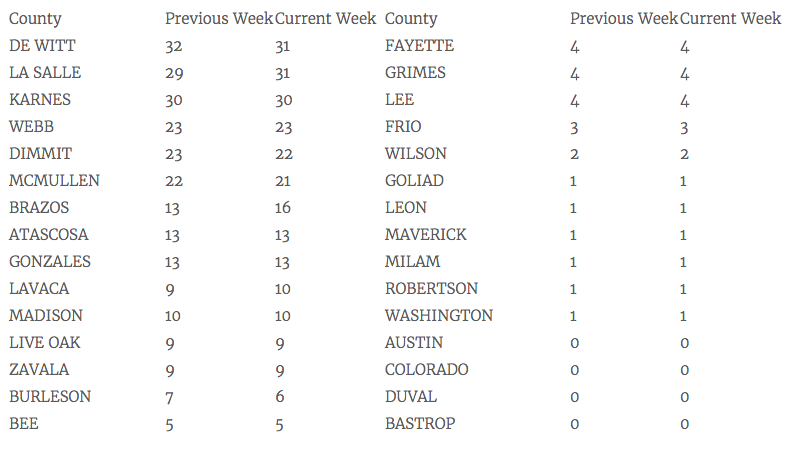
Baker Hughes rig count is quoted here. Baker Hughes also releases its own Eagle Ford Rig Count that covers the 14 core counties (213 rigs). The rig count published on EagleFordShale.com includes a 30 county area impacted by Eagle Ford development. A full list of the counties included can be found in the table near the bottom of this article.

Eagle Ford Oil & Gas Rigs

The natural gas rig count increased by one to 12 rigs running by the end of last week. Average rig counts for natural gas production in 2012 were around 82 and then dropped to around 41 in 2013. Natural gas prices fell slightly from the previous week to $4.29/mmbtu on Friday afternoon.

The oil rig count increased by one to 260 rigs running by the end of last week. WTI oil prices decreased by ~$2 from the previous week, trading at $103.68/bbl on Friday afternoon. Eagle Ford light crude traded at $100.50/bbl on July 3rd.

A total of 241 rigs are drilling horizontal wells, 13 rigs are drilling directional wells, and 18 rigs are drilling vertical wells. Karnes, La Salle, and De Witt each have at minimum 30 rigs running. De Witt and La Salle Counties have the highest rig counts this week at 31 per county. See the full list below in the Eagle Ford Shale Drilling by County below

South Texas Oil & Gas News:

Be sure to visit our South Texas Oilfield Job Listings to search openings and come back weekly for updates.

Eagle Ford Shale Drilling by County

What is the Rig Count?

The Eagle Ford Shale Rig Count is an index of the total number of oil & gas drilling rigs running across a 30 county area in South Texas. The South Texas rigs referred to in this article are for ALL drilling reported by Baker Hughes and not solely wells targeting the Eagle Ford formation. All land rigs and onshore rig data shown here are based upon industry estimates provided by the Baker Hughes Rig Count and/or Smith Service Co's (Schlumberger) Smith Rig Count.

Fracking Bans in Texas?

Mission Well Services Frac Spread

Fracking bans have already been put into place across the country, but what could a fracking ban mean for the oil & gas industry in Texas?

We may not have to wait very long to find out. In Denton, TX, a small community northwest of Dallas, the Denton Drilling Awareness Group (DAG), has petitioned enough signatures to place an ordinance on local ballots in November, banning fracking within the city limits. If the ordinance passes, that could spur a continued conversation and subsequent legal battle about the ability of local governments to regulate oil & gas activity.

Oil & Gas Activity Regulated by the State

In Texas, the Railroad Commission (RRC) is responsible for regulating oil and gas activity, and local city governments have historically had little say on the matter. Local municipalities are not without recourse, and can insist on some drilling-related restrictions, but an out-right drilling moratorium imposed by a municipal government due to fracking in the state is unprecedented.

The small community of Alpine, TX, close to the Big Bend area of the state, made headlines this week after members of the Big Bend Sierra Club presented a case against fracking in a July 1st city council meeting. The group proposed a city ordinance that would prohibit fracking in the city.

Impact of a Fracking Ban in Texas

Depending on the fall-out of a possible fracking ban in Texas, unfavorable scenarios for industry and mineral owners could result. Obviously, for industry, a drilling moratorium imposed by a municipal government, could conflict with regulatory processes with the RRC. That could open a whole new can of worms, resulting in potentially lengthy legal battles. Mineral owners in the impacted areas would also be affected, because there would be no way for their minerals to be accessed. That goes to private property rights, which historically, Texans have fought vigorously for.

Critics of fracking however maintain that it is a practice that could potentially contaminate groundwater, and cause general health concerns for the community. EagleFordShale.com will keep you updated on any developments with this story.

Hawkwood Energy Acquires East Texas Eagle Ford Acreage

Brazos County Eagle Ford Shale Map

Denver-based Hawkwood Energy, announced in early July of 2014 its entrance into the Eagle Ford with the acquisition of producing and non-producing assets in East Texas.

The deal includes 50,000 generally contiguous net undeveloped acres and approximately 1,800 b/d of current oil production, according to company officials. Development of the acquired assets has either targeted or will be prospective for the Eagle Ford Shale and Woodbine formations. The assets extend across Brazos, Leon, Madison and Robertson Counties.

Hawkwood acquired the assets in two separate transactions for undisclosed amounts from Crimson Energy Partners III and Encana Oil & Gas (USA) Inc. The deal with Crimson was mostly for acreage in Brazos County, and Encana's assets included in the transaction were located primarily in Robertson County.

“We are excited about the growing unconventional activity in the Eagle Ford and Woodbine, as well as the other long term multi-pay opportunities the area has to offer.”
— Hawkwood Energy CEO, Patrick Oenbring.

Encana Divesting East Texas Assets

Encana has historically been a major industry player for natural gas production, but recently began selling many of its non-core assets to focus on liquids-rich shale fields. Some of those non-core assets were in East Texas, and in April of 2014, Encana announced the sale of approximately 90,000 net acres in Leon and Robertson Counties for $530 million. Company officials did not name a buyer for this transaction, and the deal is expected to close in the third quarter.

In June of 2014, Encana closed on its acquisition of 45,500 net acres in the oil window of the Eagle Ford in South Texas from Freeport-McMoran for $3.1 billion. This newly acquired acreage for Encana represents a new core area.

Read more: Encana Purchases Eagle Ford Assets from Freeport-McMoran - $3.1 Billion

Read more at hawkwoodenergy.com

Texas Oil Production Reaches Levels Not Seen Since the 70s

U.S. Oil Production
U.S. Oil Production

The "good ol' days" for the oil and gas industry are back in Texas! The Energy Information Administration (EIA) recently released data showing the state produced just over 3 million b/d of crude oil in April of 2014, reaching production levels not seen in the state since the 70s.

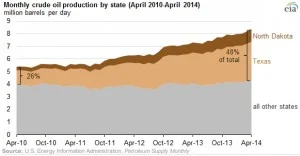
Many Texans remember well the oil bust of the early 80s, when the price of oil fell drastically, and what followed was a blight on the states' economy. A steady decline in oil production, which began in 1972, and fell sharply after the bust, signaled the state's oil boom days were likely over for good. But now Texas along with the rest of the U.S. is on track to become the top oil producer in the world by 2015, according to the International Energy Agency (IEA). The EIA said in the month of April, Texas and North Dakota, which encompasses the prolific Bakken Shale play, made up nearly half of U.S. oil production (48%).

The rise in Texas' oil production is thanks in large part to the tight oil and shale gas revolution in the Eagle Ford, and made possible by advancements in horizontal drilling and fracking technology. The Permian Basin in West Texas, a major oil producing area in the state for years, has also seen an increase in horizontal drilling since the end of 2013, and many of the areas untapped oil reserves are being accessed by the technology.

Read more: Why Horizontal Drilling is Important to Texas Oil Production

Texas Surpasses Iraq's Oil Production

The EIA's data is yet another indication of America's re-emerging prominence as a leader in world-wide oil production. In June of 2014, Iraq's production fell 400,000 b/d to 2.9 million, due to violence and civil unrest flaring up in the country, according to Bloomberg. That means Texas has likely surpassed Iraq's oil production, since Texas' production has increased on a month-to-month basis since 2011. Iraq was rated as the second largest OPEC producer in April at 3.2 million b/d.

Read more at bloomberg.com