EPA Grants Permit for $500 Million Corpus Christi Condensate Splitter

Oil Tanker Leaving Port of Corpus Christi

The Environmental Protection Agency (EPA) has given a subsidiary of Conneticut-based Castleton Commodities International the green light for the construction of new petroleum process facilities near Corpus Christi, TX. The EPA issued the final greenhouse gas and prevention of significant deterioration construction permit to the subsidiary, CCI Corpus Christi, LLC, on Sept. 15th.

The company plans to build two fractionation units, capable of producing a combined 100,000 b/d and a bulk petroleum terminal. The terminal will include storage tanks and barge loading operations that can handle 500,000 barrels a day of crude condensate for export.

Castleton hopes to get some skin in the condensate export game, according to the EPA, but will need additional approval from the federal government. So far, only two companies, Pioneer Natural Resources Co. and Enterprise Product Partners LP, have been authorized to export minimally processed condensate from the Eagle Ford Shale. More than half of all production from play is condensate, which is an ultralight crude oil.

Read more: Oil Exports to Foreign Buyers Begins

In addition to exporting product, Castleton also plans to use the crude condensate to produce diesel, jet fuel, naphtha, and other petroleum products. The project is expected to cost the company $500-million.

Read more at epa.gov

Eagle Ford Shale Rig Count Stays Flat at 263

Eagle Ford Contour Map

The Eagle Ford Shale rig count stayed flat at 263 rigs running across our coverage area by the end of last week.

In recent news, the U.S. Geological Survey (USGS) confirmed a 3.2 magnitude earthquake last week, two miles southeast of Charlotte, TX in Atascosa County, which is almost entirely in the liquids-rich or oil window of the Eagle Ford Shale. Last week, 13 active rigs were running in the area.

According to the USGS, there is evidence that some central and eastern North American earthquakes have been triggered or caused by human activities that have altered the stress conditions in earth’s crust. The cause of this most recent quake is unknown; however, in the Eagle Ford Shale and other areas for oil & gas development in Texas, a link has been made between waste water disposal/injection wells and seismic activity.

Read more: Eagle Ford Earthquake - Video

The U.S. rig count increased by six to 1,931 rigs running by the end of last week. A total of 338 rigs were targeting natural gas (two more than the previous week) and 1,592 were targeting oil in the U.S. (8 more than the previous week). The remainder were drilling service wells (e.g. disposal wells, injection wells, etc.). 905 or ~48% of rigs active in the U.S. were running in Texas.

Baker Hughes rig count is quoted here. Baker Hughes also releases its own Eagle Ford Rig Count that covers the 14 core counties (203 rigs). The rig count published on EagleFordShale.com includes a 30 county area impacted by Eagle Ford development. A full list of the counties included can be found in the table near the bottom of this article.

Eagle Ford Oil & Gas Rigs

The natural gas rig count decreased by two to 11 rigs running by the end of last week. Average rig counts for natural gas production in 2012 were around 80 and then dropped to around 40 in 2013. Natural gas prices stayed relatively flat from the previous week at $3.94/mmbtu on Friday afternoon.

The oil rig count increased by 2 to 252 rigs running by the end of last week. WTI oil prices decreased slightly from the previous week, trading at $92.34/bbl on Friday afternoon. Eagle Ford light crude traded at $88.75/bbl on Sept. 12th.

A total of 246 rigs are drilling horizontal wells, seven rigs are drilling directional wells, and ten rigs are drilling vertical wells. Karnes, La Salle, De Witt, and Webb each have at minimum 25 rigs running. Karnes County has the highest rig count this week at 38. See the full list below in the Eagle Ford Shale Drilling by County below

South Texas Oil & Gas News:

Be sure to visit our South Texas Oilfield Job Listings to search openings and come back weekly for updates.

Eagle Ford Shale Drilling by County

What is the Rig Count?

The Eagle Ford Shale Rig Count is an index of the total number of oil & gas drilling rigs running across a 30 county area in South Texas. The South Texas rigs referred to in this article are for ALL drilling reported by Baker Hughes and not solely wells targeting the Eagle Ford formation. All land rigs and onshore rig data shown here are based upon industry estimates provided by the Baker Hughes Rig Count.

Eagle Ford Earthquake - Video

The U.S. Geological Survey (USGS) confirmed a 3.2 magnitude earthquake on Wednesday, two miles southeast of Charlotte, TX in Atascosa County, which is almost entirely in the liquids-rich or oil window of the Eagle Ford Shale. Last week, 13 active rigs were running in the area. According to the USGS, there is evidence that some central and eastern North American earthquakes have been triggered or caused by human activities that have altered the stress conditions in earth's crust. The cause of this most recent quake is unknown; however, in the Eagle Ford Shale and other areas for oil & gas development in Texas, a link has been made between waste water disposal/injection wells and seismic activity.

Injection wells are necessary to the fracking process, a method by which a well is completed using treated water under extreme pressure. When a well is fracked, it produces flowback or produced water that must be disposed of properly in waste water disposal/injection wells deep underground. Recently, EagleFordShale.com posted a story about new waste water disposal rules that could be put into practice soon in Texas, following a rash of low magnitude earthquakes across the state.

Read more: Could New Waste Water Disposal Rules be Coming in Texas?

“There are two primary ways in which the oil and gas industry commonly “ads” energy (pressure) into the ground. That is through hydraulic fracturing and water injection. The industry “subtracts” energy from the ground by producing hydrocarbons and the associated water that generally comes with it. These two forces are constantly opposing and offsetting each other. On a localized basis, at any given point in time, it is possible that the net result of these two forces is great enough (in either direction) to cause small and local trimmers. No doubt many of these are of such short duration and so small that they are never even noticed. Then there are some that make it to the observable and measurable threshold. Local and hyperlocal geology will generally determine the susceptibility of a particular area to these trimmers.”
— EagleFordShale.com Founder, Kenny DuBose

How the Eagle Ford Impacts the Price at the Pump

Eagle Ford Contour Map

The Eagle Ford Shale is a powerhouse play for Texas, and it is even bigger than the last great Texas oil boom that began with Spindletop at the turn of the last century. Texans and all Americans are reaping the benefits of this modern day boom, and where this may be most evident is at the gas pump.

It wasn't long ago that the price of a gallon of gas in Texas was well above $4 a gallon, and although Texans may still feel some pain at the pump, the prices could be much higher if it wasn't for the Eagle Ford Shale and the oil and gas renaissance taking place in the U.S. Some industry professionals speculate the price of a gallon of gas could be as much $7 - $8 dollars a gallon if it wasn't for the shale oil boom, made possible by advances in horizontal drilling and fracking.

Read more: North Dakota & Texas Make Up Half of U.S. Oil Production

What Determines the Price of a Gallon of Gas

According to the Energy Information Administration (EIA), there are four main components that go into the retail price of a gallon of gas:

  • Crude Oil (67%)
  • Refining Costs and Profits (14%)
  • Distribution, Marketing, and Retail Costs and Profits (8%)
  • Federal and State Taxes (12%)

The majority of the price, as shown by the breakdown, comes from crude oil, which is determined by commodities traders. World-wide supply and demand are key factors in influencing pricing.

With the U.S. poised to become the top oil producing country in the world by 2015, more supply has entered the world market, and that has ultimately impacted the price of crude oil. There are a number of other factors (i.e. global political upheaval) that are beyond the scope of this post, and they are all taken into account when determining the price of oil futures.

How the Eagle Ford Impacts Crude Oil Supply

The Eagle Ford alone produces nearly 1.5-million b/d. That's more than half of total production for the entire state of Texas. The U.S. currently produces around 11-million b/d.

Read More:EIA: Eagle Ford Oil Production Will Hit 1.5-Million b/d – Sept. 2014

By comparison, Iraq, which is currently rated as the second largest OPEC producer, produced 3.2-million b/d in April of 2014. By June of this year, Texas' total monthly production surpassed that of Iraq, as its production dropped below 3-million b/d.

Production growth is expected to continue in the Eagle Ford, and for the immediate future, it will remain a top supplier of U.S. crude oil. That equates to the Eagle Ford continuing to play a role in influencing the price of oil.

Sundance Seeks More Eagle Ford Acreage - Sept. 2014

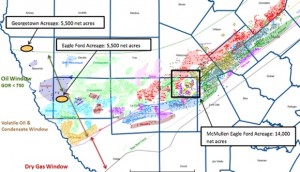
Sundance Energy's Eagle Ford Acreage

Australian-based Sundance Energy's Managing Director Eric McCrady was cited in a Bloomberg report this week saying the company plans to add 10,000 to 20,000 net acres in the Eagle Ford within 12-months.

Sundance's most recent reported acquisition came in late May of 2014, when the company announced it would purchase 11,000 net acres in Dimmit and Maverick counties for $33-million. The deal added 115 gross (69 net) locations to the company’s Eagle Ford drilling inventory and approximately 200 boe/d in production. Sundance currently has ~19,500 net Eagle Ford acres covering 295 gross (196 net) drilling locations.

Read more: Sundance Energy Acquires 11,000 Net Eagle Ford Acres for $33-Million

The company's Eagle Ford expansion comes at a time when some Eagle Ford operators will likely need to divest their assets to pay down debt. In June, Freeport McMoran completed at $3.1-billion deal with Encana to sell 45,500 net acres in the play. Freeport McMoran officials said a portion of the proceeds would be used to pay down debt.

Read more: Encana Purchases Eagle Ford Assets from Freeport-McMoran - $3.1 Billion

Sundance Eagle Ford Operations in Second Half of 2014

In July, Sundance officials said 26 gross (20.6 net) Eagle Ford wells were expected to begin production in the second half of the year, pushing the company's production up to 8,000 - 9,000 boe/ d by year's end. According to Bloomberg, McCrady confirmed the company expects to hit that target goal in September and increase output next year.

Read more at Bloomberg.com