
Goodrich Petroleum Considers Sale of Eagle Ford Assets

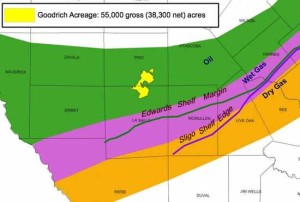
Goodrich Petroleum Eagle Ford Map

Eagle Ford player Goodrich Petroleum is considering selling all or a portion of its Eagle Ford Shale acreage in the first half of 2015. In early December of 2014, the Houston, TX-based company announced its Board of Directors had authorized management to "explore strategic alternatives" for the assets.

Goodrich, which has invested significantly in the Tuscaloosa Marine Shale (TMS) in South Louisiana and Mississippi, also announced its capex budget for 2015 this month at $150-million - $200-million. That's much less than the than $375-million budget the company projected in 2014, according to Goodrich's annual report. Company officials indicate about 95% of Goodrich’s 2015 budget will be earmarked for drilling in the TMS.

Read more: Goodrich Increases 2014 Budget by 50% and is Shifting to Tuscaloosa Marine Shale

Since June of 2014, the price of oil has dropped by nearly 50%, and Goodrich's pullback on capital investment is a strong indication of the impact of lower crude oil prices on shale oil operators. Company officials indicate a whole or partial sale of its Eagle Ford assets would significantly enhance the company's flexibility to further expand its development activities under better market conditions.

Goodrich has approximately 45,000 (30,000 net) acres in the Eagle Ford, with an estimated 383 (255 net) un-risked drilling locations remaining, according to company officials. Goodrich entered the Eagle Ford early in 2010, paying approximately $1,650 per acre.

We'll keep an eye out for any new details about Goodrich's potential exit from the Eagle Ford. Stay abreast of all EagleFordShale.com updates by subscribing to our newsletter.

Read more at GoodRichPetroleum.com

H2S Gas Found in Higher Concentrations - McMullen Co. Wells

McMullen County, TX includes some of the best development areas for the Eagle Ford Shale, but wells in the county have been found to yield higher concentrations of H2S gas compared to other areas. According to experts, early Eagle Ford well results indicated the reservoir was a relatively sweet, yielding low concentrations of H2S gas, at less than one percent. Well results from some McMullen County wells, however, have yielded H2S gas concentrations greater than four percent.

In October of 2014, Patricia DuBois, a Staff Geologist at Murphy Exploration & Production Co., and Dr. Huzeifa Ismail, a Consultant at Maxoil Process Solutions, conducted an SPE Study Group to further discuss the reasons why McMullen County wells have higher H2S concentrations. It was found deep faults intersect the wellbores of wells with higher H2S gas concentrations. Mapping of these features ultimately allowed for the prediction of areas with high H2S. An economic model was then developed based on the expected H2S concentration and production forecast to direct long term drilling and completions strategy and selection of H2S treatment options.

For more on SPE Study Groups visit spegcs.org

RRC Adopts New Pipeline Permit Rule

Texas Railroad Commission (RRC) commissioners have adopted pipeline permit rule amendments designed to clarify how a pipeline operator may be classified by the commission as a common carrier*. Common carrier pipelines in Texas are pipelines which are contracted to carry crude petroleum, gas or carbon dioxide for hire. The rule amendments require pipeline operators to verify their claim to be a common carrier when applying for a T-4 Permit to operate a pipeline or when renewing, amending or canceling an existing permit.

“The Commission’s T-4 Permit to Operate is a permit to operate a pipeline in Texas. It does not change the rights of a property owner nor does it grant eminent domain powers to a pipeline operator. Our new rules require an attestation from the operator of their knowledge of Texas eminent domain laws and the Texas Landowners’ Bill of Rights.”
— Commissioner, Barry Smitherman

The adopted rule amendments take effect on March 1, 2015, and include the following requirements:

  • permit applications must now include additional information including requested classification and purpose of the pipeline or pipeline system as a common carrier, a gas utility or private line operator;
  • permit applications must include a sworn statement from the pipeline applicant providing the operator’s factual basis supporting the classification and purpose being sought for the pipeline;
  • if applicable, the pipeline operator must submit documentation such as a contract or tariff for third-party transportation in the case of a common carrier, along with any other information requested by the Commission;
  • the pipeline T-4 permit, if granted, shall be revocable at any time after a hearing if the Commission finds that the pipeline is not being operated in accordance with state laws and Commission rules and regulations.
  • the applicant must acknowledge the eminent domain provisions in the Texas Landowner’s Bill of Rights.

Common carrier - a common carrier offers its services to the general public under license or authority provided by a regulatory body.

Read more at rrc.state.tx.us

SPE-GCS Shale Study Group to Be Formed in 2015

The Society of Professional Engineers' Gulf Coast Section (SPE-GCS) hopes to form a new group in 2015 to examine shale technologies, and collaborate with industry professionals on ways to make shale more sustainable.

“This group will help disseminate information on new technologies, new services, best practices, benchmarking, lessons learned, safety, regulation, etc., said the group’s organizer, Kim Thames, by email. “The group aims to bring together the best shale expertise and ultimately become SPEI’s leader in shale knowledge.”

It's yet to be determined how group participants will meet, but Thames notes it will be similar to other SPE Study Groups, with monthly meetings, lunch and learns, networking, sporting events, etc. In-person meetings will be in Houston, TX.

If you are interested in getting involved in this new group as a supporter or in a leadership position, contact Kim at [email protected] to have her add your name and SPE member number to the petition.

Eagle Ford Shale Rig Count Increases by One to 261

alt="Eagle Ford at One Billion Barrels"
Eagle Ford Reaches One Billion Barrels

The Eagle Ford Shale rig count increased by one to 261 rigs running across our coverage area by the end of last week.

In recent Eagle Ford news, oil prices have plummeted 40% in the last six months, and that’s putting the kibosh on some new drilling across North American shale plays.

According to DrillingInfo.com, applications for new drilling permits in South Texas’ Eagle Ford Shale and North Dakota’s and Montana’s Bakken Shale fell approximately 30% in November of 2014 compared to the previous month. However, the Texas Railroad Commission reports a whopping 4,891 new drilling and re-enter permits in the Eagle Ford from Jan. – Oct. of this year, already surpassing the total for new drilling and re-enter permits in 2013 of 4,416.

Read more: Eagle Ford and Bakken Drilling Permits Fall 30%

The U.S. rig count decreased by 18 to 1,875 rigs running by the end of last week. A total of 338 rigs were targeting natural gas (down 8 from the previous week) and 1,536 were targeting oil in the U.S. (ten less than the previous week). The remainder were drilling service wells (e.g. disposal wells, injection wells, etc.).868 or ~48% of rigs active in the U.S. were running in Texas.

Baker Hughes rig count is quoted here. Baker Hughes also releases its own Eagle Ford Rig Count that covers the 14 core counties (206 rigs). The rig count published on EagleFordShale.com includes a 30 county area impacted by Eagle Ford development. A full list of the counties included can be found in the table near the bottom of this article.

Eagle Ford Oil & Gas Rigs

The natural increased by two to 16 rigs running by the end of last week. Natural gas prices decreased by $.60 from the previous week at $3.14/mmbtu on Friday afternoon.

The oil rig count increased by three to 245 rigs running by the end of last week. WTI oil prices decreased by ~$200 from the previous week, trading at $55.98/bbl on Friday afternoon. Eagle Ford light crude traded at $53.00/bbl on December 19th.

A total of 247 rigs are drilling horizontal wells, six rigs are drilling directional wells, and eight rigs are drilling vertical wells. Karnes, Dimmit, and DeWitt each have at minimum 27 rigs running. Dimmit County has the highest rig count this week at 36. See the full list below in the Eagle Ford Shale Drilling by County below

South Texas Oil & Gas News:

Be sure to visit our South Texas Oilfield Job Listings to search openings and come back weekly for updates.

Eagle Ford Shale Drilling by County

What is the Rig Count?

The Eagle Ford Shale Rig Count is an index of the total number of oil & gas drilling rigs running across a 30 county area in South Texas. The South Texas rigs referred to in this article are for ALL drilling reported by Baker Hughes and not solely wells targeting the Eagle Ford formation. All land rigs and onshore rig data shown here are based upon industry estimates provided by the Baker Hughes Rig Count.