Texas Housing Market Strong

Texas Housing Market Strong

Housing markets in Texas remain strong remain strong despite an economic slump in the nation's energy capital, but some worry about the high prices for a few Eagle Ford residents.

Related: Low Oil Prices and the Texas Economy

The decline in oil prices over the last year has caused a slowdown in employment growth and some job cuts, but homes sales remain strong. In May 2015, there were 28,088 sales of existing single-family homes, 1.66% percent more than in May 2014.

Lawrence Yun, the chief economist for the National Association of Realtors, said that home price increases in Texas are running at about twice national rates.

While increased home prices are a great thing for property owners, for many at the bottom of the wage pool, this represents a constant struggle to make ends meet.

We need to tone down the price growth, because prices are rising too fast,” Yun said. “House prices nationally are now reaching back to 2006 levels,” before the recession.

Residents in some Eagle Ford counties are among the most vulnerable. UTSA just announced they will be conducting a study of the impact of oil-and-gas exploration on the affordability and adequacy of housing in Dimmit, La Salle and Zavala counties. The study, funded by the U.S. Department of Housing and Urban Development, will also address how federal, county and local policies affect the availability of rental housing, affordable housing and housing options for vulnerable populations.

Texas continues to lead the nation in consumer confidence. The Texas region's consumer confidence index was 130.5 in May 2015, up 7.5 percent from April 2015 and compared to the national index of 95.4.

Texas Attorney General Challenges EPA

Chesapeake Before Texas High Court
Texas Attorney General Challenges EPA

Texas Attorney General Ken Paxton has filed a lawsuit to challenge the new federal regulations under the Clean Water Act.

Related: EPA Finds Little Risk to Drinking Water from Fracking

In a news release Monday, Paxton accuses the Obama Administration of illegally attempting to expand the jurisdiction and regulatory power of the Environmental Protection Agency (EPA) in such a way as to threatens private property ownership.

The EPA’s final rule was published Monday and is very broad. it leaves much open to interpretation including whether ditches, dry creek beds, gullies and isolated ponds formed after a big rain could be considered a “water of the United States.”

The EPA’s new water rule is not about clean water – it’s about power,” Attorney General Paxton said. “This sweeping new rule is a blatant overstep of federal authority and could have a devastating effect on virtually any property owner, from farmers to ranchers to small businesses. Texans shouldn’t need permission from the federal government to use their own land, and the EPA’s attempt to erode private property rights must be put to a stop.

Paxton is also sceptical of the EPA’s Clean Power Plan (“Carbon Rule”) and warned that it would have an impact on the livelihoods and quality of life of Texans and would result in higher electricity costs and less reliability for Texans, all while doing little to nothing to affect the environment. Attorney General Paxton last month announced Texas intends to challenge the Carbon Rule when it is finalized by the EPA later this summer.

Read more at texasattorneygeneral.org

Eagle Ford Counties Win Royalties

be safe. be smart.
be safe. be smart.

New legislation allows Eagle Ford counties to keep some of its mineral wealth, which is good news for the failing road system.

Governor Greg Abbott recently signed SB 951, overturning an old provision that stripped counties of the proceeds from the minerals that ran under their roads. Since 1960, the state has received all mineral royalties, even though they do not maintain county roads.

Over a 40 month period, the money for drilling under roads in Karnes, DeWitt and Gonzales counties generated $16 million for the state. The new law allows the counties to keep this money, which will be vital to maintaining their road systems that have been significantly impacted by the shale boom.

Eagle Ford Roads Impacted by Higher Traffic & Inadequate Funding

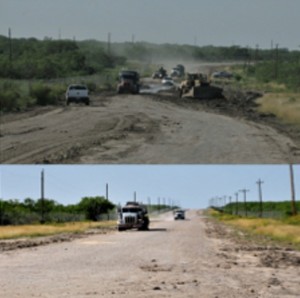
Eagle Ford production has been great for local economies, but has taken its toll on their roadways. Small gravel roads originally built for passenger cars now host huge rigs that travel at high speeds and often create deep, hazardous craters. Some road edges are shredded and the pavement can unexpectedly drop off half a foot.

The bill was filed by State Sen. Carlos Uresti who also worked last session to gain an additional $225 million to counties for road repair.

For the first time that anyone can remember in decades, the state funded the county roads. That’s always been a county function: counties, you’re on your own. But again, given all the activity, I was able to get my colleagues to pass this bill,” Uresti said, adding that more was needed.
— Senator Uresti

Pipeline Inspectors May Soon Carry Guns

S&B Infrastructure Projects
Eagle Ford Roadways Used for Criminal

The drug war is now affecting parts of the Eagle Ford as pipeline inspectors express concern for their safety.

As energy companies moved into the Eagle Ford, they have cleared brush and build dirt roads in order to make way for pipelines to carry their product.

This development has had the unintended consequence of providing potential pathways for those smuggling drugs and illegal immigrants, and officials now fear that criminals may come into contact with energy company employees, regulators and landowners.

The issue of the drug cartels exploiting the Eagle Ford Shale’s network of private roads has been a concern since 2012.

Related: Drug Smugglers Using Location Roads to Bypass Border Patrol

The federal government has been ineffective in preventing illegal activity along the border and with the unprecedented amount of oil and gas activity in the Eagle Ford Shale in recent years, Commission inspectors in South Texas have voiced concerns about their safety. It is the Railroad Commission’s duty to protect the health and safety of all Texans – and as Railroad Commissioners, this responsibility extends to ensuring that our staff is protected while doing this important work.
— Texas Railroad Commission Chairman, David Porter

Porter has implemented policy changes to keep inspectors safe including:

  • Ensuring that RRC staff and inspectors who want to carry firearms for self-protection on duty have the opportunity to obtain their concealed handgun license in a timely manner.
  • Requiring inspectors in areas of concern to use the “buddy system” to ensure they are not alone in potentially dangerous areas.
  • Purchasing cell phone boosters for inspector vehicles in remote areas of South Texas that are close to the border and have limited access to mobile communications.

For more  information, go to rrc.state.tx

Eagle Ford Rig Count Up to 119

Eagle Ford Rig Count
Eagle Ford Rigs Increase

The Eagle Ford Shale rig count increased this week to 119 rigs running across our coverage area by midday Friday.

In recent Eagle Ford news, the Energy Information Administration reported last week that Eagle Ford Shale gas production increased by 349% in the past eight years, even as rig counts plummeted.

Read more: Eagle Ford Natural Gas up 349%

The U.S. rig count increased slightly, ending with 859 rigs running by midday Friay.  A total of 228 rigs were targeting natural gas (five more the previous week) and 628 were targeting oil in the U.S. (three less than the previous week). The remainder were drilling service wells (e.g. disposal wells, injection wells, etc.)361 of the rigs active in the U.S. were running in Texas.

Baker Hughes reports its own Eagle Ford Rig Count that covers the 14 core counties. The rig count published on EagleFordShale.com includes a 30 county area impacted by Eagle Ford development. A full list of the counties included can be found in the table near the bottom of this article.

Eagle Ford Oil & Gas Rigs

Natural gas rigs in the Eagle Ford stayed flat at 26 this week and natural gas prices traded at $2.77/mmbtu, an decrease of  $.05 from the previous week.

The oil rig count increased by two to 91 with WTI oil prices remaining stable at $59.63, an $.02 increase. A total of 109 rigs are drilling horizontal wells, one rig are drilling directional wells, and seven are vertical rigs. Karnes leads development this week and is running 20 rigs, while LaSalle (19) and Webb (16) follow closely. See the full list below in the Eagle Ford Shale Drilling by County below.

Eagle Ford Shale Drilling by Count

Eagle Ford Shale News

Twin Eagle Expands Eagle Ford Operations

Japan Eyes Eagle Ford Natural Gas

Birthday of 2014 Oil Crash

What is the Rig Count?

The Eagle Ford Shale Rig Count is an index of the total number of oil & gas drilling rigs running across a 30 county area in South Texas. The South Texas rigs referred to in this article are for ALL drilling reported by Baker Hughes and not solely wells targeting the Eagle Ford formation. All land rigs and onshore rig data shown here are based upon industry estimates provided by the Baker Hughes Rig Count.

Read more at bakerhughes.com