
XTO Energy Not Responsible for Earthquakes

4.0 Quake Hits North Texas
RCC Studies Texas Quakes

The Texas Railroad Commission announced on Monday that Exxon’s XTO Energy was not likely responsible for a series of Texas earthquakes in 2013.

Related: Texas Earthquakes: The Verdict is Still Out

In April, a study published by researchers at SMU confirmed that oil and gas disposal wells were likely to blame for a series of earthquakes in Azle and Reno Texas. In spite of the public outcry, the Railroad Commission has long been skeptical of the link between fracking and earthquakes and publicly questioned the scientific evidence of the study.

The two wells blamed for the earthquakes belonged to XTO Energy and Enervest. The Texas Railroad Commission held hearings throughout the summer to investigate the matter. Both companies sent representatives to Austin to try and persuade the Texas Railroad Commission (RRC) that their operations were not to blame, and the RRC agreed.  

It appears to me the Railroad Commission’s main purpose is to protect the oil and gas industry, not regulate it. I’m not against oil and gas drilling; we need the energy production. It just needs to be done in a responsible manner.
— Azle Mayor, Alan Brundrett

Before 2008, Texas earthquakes were rare and both Azle and Reno experienced none. Since then, analysts have recorded over 150 significant quakes in North Texas including two magnitude 3.6 tremors in November and December of 2013.

Eagle Ford Remains Resilient

Texas State Flag
Eagle Ford Remains Strong

The Eagle Ford remains resilient even in the midst of recent crude pricing volatility and analysts predict continued strength for the region.

Related: Is it “Doomsday” in the Eagle Ford?

The research firm of Wood Mackenzie announced last week that the Eagle Ford Play leads other U.S. shale fields and continues to hold some of the most attractive oil and gas investments in the world. Even as producers slash budgets, spending in the Eagle Ford is projected to be around $20 billion in 2015.

Thanks to lower oil prices being moderated by improved recoveries, our forecasted crude/condensate production of two million barrels per day in 2020 is largely unchanged from our last update, although the largest phase of growth will be pushed out due to slower activity in the near-term.

As crude prices continue continue to stay low, Eagle Ford producers have been forced to tighten their budgets and change their strategies in order to stay competitive and  forcing many to resort to extreme measures to save their bottom line.

U.S. crude oil prices had a crazy ride in August,  hitting its lowest price of the 21st century before shooting back up almost $10 a barrel within three days. The commodity ended the month at close to $50.

Related: Crude Prices & the Stock Market: A Wild Ride

Eagle Ford production fell in May by 50,000 barrels per day and then increased slightly by 10,000 barrels a day from June to July. Average production throughout the region was 1.6 million b/d, about 17% higher than July 2014.

Read more at woodmac.com

Eagle Ford Counties Win Battle

S&B Infrastructure Projects
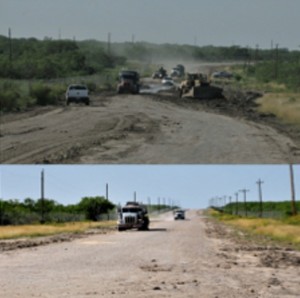
Eagle Ford Roadways Used for Criminal

An appeals court in San Antonio has ruled that Eagle Ford county officials will be able to maintain control of local roads.

Related: Eagle Ford Counties Win Royalties

In 2012, LaSalle County landowner Philip Hindes declared a stretch of dirt road his private property and granted exclusive passage to EOG, who was drilling on his land. This sparked a heated and bitter dispute as other local residents claimed Hindes did not have authority to restrict access, let alone posting guards to ensure compliance.

After a neighbor filed suit demanding access to the road, county commissioners got involved in order to make sure that their jurisdiction over  hundreds of miles of roadway in the Eagle Ford would not be compromised.  Even though commissioners declared they had a public interest in the road, Hindes obtained a temporary court order and continued to block vehicles. The litigation escalated as residents asked the courts to finally declare the road public under state law.

Local resident, Frank Plocek, 69 told FuelFix, "The oil boom has created a lot of headaches. It all comes down to money. Greed and money. I've seen a bunch of them around here that used to be friends that aren't friends anymore because of the greed and the money."

The appellate ruling issued last week, upholds the county’s right to consider the request to open the road.

Texas Counties Dominate Job Growth

Mineral Owners May be Losing Money
Top Oil and Gas Economies

Texas has both highs and lows for oil and gas economies for 2014.

Related:Low Oil Prices and the Texas Economy

Headlight Data released a report based on 2014 data from the Bureau of Labor Statistics that shares a peek into the labor market just before it headed into the oil price crash. Job creation in the Oil, Gas & Mining sector has been strong in the U.S. growing 31% over the past five years and adding 200,000 new jobs to the national economy. The sector currently employs 842,000 people in the US.

The report shows that, out of more than 1,100 counties across the U.S., Texas held top spots for both job creation and job losses. In 2014, there were 3,200 jobs created in Midland County, TX and 1,100 jobs lost in Harris County. Overall, Texas had five of the top 10 spots: Midland County, Bexar County, Frio County, Ector County, and Tarrant County.

The Eagle Ford’s Frio County came in at the fifth spot and boasts an impressive growth of 1,100 new  oil and gas jobs with a small population of 18,500 people.

The “largest oil, gas & mining job losses occurred across many parts of the US, for varying reasons. Large job losses in Harris County-TX (Houston), Collin County-TX (north Dallas), and Pinal County-AZ (Phoenix) are due to the loss of energy headquarters jobs, possibly to other parts of the metro. Elko County-NV’s job losses are in gold mining, and Charleston-WV’s job losses are in coal mining.

Top 10 Counties: Most oil, gas and mining jobs created  in 2014:

  1. Midland County (Midland, Texas): 3,169
  2. Weld County (Greely, Colo.): 2,367
  3. Williams County (Williston, N.D.): 1,807
  4. Bexar County (San Antonio): 1,416
  5. Frio County (Pearsall): 1,067
  6. Ector County (Odessa): 1,064
  7. Tarrant County (Fort Worth): 908
  8. Denver County (Denver): 893
  9. Lea County (Hobbs, N.M.): 785

Bottom 10 Counties: Most oil, gas and mining jobs lost in 2014:

  1. Harris County (Houston): -1,115
  2. Elko County (Elko, Nev.): -744
  3. Collin County (McKinney, Texas): -584
  4. Boone County (Charleston, W.V.): -551
  5. Pinal County (Phoenix, Ariz.) -535
  6. St. Martin Parish (Lafayette, La.): -459
  7. Salt Lake County (Salt Lake City): -451
  8. Mingo County (Williamson, W.Va.): -444
  9. Contra Costa County (San Francisco): -439
  10. Hopkins County (Madisonville, Ky.): -376

Eagle Ford Loses More Rigs

NOAA Studies Eagle Ford Emissions
Eagle Ford Rigs

The Eagle Ford Shale rig count fell this week to 110 rigs running across our coverage area by midday Friday.

In recent Eagle Ford news, oil production in the region increased slightly during July. After production fell in May by 50,000 barrels per day, it increased a slighttly from June to July by 10,000 barrels a day. Average production throughout the region was 1.6 million b/d, about 17% higher than July 2014.

Read more: Eagle Ford Production up 1%

The U.S. rig count decreased by eight, ending with 877 rigs running by midday Friday.  A total of 202 rigs were targeting natural gas (nine less than the previous week) and 675 were targeting oil in the U.S. (one more than the previous week). The remainder were drilling service wells (e.g. disposal wells, injection wells, etc.)383 of the rigs active in the U.S. were running in Texas.

Baker Hughes reports its own Eagle Ford Rig Count that covers the 14 core counties. The rig count published on EagleFordShale.com includes a 30 county area impacted by Eagle Ford development. A full list of the counties included can be found in the table near the bottom of this article.

Eagle Ford Oil & Gas Rigs

Natural gas rigs in the Eagle Ford decreased again to 15 this week as natural gas prices traded at $2.71/mmbtu, a $.03 increase from the previous week.

The oil rig count was at 95 as WTI oil prices rose to $44.99, an increase of $4.54. A total of 101 rigs are drilling horizontal wells, one is drilling directional wells, and eight are vertical rigs. Karnes County continues to lead development this week running 19 rigs, with DeWitt (18), following closely behind. See the full list below in the Eagle Ford Shale Drilling by County below.

Eagle Ford Shale Drilling by Count

Eagle Ford Shale News

Will Re-Fracking Save the Eagle Ford?

Mexico Oil Swap Not Significant

NextEra Energy Moves into the Eagle Ford

What is the Rig Count?

The Eagle Ford Shale Rig Count is an index of the total number of oil & gas drilling rigs running across a 30 county area in South Texas. The South Texas rigs referred to in this article are for ALL drilling reported by Baker Hughes and not solely wells targeting the Eagle Ford formation. All land rigs and onshore rig data shown here are based upon industry estimates provided by the Baker Hughes Rig Count.

Read more at bakerhughes.com