Eagle Ford Rig Count at 88

Eagle Ford Rig Count
Eagle Ford Rig Counts

The Eagle Ford Shale rig count increased by one this week ending with 88 rigs running across our coverage area by midday Friday.

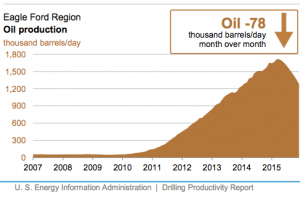
In recent Eagle Ford news, the U.S. Energy Information Administration (EIA) released the latest drilling productivity report showing production across the shale basins continues to decline with the Eagle Ford taking a big hit.

Read more: EIA: Eagle Ford Production Plummeting

A total of 757 oil and gas rigs were running across the United States this week. 193 were targeting natural gas (the same as the previous week) and 564 were targeting oil in the U.S. (10 less than the previous week). The remainder were drilling service wells (e.g. disposal wells, injection wells, etc.)342 of the rigs active in the U.S. were running in Texas.

Baker Hughes reports its own Eagle Ford Rig Count that covers the 14 core counties. The rig count published on EagleFordShale.com includes a 30 county area impacted by Eagle Ford development. A full list of the counties included can be found in the table below.

Eagle Ford Oil & Gas Rigs

Natural gas rigs in the Eagle Ford are at 13 this week as natural gas prices fell slightly, trading at $2.17/mmbtu, a $.19 decrease from the previous week.

The Eagle Ford oil rig count is to 75 with WTI oil prices ending the week at $42.11, an increase of $1.37. A total of 81 rigs are drilling horizontal wells, two are drilling directional wells, and five are vertical rigs. Karnes County leads the region in development with 20 rigs this week. See the full list below in the Eagle Ford Shale Drilling by County below.

Eagle Ford Shale Drilling by County

Eagle Ford Shale News

Marathon Oil Shifts Focus to U.S. Shale

Atlas Shifting all Activity to Eagle Ford

UTSA: Eagle Ford Counties Must Diversify

Carrizo Plans Eagle Ford Acquisitions

What is the Rig Count?

The Eagle Ford Shale Rig Count is an index of the total number of oil & gas drilling rigs running across a 30 county area in South Texas. The South Texas rigs referred to in this article are for ALL drilling reported by Baker Hughes and not solely wells targeting the Eagle Ford formation. All land rigs and onshore rig data shown here are based upon industry estimates provided by the Baker Hughes Rig Count.

Read more at bakerhughes.com

Carrizo Plans Eagle Ford Acquisitions

Chesapeake Released 2015 Q1
Carrizo Q3 2015

Carrizo Oil and Gas released third quarter earnings that included plans to jump on new opportunities in the Eagle Ford.

Related:Eagle Ford Shale Drives Carrizo's Q1

During the third quarter of 2015, Carrizo reported a net loss of $708 million. They also achieved record oil production of23,573 Bbls/d, 18% above the third quarter of 2014.

Carrizo's executives are quick to credit the company's Eagle Ford operations for the strong production growth. In an earnings call earlier this month, the CEO revealed that they are looking around for additional opportunities to acquire more Eagle Ford assets

Well, we’re opportunistic about Eagle Ford acreage in our area. The economics of buying that acreage and then drilling on it is the most profitable thing we have in the company right now. We’ve never paid big prices to buy acreage in the Eagle Ford. So we’ve never gone to the $30,000 or $40,000 per acre as some of the prices in DeWitt, Karnes areas have gone to. So we’re offering sometimes $1 or $2 a barrel essentially for PUDs when we make Eagle Ford acquisitions.
— Sylvester P. Johnson - President, Chief Executive Officer & Director

Eagle Ford highlights:

  • Cost reduction initiatives, including the saltwater disposal system in the Eagle Ford that has substantially reduced the amount of water being trucked to disposal sites
  • Drilling and completion capital expenditures for the quarter were $122 million, over 85% of which was in the Eagle Ford
  • Producing from 250 gross or 219 net wells with two drilling rigs running and one 24/7 frac crew
  • 25 gross or 23.2 net operated Eagle Ford wells waiting on completion, equating to net crude oil production potential of approximately 8,700 barrels per day

For more information go to carrizo.com

UTSA: Eagle Ford Counties Must Diversify

Poverty Rates in Eagle Ford

Eagle Ford Shale counties must diversify to stay afloat, advises new university study.

Related: Eagle Ford Town Thrives Despite Oil Crisis

Over the last year, the decline in oil prices has caused a wave of bankruptcies, restructuring and budget cuts for oil and gas producers and the industries that serve them. Also at risk are the smaller counties and communities in the Eagle Ford.

The UTSA Institute for Economic Development works to foster economic development in south Texas and with the current downturn their services are needed more than ever. The agency recently published a new study in the The Journal of Regional Analysis & Policy outlining their their concern over how smaller Eagle Ford counties may fair long term due to the oil crisis.

Research director, Thomas Tunstall says “There may be 1,000 or more ghost towns in Texas. We have to figure out a way to keep the communities that are still here viable.”

Tunstall concluded that communities that avoided immediately spending their newfound oil and gas wealth are doing better than those who did not, and that those that diversified are doing best of all. The study goes on to say that good local governance and thoughtful long-term planning are the keys to future health.

Examples of cities getting it right include Gonzales, Karnes City and Pleasanton, the latter of which boasts:

  • Sales tax increases of 3.64%
  • A new building program for the Pleasanton Independent School District
  • The city is expanding water service out to Interstate 37
  • An extension plan for the Pleasanton Municipal Airport runway from 4,000 to 5,002 feet.
  • A new well-designed Pleasanton Civic Center
  • H-E-B has completed a new store
  • Atascosa Health Center is completing its new building
  • Plans to build a new fire station with EMS facilities and AirLIFE for 24/7 operations

Read more at iedtexas.org

Atlas Shifting all Activity to Eagle Ford

Chesapeake Released 2015 Q1
Noble Q3 2015

Atlas Resource Partners counts its Eagle Ford assets as bright spot in the company's portfolio.

Related: Atlas Resource Partners Enter Eagle Ford - $225 Million Deal

After reporting a net loss of $560.9 million for the third quarter of 2015, Atlas is focused on positioning the company to withstand the current markets. Central to this strategy is shifting all development activity entirely to the Eagle Ford.

Our sole focus in development activity is in the Eagle Ford shale where we have a substantial position. The economics there remain very attractive on a heads-up basis, and even more attractive to us through our investment partnership business.
— Daniel Herz - Chief Executive Officer

Eagle Ford Highlights

During the third quarter, Atlas drilled and completed its first three Eagle Ford wells. Those wells are producing an average of 3,573 barrels of oil per day, and an average of 313,000 cubic feet of natural gas per day. The company has over $400 million worth of drilling inventory in the Eagle Ford at current cost of drilling.

Atlas Resource Partners is a relative newcomer to the Eagle Ford, entering the region in November 2014. The company's current Eagle Ford activity includes 22 producing wells in Atascosa County and 19 undeveloped locations.

Read more at atlasresourcepartners.com

EIA: Eagle Ford Production Plummeting

EIA: Monthly Productivity Report

Oil production in the Eagle Ford is plummeting, according to new data.

Related: OPEC's Plan to Squeeze out U.S. Shale: Is it Working?

The U.S. Energy Information Administration (EIA) released the latest drilling productivity report showing production across the shale basins continues to decline with the Eagle Ford taking a big hit.

The agency estimates that the Eagle Ford will lose 78,000 barrels of production in the month of December. The decline has been a trend since the numbers peaked in April.

Related: U.S. Oil Production Has Peaked