Texas Severance Taxes Fall ~49%

Texas Severance Tax Declines

Texas joins other energy states to see a hefty decline in mineral severance taxes, according to the EIA.

Related: Eagle Ford Shale Year in Review 2015

The Energy Information Administration released a report yesterday that showed the tax consequences of the months of falling crude prices. States assess severance taxes on companies that remove nonrenewable resources like crude oil, natural gas, and coal and when less is taken from the ground, there is less to tax.

Learn more about oil severance taxes by state

The comptroller of Texas reports that as of November 2015, revenues from the oil and gas industry have declined significantly over the previous year. These decreases include:

  • Natural gas production tax -48.14%
  • Oil production tax -48.91%
Lower fossil fuel prices, and in some cases, lower production, have led to lower severance tax receipts than were expected when revenue estimates were developed.
— Robert McManmon and Grant Nülle, Energy Information Administration (EIA).

The good news is that the Texas economy is more diversified than it has been during previous downturns. This means that severance taxes make up a lower percent the total state tax receipts (11% in 2014), so there will likely not be a need to make drastic changes to the 2016 budget.

Other states that are feeling the pinch include Alaska, North Dakota, Oklahoma, West Virginia and Wyoming. These states get most of their tax revenues from their energy sectors with severance taxes ranging from 40% to even as high as 75% of a state’s overall tax receipts.

Read more at texastransparency.org

Eagle Ford Headed for Big Losses

Texas Job Growth Slows
Will Tax Revenues Fall For Texas Schools?

Analysts are predicting that the Eagle Ford will lead the pack for huge losses in early 2016.

Related: Eagle Ford Shale Year in Review 2015

New numbers released by the U.S. Energy Information Administration (EIA) indicate that volumes from the seven major shale regions in the U.S. will drop by 116,000 barrels a day in February. That’s more oil than OPEC's Ecuador or Libya produced last year on average.

The Eagle Ford Shale Play is predicted to take the biggest hit of all the shale plays and is expected to drop 72,000 barrels a day to 1.15 million, according to the EIA. The Bakken in North Dakota losing 24,000 barrels to 1.1 million.

The current rate of decline in the Eagle Ford is hovering between upper 6% and nearly 12% per month (72% to 144% per year).

The devastation of shale industry is making news. In the video clip below, CNBC reports that more than half of U.S. shale oil producers could go bankrupt before the crude market reaches equilibrium.

Daniel Jones, an investment manager at Avaring Capital Advisors, LLC, says that his research suggests the output could fall by as much as 1 million barrels per day in the Eagle Ford this year.

Right now, many investors seem to be bearish regarding oil but I have a hard time understanding why. Yes, we do have a large global oil glut (though it’s small as a percent of overall inventories) but production should continue declining throughout most regions during 2016 if prices don’t rise materially. The key player in determining how much we produce over the next 12 months is, undeniably, the Eagle Ford but even fairly conservative assumptions seem to indicate that production will likely drop much lower than where it is today. If that’s not bullish, I don’t know what is.

ZaZA Energy Directors Resign

Chesapeake Cuts Budget for 2015
Za ZA Energy Loses Directors

Eagle Ford Operator, ZaZa Energy loses top leadership, according to a recent SEC filing.

Related: Swift Files Chapter 11

On January 8th, ZaZa filed a report with the Securities and Exchange Commission to notify the agency that six of the company's directors, including CEO Todd Brooks have turned in their resignation. Others who resigned included Herbert Williamson IV, Travis H. Burris, A. Haag Sherman, Gaston Kearby andJohn Hearn.

The report claims the company has been unable to pay the directors in more than a year due "deteriorating economic conditions" in the wake of the 2014-15 oil price decline. The company reported that it owes ~$14 million in unpaid compensation to its former employees and directors.

The company has been in trouble for awhile and has not issued financial reports on its website since 2013. In November the Mergers & Acquisitions News listed ZaZa Energy as one of the most distressed energy company in Texas.

Over the course of late 2014 and 2015, the Company retained a number of financial advisors to undertake a full strategic review of the Company and to assist it with refinancing its debt, restructuring its balance sheet, and/or entering into a strategic transaction. Despite extensive marketing efforts, the Company’s financial advisors were unable to identify any counterparty willing to engage in such a transaction in the low commodity price environment.
— ZaZA

Eagle Ford Rig Count Drops to 81

Eagle Ford Rig Count
Eagle Ford Rig Counts

The Eagle Ford Shale rig count declined by six this week with 81 rigs running across our coverage area by midday Friday.

In recent Eagle Ford news, congress' action to lift the oil export ban is indeed wonderful news for the Eagle Ford, evidenced by the companies who have moved quickly to get their product out the door.

Read more:First Eagle Ford Crude Ships to Europe

A total of 664 oil and gas rigs were running across the United States this week. 148 were targeting natural gas (14 less than the previous week) and 516 were targeting oil in the U.S. (20 less than the previous week). The remainder were drilling service wells (e.g. disposal wells, injection wells, etc.)308 of the rigs active in the U.S. were running in Texas.

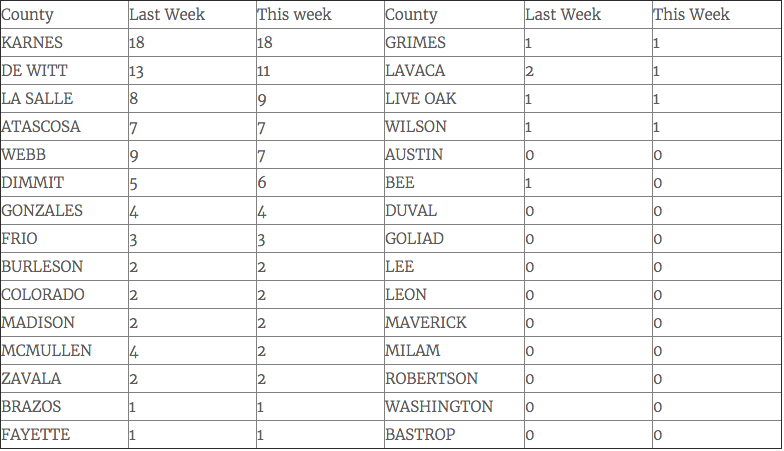
Baker Hughes reports its own Eagle Ford Rig Count that covers the 14 core counties. The rig count published on EagleFordShale.com includes a 30 county area impacted by Eagle Ford development. A full list of the counties included can be found in the table below.

Eagle Ford Oil & Gas Rigs

Natural gas rigs in the Eagle Ford are at seven this week as natural gas prices rose slightly, trading at $2.47/mmbtu, a $.14 increase from the previous week.

The Eagle Ford oil rig count fell to 74 with WTI oil prices ending the week at $33.16, a decrease of $4.41. A total of 74 rigs are drilling horizontal wells, one are drilling directional wells, and six are vertical rigs. Karnes County leads the region in development with 18 rigs this week. See the full list below in the Eagle Ford Shale Drilling by County below.

Eagle Ford Shale Drilling by County

Eagle Ford Shale News

Baytex Energy to Focus on Eagle Ford in 2016

Swift Energy Files Chapter 11

Eagle Ford Shale Year in Review 2015

What is the Rig Count?

The Eagle Ford Shale Rig Count is an index of the total number of oil & gas drilling rigs running across a 30 county area in South Texas. The South Texas rigs referred to in this article are for ALL drilling reported by Baker Hughes and not solely wells targeting the Eagle Ford formation. All land rigs and onshore rig data shown here are based upon industry estimates provided by the Baker Hughes Rig Count.

Read more at bakerhughes.com

Baytex Energy to Focus on Eagle Ford in 2016

Chesapeake Released 2015 Q1
Baytex 2016 Eagle Ford

Baytex Energy announces 2016 spending plans that focus heavily on the Eagle Ford Shale.

Related: Baytex Energy Tackles Eagle Ford Debt with Bakken Sale

In a press release last month, Calgary-based Baytex announced its planned 2016 capex, which includes directing approximately 80% to 90% of its budget to the company's Eagle Ford operations,

Baytex' Board of Directors approved a 2016 capital budget of $325 to $400 million to be heavily weighted to drilling and completion activities (approximately 83%) with the balance for facilities and pipelines (approximately 15%) and land and seismic (approximately 2%). The goal is to generate an average annual production of 74,000 to 78,000 boe/d.

Eagle Ford Highlights for 2016

  • EFS represents the highest individual well economics and highest netbacks in the company's portfolio.
  • Company plans for four to six rigs running throughout the year
  • Will continue to advance the multi-zone potential of the Sugarkane acreage with individual pads targeting up to three zones in the Eagle Ford formation plus overlying Austin Chalk formation
  • Will bring approximately 35 to 40 net wells on production in 2016

Learn more about Baytex in the Eagle Ford

We have structured our 2016 capital budget to ensure maximum flexibility with respect to both the timing and level of spend. In the first half of 2016, our budget will emphasize our highest rate of return and highest netback projects in the Eagle Ford.
— James Bowzer, President and CEO

Read more at Baytex Energy.com