Tax Breaks for Low Producing Wells

Severance Tax Breaks for  Stripper Wells
Severance Tax Breaks for Stripper Wells

The prolonged downturn means tax breaks for some producers.

Related: Eagle Ford School Districts Give Back Millions

In 2005, Texas lawmakers created a tax credit to bring relief to oil producers with low-producing wells. The tax break was set to trigger when oil prices dropped below a certain levels, a move designed to keep marginal wells in production during hard times.

Those hard times are now here and in February, the Texas Comptroller announced that low crude prices have triggered a 50% severance tax exemption on these 'stripper wells.

The Texas Tax Code classifies a ‘qualifying low-producing oil lease’ as an oil well that is part of a lease whose production during a 90-day period is less than 15 barrels of oil per day of production or five percent recoverable oil per barrel of produced water.

The amount of severance tax credit for qualified wells is tied to oil prices:

  • 25% credit: average taxable oil price were above $25 per barrel but not more than $30
  • 50% credit: if the price were above $22 per barrel but not more than $25.
  • 100% credit: tax credit if the price were $22 or less

Currently in Texas, the severance tax for oil production is 4.6% of the oil's market value. According to the Texas Comptroller’s Office, the state took in nearly $2.9 billion in oil production taxes in 2015, down 25.% from 2014.

well exemptions
well exemptions

Texas Oil & Gas Permits Drop

Eagle Ford Shale March 2016

Well permits and completions across Texas are at about 50% less than this time last year, according to the Texas Railroad Commission.

Related: Eagle Ford Counties Lead Production

Since the beginning of the year, the Texas Railroad Commission (RRC) has issued 1,594 permits for wells throughout Texas. This is in contrast to the 2,949 issued between January and March of 2015. For March alone, the agency issued a total of 511 original drilling permits that included 129 oil, 30 gas, 312 oil or gas, 30 injection and 10 other. This was a drop from 923 in March 2015.

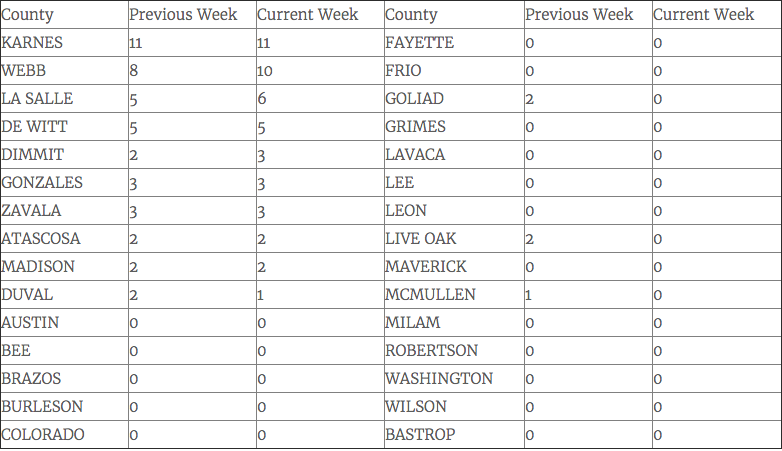
The Eagle Ford Shale rig count increased by one last week ending at 48 rigs running across our coverage area by midday Friday with Karnes County topping the list with 11 rigs.

2016-04-11_1553
2016-04-11_1553

Total well completions for 2016 year to date are 3,452 down from 5,946 recorded during the same period in 2015.

Read more at rrc.tx.gov

Texas Rig Count Falls Below 200

Eagle Ford Rig Count
Eagle Ford Rig Counts

The Eagle Ford Shale rig count decreased by two, ending the week with 46 rigs running across our coverage area by midday Friday.

In recent Eagle Ford news, NASA released new images that show the growth of the region and the total transformation of the landscape over the past few years.

Read more: The View of Eagle Ford Shale from Space

A total of 443 oil and gas rigs were running across the United States this week, which is a drop of seven over last week. 89 were targeting natural gas (one more than the previous week) and 354 were targeting oil in the U.S. (eight less than the previous week). The remainder were drilling service wells (e.g. disposal wells, injection wells, etc.)197 of the rigs active in the U.S. were running in Texas.

Baker Hughes reports its own Eagle Ford Rig Count that covers the 14 core counties. The rig count published on EagleFordShale.com includes a 30 county area impacted by Eagle Ford development. A full list of the counties included can be found in the table below.

Eagle Ford Oil & Gas Rigs

Natural gas rigs increased in the Eagle Ford fell to five this week as natural gas prices remained flat, trading at $1.99/mmbtu.

The Eagle Ford saw an increase in running oil rigs up this week to 41 with WTI oil prices remaining steady and ending the week at $36.79. A total of 43 rigs are drilling horizontal wells, zero are drilling directional wells, and three are vertical rigs.

Karnes County continues to lead the region in development with 11 running rigs. See the full list below in the Eagle Ford Shale Drilling by County below.

Eagle Ford Shale Drilling by County

Eagle Ford Shale News

Texas on Short List for Fracking-Induced Earthquakes

Fracking Facts: Is Our Water Supply at Risk?

Fracking Rules Tightened in North Texas

Eagle Ford Shale: the View from Space

What is the Rig Count?

The Eagle Ford Shale Rig Count is an index of the total number of oil & gas drilling rigs running across a 30 county area in South Texas. The South Texas rigs referred to in this article are for ALL drilling reported by Baker Hughes and not solely wells targeting the Eagle Ford formation. All land rigs and onshore rig data shown here are based upon industry estimates provided by the Baker Hughes Rig Count.

Read more at bakerhughes.com

Texas on Short List for Fracking-Induced Earthquakes

4.0 Quake Hits North Texas
New Maps Plot Texas Earthquake Risk

New maps outline the threat of potential human-induced earthquakes in Texas.

Related: Fracking Rules Tightened in North Texas

Until a few short years ago, earthquakes in Texas were virtually non-existent. But since 2008 there has been an increase in seismic activity, leaving many to wonder whether they are a direct result of oil and gas activity in the region.

The U.S. Geological Survey (USGS) is adding more fuel to the debate with a recently released forecast for 2016 that include maps identifying potential seismic events from both human-induced and natural earthquakes.

This is the first time that these maps have added the human-induced competent, with wastewater disposal from fracking considered to be the primary cause.

By including human-induced events, our assessment of earthquake hazards has significantly increased in parts of the U.S.,” said Mark Petersen, Chief of the USGS National Seismic Hazard Mapping Project. “This research also shows that much more of the nation faces a significant chance of having damaging earthquakes over the next year, whether natural or human-induced.

The maps show that the most significant hazards from induced seismicity are in Oklahoma, Kansas, Texas, Colorado, New Mexico and Arkansas. The Eagle Ford shows a less than 1% chance of any type of seismic activity, either manmade or natural.

Last year, SMU released a study that concluded oil and gas operations are causing the tremors that began rattling the North Texas towns of Azle and Reno. and, just last week, the U.S. Army Corp of Engineers tightened fracking regulations near a North Texas Dam over concerns that the dam might be in danger.

Even under a mountain of evidence, the Texas Railroad Commission continues to be skeptical of the link between fracking and earthquakes and has publicly questioned the mounting scientific evidence of the link.

Read more at usgs.gov

Fracking Facts: Is Our Water Supply at Risk?

Fracking Conserves Water

In the debate against fracking and its impacts on the environment, there have been many concerns raised about the amount of water used in the fracking process and the potential danger to the depletion of our nation’s water supply.

Related: Fracking Facts: Cleaner Than Coal

But...is fracking actually using more water than the production of other energy sources?

Fracking vs. Other Conventional Extraction Methods

Before a power supply  can be processed for energy use, it has to be mined or extracted from the earth. Every type of conventional energy source uses water in its extraction method, with fracking using less than the others.

  • Coal: According the Department of Energy, mining coal takes a minimum 230 trillion gallons of water a year.
  • Fracking Oil and Gas: In comparison to coal, between 2009-2014, only 240 billion gallons of water were used in fracking operations across the country.
  • One example is that electric generation in Pennsylvania's Susquehanna River Basin uses nearly 150 million gallons a day in the, while the projected total demand for peak Marcellus Shale activity in the same area is 8.4 million gallons per day.

Setting up a fracking well can take up to two times the amount of water than a conventional oil well, but research shows that fracked wells produce significantly less waste, making it a better alternative for the environment, especially over the lifetime of the well.

All together, the amount of water used in fracking is estimated to be at .87% of the total industrial water used and .04% of the total freshwater in the United States (Duke University). The area of the United States that consumes the most water in it’s active shale plays is Texas, however a recent study done by the University of Texas states, “ hydraulic fracturing is actually helping to shield Texas from water shortages because it is allowing the state to move away from using more water intensive energy resources.”

The Processing of Natural Gas vs. Other Energy Sources

After extracting the resource, it has to be refined and turned into electricity, and again the use of natural gas (as a direct result of fracking) uses significantly less water than other sources. The following table shows the amount of water used to generate electricity from the top three current energy sources:

fracking water
fracking water

Environmentalists are quick to point to the superior choice of solar or thermal energy, but it is unlikely that those sources will ever be able to provide enough energy to quench our national thirst. Natural gas, acquired through fracking,  is quickly rising to the top of the playing field as an environmentally safe and economical alternative to less desirable sources.

From a 2015 study done by Stanford University, “Fracking’s impact on both climate change and local air pollution is similar to its impact on water...Unconventional energy generates income and, done well, can reduce air pollution and even water use compared with other fossil fuels.