Birthday of 2014 Oil Crash

Crude Price History
Crude Price History

This week marks the birth of the 2014 oil crash and a closer look suggests that things aren't as bad as some predicted.

What started as a slow decline in June 2014 accelerated into a full-blown crash throughout the fall. When prices finally bottomed out in March, they had dropped by more than half from over $105.00 to $48.00.

By last December, uncertainty fueled the news machines and cries of doom became commonplace. Some analysts predicted possible economic ruin for oil-dependent states and others warned of the crippling of the industry.

But many seasoned oilmen saw the downturn as a wake up call of sorts and an opportunity for producers to take a hard look at their systems, processes, personnel, technology and strategies outside of the frenetic pace the boom required.

Read more:  Oil Bust Brings Opportunities

Cutting Costs: Over the last few month, producers have been forced to tighten their budgets and change their strategies in order to stay competitive. These tactics have worked well and first quarter results show many companies have been able to stay the course and gain strength by slashing costs associated with drilling through greater efficiencies and supplier reductions.

  • Sanchez reported Q1 costs at 30 to 40% below fourth quarter 2014
  • Matador reduced operating costs 30% to 40% for Q1
  • Continental’s drilling and completion costs fell by 15%
  • EOG announced it has benefitted greatly from the pull-back in activity and progress is being made to lowering cost in each phase of their operations

Innovation: Cutting edge producers are pushing the science and technology to new levels as they work to get the most out of their resources. These include advancements in 3-D seismic research, telemetry, remote guidance and innovations in  CO2 or nitrogen-style completions.

Oil production is becoming a modern manufacturing process. The frackers are engaged in ‘just-in-time’ production, analogous to the methods pioneered by Japanese manufacturers in the 1970s and 1980s, which led directly to hyper-efficient global supply-chain management perfected by Wal-Mart in the 1990s.
— Wall Street Journal

Economic Impact: Thousands of jobs have been cut across all sectors of the industry, but both Texas and North Dakota report that the oil crisis has had minimal impact on their states. Data shows that Texas dipped in the first quarter but is already showing signs of a rebound and the North Dakota Department of Commerce boasts that the ND economy is still booming.

Dropping Rig Counts: The national and regional rig counts took a big hit this year as producers pulled rigs offline to save money. Many report that these wells are waiting in the wings and are ready to be put back into production later this year.

Record Production: Even in light of the price drop, production over the last 12 months has been at record levels. The EIA data published this month shows that global petroleum oversupply has more than doubled to 2.6 million bpd since the end of the second quarter last year and they expect the oversupply to last at least until 2017.

Eagle Ford Natural Gas up 349%

Eagle Ford Natural Gas May 2015 | click to enlarge

The Energy Information Administration reported last week that Eagle Ford Shale gas production increased by 349% in the past eight years, even as rig counts plummeted.

Related: Eagle Ford Shale Midstream Sold

In May 2007, the region was producing 1.63 Bcf per day with less than 100 rigs, and one year ago 260 drilling rigs were producing around 6.2 Bcf per day. In May 2015, the region produced a record 7.33 Bcf per day while running about 120 rigs.

At the start of 2014, the Eagle Ford was producing less gas than either the Barnett or the Haynesville. However, as of June 2015, Wood Mackenzie estimates that the Eagle Ford is producing approximately 5.2 bcfd of gas, which is 34% more than the Barnett and 15% more than the Haynesville.

For the first time in many months, Webb County has taken over Texas top gas production spot for the month of March, producing 55,645,145 MCF compared to Tarrant County’s 53,003,565 MCF.

Eagle Ford is quickly gaining ranks as a major natural gas producer with companies such as Anadarko, Chesapeake, Swift and Rosetta growing production as they successfully reduced cycle times and maximize scale in the play.

Eagle Ford Rig Count at 115

NOAA Studies Eagle Ford Emissions
Eagle Ford Rig Count Increases

The Eagle Ford Shale rig count increased by one to 115 rigs running across our coverage area by midday Friday.

In recent Eagle Ford news, XTO and Enervest were summoned to Austin last week to try and persuade the Texas Railroad Commission that their operations are not to blame for recent earthquakes in North Dallas.

Read more: Producers Defend Fracking Practices

The U.S. rig count slowed its decline this week falling by two to 857 rigs running by midday Friday.  A total of 223 rigs were targeting natural gas (dtwo more than the previous week) and 631 were targeting oil in the U.S. (four less than the previous week). The remainder were drilling service wells (e.g. disposal wells, injection wells, etc.)363 of the rigs active in the U.S. were running in Texas.

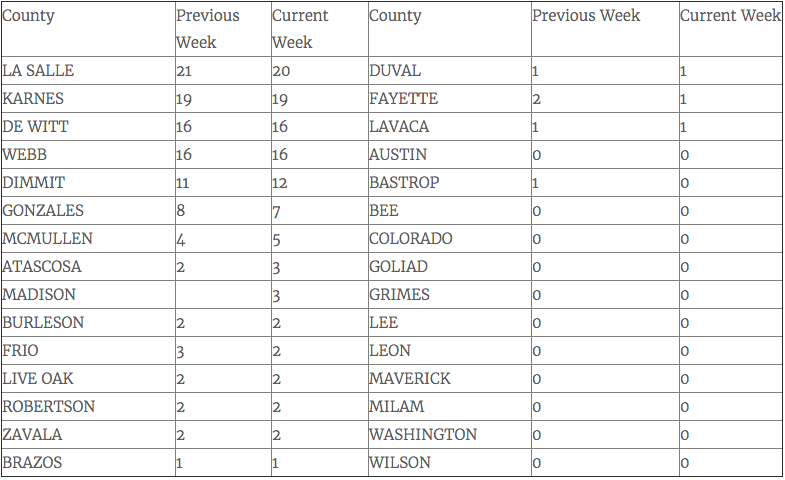
Baker Hughes reports its own Eagle Ford Rig Count that covers the 14 core counties. The rig count published on EagleFordShale.com includes a 30 county area impacted by Eagle Ford development. A full list of the counties included can be found in the table near the bottom of this article.

Eagle Ford Oil & Gas Rigs

Natural gas rigs in the Eagle Ford rose another four to 26 this week and natural gas prices traded at $2.82/mmbtu, an increase of $.06 from the previous week.

The oil rig count decreased by three to 89with WTI oil prices moving down this week to $59.61, an $.37 decrease. A total of 109 rigs are drilling horizontal wells, one rigs are drilling directional wells, and five are vertical rigs. LaSalle led the Eagle Ford count with 20 rigs, while Karnes (19), Webb (16) and DeWitt (16)following closely. See the full list below in the Eagle Ford Shale Drilling by County below.

Eagle Ford Shale Drilling by County

Eagle Ford Shale News

Pipeline Explodes in DeWitt County

EP Energy Expands Operations

Karnes County Explosion Proves Costly

What is the Rig Count?

The Eagle Ford Shale Rig Count is an index of the total number of oil & gas drilling rigs running across a 30 county area in South Texas. The South Texas rigs referred to in this article are for ALL drilling reported by Baker Hughes and not solely wells targeting the Eagle Ford formation. All land rigs and onshore rig data shown here are based upon industry estimates provided by the Baker Hughes Rig Count.

Read more at bakerhughes.com

Karnes County Explosion Proves Costly

Chesapeake Released 2015 Q1
Encan Corp Q1

Almost one month after a fiery oil rig explosion in Karnes county, Encana Corp released final figures to state regulators.

Encana Corp. reported that the accident released over 760,000 pounds of crude oil and possibly tens of thousands of pounds of gas and into the air. The company estimates that the crude was worth more than $197,000.

The county sheriff called the May 19th accident the ‘worst environmental disaster in more than 20 years’, leaving trees, fields, roads and houses covered in oil and displacing numerous families.

Related: Karnes County Accident Worst in 20 Years

The clean up has been a massive effort and has included subcontractors to control runoff, pump out nearby stock tanks, evaluate livestock, take soil samples, evaluate vegetation, clean homes and repair nearly half a mile of roadway on FM 792.

First quarter results for Encana show improved production and lower costs for its Eagle Ford operations. Highlights include:

  • Drilled its fastest three wells to date and reduced normalized drilling costs by 15%
  • Reduced drilling and completion costs by $1 million per well
  • Promising early results from new wells in an area known as the Graben
  • Base optimization efforts reduced decline rates by 50%
  • 27 net wells were drilled
  • Liquids production averaged 36,000 bbls/d

Read more at encana.com

EP Energy Expands Operations

Chesapeake Released 2015 Q1
EP Energy Expands in Texas

Houston -based EP Energy plans to expand its presence in the Eagle Ford by adding new training, office and warehouse space to its operations in Dilley.

Related: Penn Virginia Invests in the Eagle Ford

EP Energy currently holds over 91,000 acres in the Eagle Ford with activity in La Salle and Atascosa counties. In addition to adding 8,300 square feet of work, the $1.3 million construction project will likely add new jobs to the area.

The company reported strong first quarter results for its Eagle Ford operations and touted improved well performance and significantly lowering well costs. Additionally, about two-thirds of the Q1 capital was allocated to the Eagle Ford program.

We also continue to see execution improvements. We have reduced our average drilling cycle times from 10 days to 9 days and this is in an asset that we have been drilling in for over five years. Our 40-acre development is driving cost efficiencies, due to the use of three and four well pads. Importantly this development is improving our reserve recoveries per section which results in improved returns from our capital program.
— Clay Carrell - COO

Q1 Highlights for Eagle Ford:

  • Completed 38 wells across its Eagle Ford program
  • Grew oil production to 38.0 MBbls/d, a 20 percent increase compared with the same period in 2014
  • Total equivalent production was 54.7 MBoe/d, an 18 percent increase compared with the same period in 2014
  • Reducing the midpoint of our per unit cost ranges by over 5%
  • Reduced the average drilling cycle times from 10 days to 9 days