
H2S, Labor & Pipeline Shortages, Higher Service Costs Headline 2011

Eagle Ford Shale oil & gas was the talk of the town in San Antonio today. The oil and gas conference goes through tomorrow and will continue with both operators and service providers presenting. For everyone who wasn't able to attend, here are a few things we're hearing around the conference:

  • H2S is a much bigger issue than reported in early Eagle Ford wells. No one was able to describe why, but wells are producing various amounts of H2S throughout the play. H2S can be treated, but wells aren't consistent either. In some cases, adjacent leases are producing vastly different amounts of the corrosive gas
  • A lot of liquids are being produced, but we don't have enough pipelines to move the crude effectively. That will change over the next few years, but we'll experience a period of larger price differentials before it corrects itself
  • Higher service costs have hit the operators hard in 2011. We've heard examples of well costs going up 50%+ year over year. A lot of it is service costs inflation, but a lot of it is longer laterals, larger completions, and wide spread use of more expensive proppants
  • The labor shortage is a big issue. I won't guess a number, but there would be a lot more rigs active if there were people to provide all of the needed services
  • If you've missed it, there's also a housing shortage across South Texas. As you move closer to the border, we've heard companies might build large scale man camps and move to a two weeks on, two weeks off schedule

Alice TX - No Drilling, But Still a Boom Time

Alice Texas doesn't sit in the fairway of the Eagle Ford Shale, but it sure seems to be benefiting. A $6 million sales tax surplus was realized over the past year. The city budgeted income of $650,000 per month and only one month came in under $1,000,000. Weatherford, whose office had shrunk over several years, has grown from 27 to over 300 employees in three short years. An Alice based frack sand company, SandPro, has over 400 employees in the state. For reference, Alice's population is somewhere around 20,000. Companies with hundreds of employees make a big impact.

While not in the middle of development, the city is positioned centrally from east to west and the existing presence of the oil industry before the Eagle Ford boom, makes it an easy location for distribution and offices. 

SandPro trucking started two years ago with three trucks hauling sand to the oil field, and four employees; today it has 350 trucks and more than 400 employees around the state.

SandPro and other companies that have brought jobs, money and people to Alice since 2009 illustrate the remarkable ripple effect of the drilling frenzy on towns not directly over the Eagle Ford Shale. The closest producing Eagle Ford well is about 40 miles away, according to a Texas Railroad Commission map.

You wouldn't know it judging by the city's sales taxes. For the fiscal year ending Sept. 30, Alice budgeted $650,000 a month in sales tax revenue. Only one month came in under $1 million, giving the city a $6 million surplus, City Manager Ray De Los Santos said.


Gate Keepers Make $300 Per Day And Rentals Are Full

In the oilfield, you could make $75,000 just watching the gate. A retired teacher now makes anywhere from $100 to $300 per day logging trucks coming in and out of an oil & gas lease in South Texas. 100's of job openings are creating opportunity for residents across the region. Three Rivers' population of 2,400 wasn't quite ready for the boom. Rentals are scarce and you can almost forget about buying a home. There aren't any on the market. 

But workers do, in shifts, and there aren't enough houses, hotel rooms or apartments to hold them all. Rooms at small, independently owned motels that a year ago went for $50 are now renting for $100 to $150 a night, about the same as the Omni Bayfront in Corpus Christi.

The Atria, a 42-unit hotel that opened in April, was full in its first week, manager C.J. Patel said. A similar hotel is under construction next door.

Landlords who once leased three-bedroom houses to locals for $500 a month are letting their leases run out, doubling or tripling rent, and leasing to oil field workers from San Antonio. Gas stations and restaurants have windows plastered with ads offering bedrooms for rent.

A friend of Sowell's placed a sign at the restaurant's cash register advertising RV rentals. Thirty minutes later, he called and begged Sowell to take it down.

"His phone hadn't stopped ringing," Sowell said. "He was tired of taking calls."

Read the entire news release at caller.com

Eagle Ford Shale Drilling Rig Count - October 7, 2011

drilling rig
Drilling Rig Photo

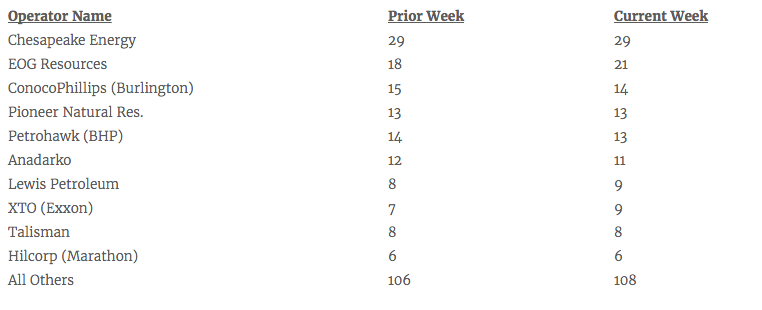
The Eagle Ford Shale drilling rig count jumped five to 241 active drilling rigs. That's higher than the Eagle Ford era record of 239 that we hit twice over the past two months. The number of natural gas rigs working increase six to 124, while losing one oil rig to fall to 117. Horizontal wells account for 210 of the 241 rigs drilling in the South Texas region. Webb and Gonzales counties saw the largest jumps in the week by adding three and four rigs, respectively. Several rigs moved around in the play, but no county lost more than two rigs during the week.

Chesapeake Energy (29) and EOG Resources (21) are the only operators with more than 20 rigs active in the play.  23 companies have more than two active drilling units.

Be sure to visit the site frequently next week as we'll provide more updates than normal, while attending the oil & gas conference in San Antonio on Tuesday (Oct 11) and Wednesday (Oct 12). You can also follow us on Twitter @EagleFord_Shale.

Eagle Ford News from the past week:

"Double" was the key term - Koch's staff in S. TX and Eagle Ford production are expected to double in 2011. Nothing short of biblical prophecy would have predicted a Beeville, TX, career fair would have 1,000 open jobs and 2,000 visitors seeking employment.

Stay tuned each week for an update on the South Texas rig count.

Drilling Rig Count by Operator

What is the Rig Count?

The Eagle Ford Shale Rig Count is an index of the total number of oil & gas drilling rigs running across a 30 county area in South Texas. The South Texas rigs referred to in this article are for ALL drilling reported by SmithBits and not solely wells targeting the Eagle Ford Shale. All land rigs and onshore rig data shown here are based upon industry estimates provided by the Baker Hughes Rig Count and/or Smith Service Co's (Schlumberger) Smith Rig Count.

Drilling Rigs by County

Gulf Coast Refineries Supported by Eagle Ford Crude

Gulf Coast refineries are increasing margins as they absorb more domestic crude from the Eagle Ford Shale. Lighter crudes and condensates produced in the Eagle Ford directly offset imports to the Gulf Coast Region. For those counting, that means more jobs in the U.S. Light crude can be refined into products more easily than many of the heavy crudes imported from South America. Easier means cheaper, which in turn makes Gulf Coast refineries more competitive on a global basis. If you've missed the past few years, owning a refinery hasn't been the best of the business world. Production expectations from shales and a lighter crude slate look to be shifting the winds for refineries. 

The booming Eagle Ford shale deposits in southeast Texas offer regional refiners the opportunity to whip up a crude cocktail cheaper than imported and domestic offshore competition.

The cost benefits will get even better when new pipelines enter service that will bypass current bottlenecks and give refiners access to surging supplies of cheap crude from North Dakota and Canada.

Shale oil from the Eagle Ford deposit in southeast Texas has come on strong this year, rising to 272,000 barrels per day (bpd) in June from 70,000 bpd in April, according to energy consultancy Bentek. Some experts say it could top 400,000 bpd by 2013, enough to virtually back out all the region's imports from Nigeria.

Read the entire news release at reuters.com