Eagle Ford Production Surpasses 2 Bcf/d and 500k b/d

The EIA's latest numbers show the Eagle Ford is blazing through expectations.  The play is on pace to have more development drilling and higher production than many expected just a few short months ago. Highlights from the report include:

  • 856 wells started in the first quarter of 2012 (100%+ increase over 2011)
  • On pace for more than 3,000 wells started in 2012. With added rigs and drilling efficiency gains, 3,500+ is likely
  • 500,000 bbl/d of crude and condensate produced in April
  • Eagle Ford natural gas production has eclipsed 2 Bcfd (U.S. produced 83 Bcfd in Jan. 2012)

Read the entire update at eia.gov

Overall, drilling starts are up from less than 50 per month at the beginning of 2010 to more than 350 in March of 2012. Wow!
Eagle Ford Crude is Driving Rail Traffic Across South Texas

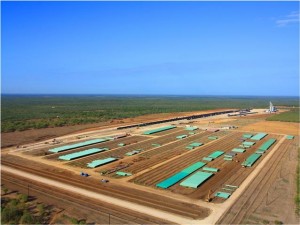
Gardendale Pipe Yard

South Texas rail traffic is on the rise. Some of the traffic is directly related to growth in the Eagle Ford and some is related to economic growth across the board.

The Port of San Antonio's East Kelly Railport is set for an expansion this year. Watco is expanding to occupy 20 acres of the 350 acre railport and will nearly double the amount of track it has in place from 20,000 ft to more than 35,000 ft. The development is in response to growth from serving a little more than 2,600 railcars in 2010 to more than 4,500 in 2011.

San Antonio isn't alone either. The Gardendale railroad was almost abandoned a few short years ago, but now the interchange has five switching engines running.

Gardendale Rail Map
Gardendale Rail Map

Frack sand silos rise above the yard and black tank cars hauling Eagle Ford crude stand ready for transport. Adjacent to the interchange, you'll see several loads of pipe waiting to be put to work. There's no doubt who is driving growth in Gardendale. It's all oil & gas.

There's enough activity that Ironhorse Resources, operator of the Gardendale Railroad, has added around 80,000 ft of track and has expansion plans that will cover more than 350 acres. The facility is built to handle 15,000 railcars per year, but that number will stretch well above 20,000 as expansions are completed.

You can read in regards to Ironhorse's facility at gardendalerail.com

ConocoPhillips Revenue Down in Q1 - Eagle Ford Activity Up

ConocoPhillips Eagle Ford Production

ConocoPhillips (COP) is in the process of spinning off its crude oil refining business into a new company named Phillips 66. The company reported lower revenues than expected in the first quarter of 2012. I'm sure the details of the split are distracting corporate executives, but there isn't any sign of letting up in the Eagle Ford. Conoco ran an average of more than 16 rigs targeting the Eagle Ford during the first quarter of 2012. That's up two rigs from 14 during the fourth quarter of 2011.

The company is on pace to grow production to more than 60,000 boe/d in 2012 and to almost 120,000 boe/d in 2013. For those counting, that's 100% growth this year and 100% growth next year. In the Eagle Ford, the company reports industry leading performance with wells that breakeven at $37/bbl WTI. ConocoPhillip's 200,000 plus acres span the border of the black oil and condensate window in the play (Lavaca, DeWitt, Karnes, Live Oak, and McMullen counties), where the company reports the Eagle Ford will produce 77% liquids. That's good news in today's natural gas price environment.

ConocoPhillip's average well comes online at more than 700 bbls per day and will produce over 175,000 boe in the first year of its life. That puts first year revenue, for the average well, in the neighborhood of $10 million. Consider a 20% royalty burden and the company is operating wells that have around a 1-year payout.

Eagle Ford Rig Count Soaring Through Records - April 20, 2012

drilling rig
drilling rig 8

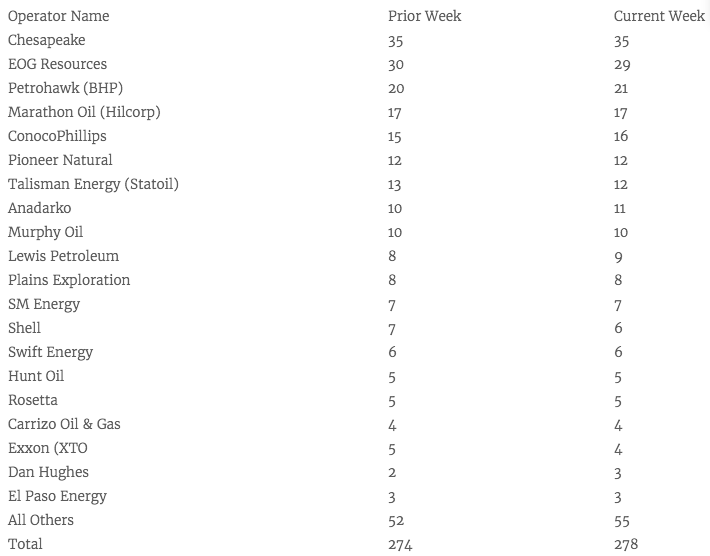
The Eagle Ford Shale drilling rig count rose four rigs to 278 working units. That eclipses the previous regional record of 275 set in mid-march.  That's the rig count for the entire area, but from looking at operators and locations we've likely surpassed 250 rigs targeting the Eagle Ford alone. The other 10% of rigs are targeting formations other than the Eagle Ford proper.

Eagle Ford Oil & Gas Rigs

The natural gas directed rig count fell one rig to 70 running this week. That's on the back of hitting 11 year lows today in the natural gas spot market. I know that sounds like a broken record, but we've hit new lows for Henry Hub prices in three of the past four weeks. Oil directed activity jumped five rigs to 207.  That surpasses last weeks record of 202.

Future prices for Henry Hub were trading at $1.92/mmbtu as of Friday afternoon. Oil prices have gone almost unchanged the past three weeks $103 per barrel (WTI).

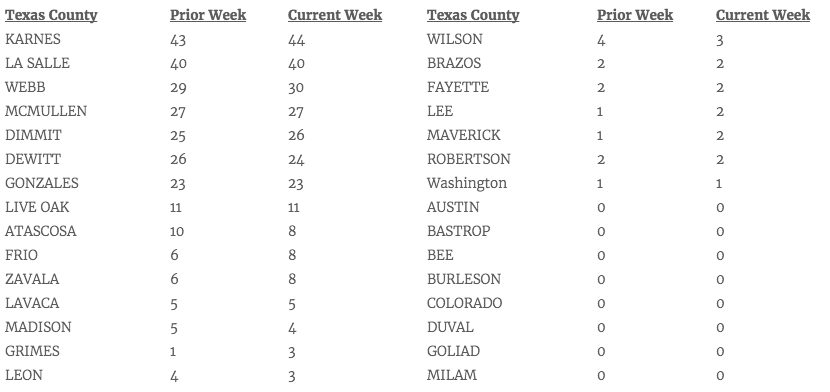
260 horizontal rigs are running and we have 1 storage well being drilled in La Salle County. Karnes County leads development with 44 rigs. La Salle (40), Webb (30), McMullen (27), Dimmit (26), DeWitt (24), Gonzales (23), Live Oak (11), and Atascosa, Frio, and Zavala counties with 8 rigs each make up the top Eagle Ford counties.

News highlights this week included:

If you are headed to San Antonio/South Texas, visit our Eagle Ford Hotels page. We've negotiated discounted rates with hotels that are welcoming the Oil & Gas Industry.

Come back weekly for updates or sign up for alert.

Drilling Rig Count by Operator

While missed in the census this week, Lewis Petroleum has indicated it has 11 rigs running.  That means the actual rig count is 280.

What is the Rig Count?

The Eagle Ford Shale Rig Count is an index of the total number of oil & gas drilling rigs running across a 30 county area in South Texas. The South Texas rigs referred to in this article are for ALL drilling reported by SmithBits and not solely wells targeting the Eagle Ford formation. All land rigs and onshore rig data shown here are based upon industry estimates provided by the Baker Hughes Rig Count and/or Smith Service Co's (Schlumberger) Smith Rig Count.

Drilling Rigs by County

Largest Refineries in the U.S. Benefit From Eagle Ford Crude

In about a month's time, Motiva Enterprises' Port Arthur refinery will become the largest in the U.S., with 600,000 barrels per day of crude refining capacity.  The facility will surpass ExxonMobil's Baytown refinery that has a capacity of approximately 560,000 barrels per day. Both will benefit from growing U.S. crude supplies. Motiva is a joint venture owned by Shell and Saudi Aramco. The expansion of the Port Arthur refinery was planned over five years ago without the knowledge of growing production in the Eagle Ford Shale and Permian Basin. That's a bonus that will be welcomed with open arms. Local supply generally leads to better margins for refineries.

While parts of the refining industry have made little to negative returns over the past few years, new facilities like Motiva's will be the benchmark for the future. The economies of scale and modern technology will give it an even greater advantage over other U.S. refineries that are near the end of their useful lives.

If you'd like to learn more, you can read an entire article on the subject at minyanville.com