Anadarko Eagle Ford Drilling Time Falls to 6.8 Days for Record

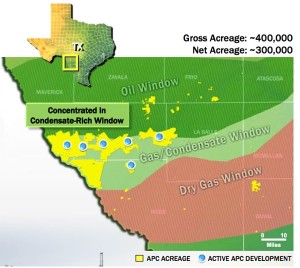
Anadarko Eagle Ford Shale Map

Anadarko set an Eagle Ford record with a spud to rig release time of just 6.8 days for its best well in the second quarter of 2012. On average, the company spent just 10.5 days from spud to rig release for each well. That is down from almost 18 days when the company started drilling Eagle Ford wells in 2009.

Anadarko also set a record with a weekly net production rate of 32,300 boe/d in the quarter. Gross processed production is approaching 100,000 boe/d.

Anadarko is utilizing 9 conventional rigs and 1 spudder rig in the play. Eagle Ford drilling for the second quarter included spudding 70 wells, completing 50 wells, and reaching first production on 44 wells.
Comstock - KKR Eagle Ford Partnership Agreed at $25,000/acre

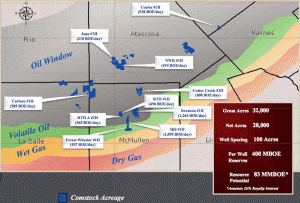
Comstock Resources Eagle Ford Map

Comstock and KKR (Kohlberg, Kravis, Roberts & Co) have signed a participation agreement in the Eagle Ford. KKR will have the right to participate for 1/3 of Comstock's interest in 28,000 net acres across Atascosa, Frio, Karnes, La Salle, McMullen, and Wilson counties. In exchange, KKR will pay the equivalent of $25,000 per acre through a drilling carry for each acre acquired. Comstock plans for development with spacing of 80-acres per well.

KKR has committed to the drilling carry equivalent of $25,000 per acre for the next 100 wells in Comstock's planned development. The private equity partner will have the ability to participate in additional Comstock wells under the same terms.

Check my math, but if KKR participates across all of Comstock's acreage:

28,000 net acres x 33% x $25,000/acre = ~$233 million

While there is potential for as much as a $233 million dollar investment, the announcement indicates KKR has the "right" to participate. I assume that means they are not "obligated" to participate. If you consider the next 100 wells,

100 wells x 80-acres/well x 33% x $25,000/acre = $66 million

It sounds like KKR has committed to spending $66 million and will have an option on participating on additional acreage that could increase the company's commitment up to $230+ million.

Check my math and let me know your thoughts on the deal in the comments below.

Eagle Ford Shale Contends for #1 Spot Among Shale Oil Plays

The Eagle Ford's promising economics are not news to anyone in South Texas, IHS reported promising results from a study the research company has underway. Eagle Ford wells are producing better than the Bakken Shale of North Dakota and Montana.

A typical well in the Eagle Ford averages 300 to 600 barrels-per-day (bpd) in its peak month of production, compared with 150 to 300 bpd for a Bakken well, according to the study.

Current Eagle Ford production is just half that of the Bakken, but the ND shale play had a 10-year head start. A little over 200 rigs are drilling in the Bakken vs. ~250 in the Eagle Ford. It's also worth noting that horizontal laterals are consistently 10,000 ft in the Bakken. That's roughly double the most common lateral length in South Texas. That means the Eagle Ford is out producing the Bakken with as little as half the reservoir contact.

All is good news for South Texas. Companies deploy their capital to the areas of their portfolio that provides the best economic returns. In general, the rank of either oil or gas plays doesn't change dramatically over short periods of time. Commodity prices do, but the Eagle Ford is the top play in the U.S. at both $50 and $100 oil prices. In the absence of a severe recession, Eagle Ford development will boost the South Texas economy for decades to come.

You can read more at reuters.com

Eagle Ford Shale Regional Rig Count at 270 - July 27, 2012

Eagle Ford Shale Well Map - July 2012

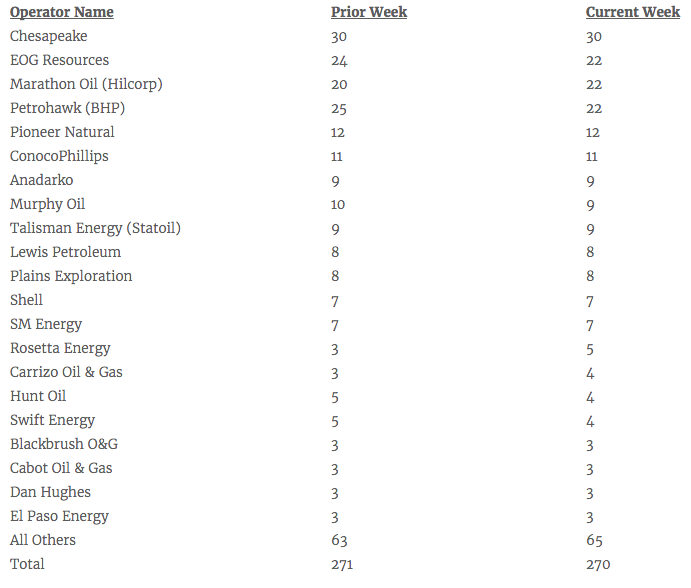
The Eagle Ford Shale drilling rig count fell one rig to 270 this week. 270 rigs happens to be the average number of rigs the region had working in the first half of 2012. As we enter the second half of the year, watch to see if activity slows or if operators continue to increase activity levels. Don't forget - fewer rigs does not necessarily equate to fewer wells. Operators are getting much more efficient. Wells that once took 30 days to drill are now taking half that time.

The map highlighted this week is the Texas RRC's latest Eagle Ford Well map. Since the latest update in mid-May, operators have brought more than eight wells per day online to bring the total number of Eagle Ford producing wells to 2,400. The Railroad Commission has also issued more than 360 permits since that time. Expectations are that the number of producing wells will exceed 3,000 by the end of August or early September.

Eagle Ford Oil & Gas Rigs

The number of natural gas rigs (Smithbits) fell to 60 this week, down three from last week's count. The only counties with over ten rigs targeting natural gas are Karnes and Webb.

Henry Hub futures were trading at ~$3.00 on Friday afternoon. Two weeks over $3 is a milestone in 2012. It has been a tough year for natural gas producers and demand looks to be holding at this price level. Coal prices become more important as natural as prices rise. There is a certain amount of power that can be served by coal or natural gas depending on what provides a better return for electric companies.

Oil prices changed several dollars over the last week, but are ending the week at almost the same prices as last week. WTI was trading at ~$90/bbl Friday afternoon and LLS crude prices are just above $107/bbl. If oil prices remain higher than $90/bbl throughout the remainder of the year, operators will be inclined to increase their development drilling efforts. My expectation is that operators that have the flexibility with their balance sheets will increase the number of wells planned for the year.

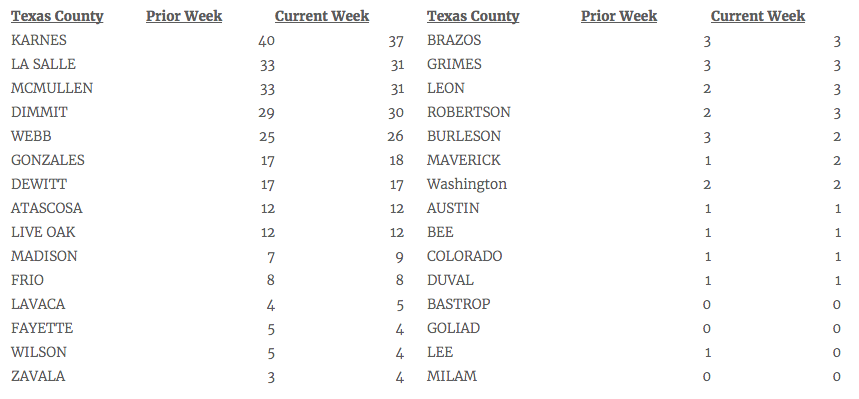
There are 248 horizontal rigs running in the region. There is one water well being drilled in McMullen County and a disposal well in Leon County. The three counties leading development are Karnes with 37 rigs, and La Salle and McMullen each with 31. Dimmit (30), Webb (26), Gonzales (18), DeWitt (17), Atascosa (12), and Live Oak (12) round out the top Eagle Ford counties for this week.

News items this week included:

Come back weekly for updates or sign up for alerts.

Drilling Rig Count by Operator

What is the Rig Count?

The Eagle Ford Shale Rig Count is an index of the total number of oil & gas drilling rigs running across a 30 county area in South Texas. The South Texas rigs referred to in this article are for ALL drilling reported by SmithBits and not solely wells targeting the Eagle Ford formation. All land rigs and onshore rig data shown here are based upon industry estimates provided by the Baker Hughes Rig Count and/or Smith Service Co's (Schlumberger) Smith Rig Count.

Drilling Rigs by County

New Eagle Ford Well Map from the TX RRC - July 2012

Eagle Ford Shale Well Map - July 2012

The Texas RRC updated its Eagle Ford Shale well map with the most recent reported data through July 3, 2012.

Since May 14 when the RRC last updated the data points on its map, the commission has issued 367 permits. That's more than 7 permits per day over a period of 50 days.

A total of 2,400 wells had been reported producing as of July 3. That's 314 more oil wells and 107 more gas wells than we had as of May 14. If you're counting, that's a pace of more than 8 wells coming online per day.

Data from the RRC is always a little delayed, so we're likely on pace to surpass 3,000 producing wells by the end of August or early September.