Eagle Ford Shale Regional Rig Count at 268 August 17, 2012

Eagle Ford Rig Map August 2012

The Eagle Ford Shale drilling rig count fell three rigs to 268 this past week. KNES 5 in San Antonio stirred the pot this week when the organization reported that oil companies are threatening counties with lawsuits if they go forward with access and impact fees. You can watch the news report in the article Eagle Ford Oil Companies Fight Back - The State Should Share Revenues. The Texas Oil & Gas Association responded quickly to the report stating the organization had made no threats to sue any county in South Texas in regard to transportation fees. You can read the full response in the story TXOGA Responds to KENS 5 Story Regarding Lawsuit Threats.

As roads deteriorate, we'll see both oil companies and local constituents lobbying the state legislature to share oil and gas revenues more liberally with areas of development. Reference the map above to see how rig activity is disbursed across the region.

Eagle Ford Oil & Gas Rigs

The number of natural gas rigs running jumped up to 65 this week from 59 last week. McMullen County (10) rejoined the ranks of Karnes (13) and Webb (12) counties this week to be only areas with 10 or more gas rigs running. There are 200 oil rigs working, which 10 off the record we touched last week. As you can tell, most of those rigs simply shifted from oil to gas. We also have one disposal well being drilled in Leon County, TX.

Henry Hub futures were trading at ~$2.73 on Friday afternoon. That's roughly flat over last week, but down 10% over the past month. In contrast to the past few weeks, spot prices are now more in line with futures prices at $2.78/mmbtu.

WTI was trading at ~$96/bbl Friday afternoon and LLS crude prices are just above $112/bbl. We're now running on several weeks of gains in the oil market. Watch to see if prices surpass $100 per barrel and stay there.

There are 250 horizontal rigs running in the region. The three counties leading development are Karnes with 36 rigs, La Salle with 32 and McMullen with 30. Dimmit (27), DeWitt (22), Webb (21), Gonzales (17), Frio (12), Atascosa (11), and Live Oak (10) round out the top Eagle Ford counties.

News items this week included:

Thank you to Devorah Fox of Mike Byrnes & Assc. who contributed an article highlighting the Top Ten Characteristics of a Great Truck Driver.

Be sure to visit our Eagle Ford Shale Job Listings to search openings and come back weekly for updates or sign up for alerts.

Drilling Rig Count by Operator

What is the Rig Count?

The Eagle Ford Shale Rig Count is an index of the total number of oil & gas drilling rigs running across a 30 county area in South Texas. The South Texas rigs referred to in this article are for ALL drilling reported by SmithBits and not solely wells targeting the Eagle Ford formation. All land rigs and onshore rig data shown here are based upon industry estimates provided by the Baker Hughes Rig Count and/or Smith Service Co's (Schlumberger) Smith Rig Count.

Drilling Rigs by County

TXOGA's Response to the KENS Story Regarding County Lawsuit Threats

The Texas Oil & Gas Association (TXOGA) issued an official response to a story reported by KENS Channel 5. You can watch the report in the article Eagle Ford Oil Companies Fight Back - State Revenues Should Be Shared. KENS 5 reported that oil companies were threatening counties with lawsuits and the organization released this response:

Texas Oil & Gas Association Memo Explained Current Law on Counties’ Authority and Roads -- TXOGA Did Not Threaten Lawsuit and Believes Current Law May Need to Change so Counties Receive Necessary Funding

The following can be attributed to Deb Hastings, executive vice president of the Texas Oil & Gas Association (TXOGA):

In April 2012, the Texas Oil & Gas Association prepared a reference memo describing current law with regard to counties’ authority to assess fees or require agreements with oil and gas operators. The Texas Oil & Gas Association has not threatened to sue any county regarding transportation fees.

The roads situation is serious in South Texas and elsewhere where oil and gas development is expanding. Funding is necessary to repair and improve existing roads. The Legislature will determine the source of that funding. A change in law may be required to re-figure how funds are allocated to local municipalities. For example, oil and gas operators paid more than $9 billion in taxes and royalties to the state in fiscal 2011. We need to assess if those funds are getting into the right hands for emerging needs.

The Texas Oil & Gas Association is committed to helping to develop a solution to repair, maintain and strengthen the infrastructure necessary to support the tremendous economic activity that is generating thousands of jobs and billions of dollars in state and local tax revenue.

You can read more about the association at www.txoga.org

Eagle Ford Oil Companies Fight Back - The State Should Share Revenues

Eagle Ford oil companies are fighting back against local impact fees. Operators already pay multiple taxes and permitting fees. The problem is not much of that revenue is shared with the counties and counties don't have authority to enforce one off fees. As roads continue to deteriorate, we'll likely see both oil companies and local constituents lobbying to have more money allocated to improvements in South Texas.

Top Ten Characteristics of a Great Truck Driver

Oil Tanker on the Highway

With a little training and practice, probably most people can manage to drive a tractor-trailer. However professional truck driving is more than just getting a vehicle from Point A to Point B. Great truck drivers are much more than mere steering-wheel holders. In the Eagle Ford Shale play, driving a heavy vehicle with its cargo of costly supplies and equipment and keeping to a demanding schedule isn’t a job for an ordinary driver. Do you aspire to have not just a job, but a career, and a great one at that? Check out these characteristics of a great truck driver.

  1. RELIABLE. Great truckers do what they say they’re going to do, how and when they promise to do it. They know that employers and customers have deadlines and schedules that depend on the trucker’s timely performance. Great truckers aim to be not the problem, but the solution to shipping and cargo transport challenges.
  2. SELF-DEPENDENT. Office workers are just a door or floor away from a department of support personnel who can provide help or advice. However even team drivers are essentially working alone in that they are out on the road, away from “technical support.” Truck drivers have to be able to handle having sole responsibility for the truck and its cargo and make the right decision in an emergency They also have to be able to cope with being alone most of the workday, or work-night as is often the case. Great truck drivers keep their knowledge and skill current so that they can solve problems when and where they occur, whether they are mechanical difficulties, traffic tie-ups or cargo issues. They learn how to manage the personal aspects of their life so it goes smoothly whether they are home or on the road.
  3. COURTEOUS. While it’s true that truck drivers spend a lot of time alone, the great ones nevertheless have good “people skills.” They know how to interact with employers, other drivers, dock workers, customers and service staff such that everyone truckers come in contact with feel listened to and respected. Great truck drivers are courteous to clients, and treat the cargo with care.
  4. MECHANICAL SKILLS. Great truck drivers have basic knowledge of how a truck operates. They can perform repairs as necessary, such as changing a fuse or light bulb, and can do what’s needed to help ensure the truck meets compliance and other safety standards. This contributes to a safer working environment not only for the truckers themselves but for everyone else who is sharing the road along with them.
  5. STRESS MANAGEMENT SKILLS. Great truckers know how to manage stress. They take setbacks in stride and don’t let them ruin their day or their life. They’re sensitive to how a truck driving career can put pressure on their families as well as themselves.
  6. HONESTY. Great truck drivers don’t try to get away cheaply but rather give true value for the money that employers and customers spend with them. They don’t fudge on aspects of laws and regulations, either. Great drivers know that in taking shortcuts they are ultimately cheating themselves of the satisfaction of having done the job right, completely, legally and safely.
  7. ALERTNESS. Great truckers must be aware of many factors including the condition of the vehicle, the road and traffic. Driving challenges nearly all the senses, not just sight. Alert drivers who are attuned to all the input that they’re receiving will realize that a strange sound, vibration or even an odor is an early warning signal of developing trouble. They must be able to evaluate and assess their own condition and take a break when tiredness dictates that it would be more efficient, not to mention safer, to rest.
  8. FITNESS. That quality of awareness comes as part of an overall level of physical fitness. A fit driver is more able to work long hours and remain sharp. Truck drivers also simply need a certain level of physical strength in order to load and unload freight.
  9. EXCELLENT DRIVING RECORD. Great truck drivers have an excellent driving record. This gives the employer and customers confidence that the equipment and cargo is in good hands.  Great drivers are also cheaper to insure and keep costs of vehicle operation down. An excellent driving record shows that the driver not only has respect for others sharing the road, but also self-respect and professionalism.
  10. COMMERCIAL DRIVER’S LICENSE. It almost goes without saying that a great truck driver has a CDL. To earn a commercial driver’s license, drivers take tests to demonstrate that they have the minimum knowledge and skill that the licensing state has determined is necessary to do the job. However great truck drivers go beyond the minimum. They stay current with developments in equipment, tools, business practices and regulations so their knowledge and skills are always sharp and up-to-date. This enables them to work with less stress and more satisfaction.

With a little effort and dedication, good truck drivers can become great truck drivers, and great drivers are what's needed in today's cargo transport industry.

Visit the Eagle Ford Jobs page to apply for open driving positions.

Pioneer Cuts Back Eagle Ford Dry Gas Drilling Again

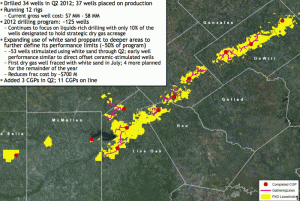
Pioneer Eagle Ford Update Map

Pioneer Natural Resources is cutting back its dry-gas development plans in the Eagle Ford from 15% to just 10% of its budgeted activity. Gas drilling is only going forward at this level to secure leases for when gas prices improve.

The company reported earnings for the second quarter at the end of July and is right on target to meet expectations for the year in South Texas. Highlights from the quarter include:

  • Drilled 34 wells and brought 37 to production
  • Added three central gathering plants to reach a total of 11 in operation
  • Lowered dry-gas activity from 15% to 10% of wells budgeted. Gas drilling is only being utilized to hold acreage by production
  • Expanding the use of White Sand into gas well completions ($700,000 savings)

Pioneer produced approximately 23,000 boe/d in the first quarter, 24,000 boe/d in the second quarter and has provided guidance of 25,000-29,000 boe/d for 2012. Expect the company to realize its biggest production increases in the second half of the year.

Read more about the company's position at our Pioneer Eagle Ford page.