Eagle Ford Shale Regional Rig Count - October 26, 2012

Newfield Eagle Ford Well Performance

Eagle Ford Shale drilling fell one rig to 273 over the past week. This is roughly the third week in a row the rig count has gone almost unchanged. That likely means operators are settled in and don't plan to make major changes before the end of the year.  Third quarter earnings announcements are starting to roll in and results have been positive to date. I've heard a couple of operators who have 1-2 rigs active say they are planning for three or more in 2013. Capital budgets are being set as we speak, so we'll have a really good idea of what to expect come January.

Newfield is one operator who plans to pick up its pace of development in 2013. The company has drilled four extended lateral wells (7,500 ft) in Dimmit County and expects ultimate recoveries from each of the wells will surpass 500,000 barrels. The company also has plans to test a 10,000 ft lateral in the area. With additional efficiency gains through pad drilling, internal rates of returns on the company's wells will easily surpass 50%.

Eagle Ford Oil & Gas Rigs

The natural gas rig count held flat at 53 rigs running this past week. With gas holding relatively strong in the mid-$3 range, it's no surprise to see operators honing in on gassy areas.

The oil rig count was essentially flat, dropping one rig to settle at 219 running. Just one service well is currently being drilled and it is a water well in Bastrop County.

Henry Hub futures were down two dimes to end the week at ~$3.40 on Friday. Spot prices were trading in the same range.

WTI was down 7% to ~$86 this week. Generally, weak corporate earnings reports are taking a toll on commodities. Eagle Ford crude priced at $95.18/bbl on the 26th of October. Light crude and condensate in the area traded at $86.75 and $81.75, respectively.

There are 259 horizontal rigs running in the region. La Salle County still leads development with 39 rigs running. Karnes with 36 rigs, McMullen (30), Webb (25), Dimmit (23), Gonzales (20), DeWitt (17), Atascosa (11), Live Oak (11), and Frio (8) round out the top Eagle Ford counties.

News items this week included:

Be sure to visit our South Texas Oilfield Job Listings to search openings and come back weekly for updates or sign up for alerts.

Eagle Ford Rig Count by Operator

What is the Rig Count?

The Eagle Ford Shale Rig Count is an index of the total number of oil & gas drilling rigs running across a 30 county area in South Texas. The South Texas rigs referred to in this article are for ALL drilling reported by SmithBits and not solely wells targeting the Eagle Ford formation. All land rigs and onshore rig data shown here are based upon industry estimates provided by the Baker Hughes Rig Count and/or Smith Service Co's (Schlumberger) Smith Rig Count.

Eagle Ford Shale Drilling by County

DCP's Sand Hills Pipeline Moving Eagle Ford NGLs to Mont Belvieu

DCP Sand Hills Pipeline Map - Eagle Ford Segment

DCP's Sand Hills Pipeline has started servicing the Eagle Ford Shale. The company is opening the 720 mile pipeline that runs from the Permian Basin to Mont Belvieu (East of Houston) in segments. The next segment connects directly to Mont Belvieu and will be open by the end of 2012. Construction tying in the Permian Basin will be finished mid-2013.

“When finished, Sand Hills Pipeline will be a major link between the liquids-rich Eagle Ford and Permian producing regions and growing Gulf Coast markets,” said Tom O'Connor, chairman and chief executive officer of DCP Midstream. “With Sand Hills, we can offer an integrated NGL takeaway solution to producers, who will enjoy reliable one-stop service. Sand Hills adds to our well positioned assets in the Permian and Eagle Ford producing regions.”

When finished, the Sand Hills Pipeline will be 720 miles of 20-inch pipe with capacity of 200,000 barrels per day of NGLs and will have the ability to expand to 350,000 b/dif needed. DCP is projecting it will spend $1 billion on the pipeline and offers three strategic reasons for constructing the pipeline:

  • Provides critical capacity and NGL transport from South Texas and the Permian Basin
  • Capitalizes on increased Eagle Ford growth
  • Improves reliability of the overall NGL network

Newfield's Extended Lateral Wells in Dimmit County Produce 900 BOED

Newfield Eagle Ford Well Performance

Newfield Explorations has drilled four extended lateral (SXL) wells in Dimmit County to date. Initial wells results look promising with initial production rates near 900 boe/d. The company has drilled the wells with 7,500 ft laterals in as little as 12 days. That's moving. The company has five additional SXL wells planned before year-end and also plans to test a wells with a 10,000 ft lateral. Results point to SXL wells yielding more than 500,0000 barrels and 10,000 ft laterals might grow potential EURs even further. The company commented:

Again, we are using controlled flowback to manage the production, limit pressure drawdown and maximize EURs. Our South Texas drilling team is able to drill and case these wells in 12 days for less than $3 million. We are seeing some relief in completion cost and expect the favorable trends to continue into 2013.

The company expects pad drilling will drive total drilling and completion costs down to $8 million per well. Lower costs will help the company reach internal rates of return of more than 50% per well. That alone has prompted the company to invest more heavily in 2013.

We will be increasing our planned development activities in the Eagle Ford and expect to drill as many as 35 wells. In addition, we will be working more than 200,000-plus net acre position into the economic window.

Newfield's current development efforts are focused in four areas of the country. The company is targeting the resource potential of the Bakken Shale of North Dakota, Cana Woodford of Western Oklahoma, oil prospects in Utah, and the South Texas Eagle Ford Shale.

Eagle Ford Shale Stakeholders Summit - 2012

Eagle Ford Shale Workforce Analysis Map

The Eagle Ford Shale Stakeholders Summit was held October 23, 2012, at Texas A&M International University in Laredo. A study released by UTSA's Tom Tunstall was the talk of the meeting. Tunstall recently published an Eagle Ford workforce analysis and the numbers are quite promising.

In the 14 counties where the play is actively producing, 38,000 Eagle Ford jobs were supported in 2011 and over 80,000 jobs will be supported by 2021. The most significant occupational impacts have been see in what Tunstall characterizes as construction and extraction, office support, transportation, support services, management, and other professional occupations.

Webb County and Karnes County led the region in Eagle Ford workforce with 6,983 and 6,092 jobs supported by the development in 2011. Those numbers are projected to grow to over 10,000 jobs in Webb and almost 15,000 jobs in Karnes by 2012. Wow.

Interestingly, over one-half of all employees hired have only required moderate to short-term on-the-job training as of 2011. Only 10% of jobs require a bachelors degree. In 2021, moderate to short-term on-the-job training will still account for almost half of the workforce and jobs requiring a bachelors degree will rise to 15% of the workforce.

Other items covered at the event included:

  • Finding workers is difficult and the industry needs everyone from drivers to engineers
  • Truck routes are being developed, but roads are taking a pounding in the mean time
  • Teachers and lower paid employees in oil communities are moving 30+ miles away and commuting because of the housing shortage

Watch for a full summary of the UTSA report referenced above in the next few days.

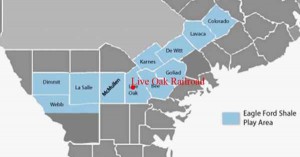
Live Oak Railroad Near Three Rivers Coming

Live Oak Railroad Location Map

The Live Oak Railroad will be breaking ground in November with plans to open in the first half of 2013. The new rail facility will include 28,000 ft of track located just south of Three Rivers. The facility has a great location almost halfway between San Antonio and Corpus Christi. If you have noticed, there has been a dramatic rise in rail traffic in South Texas related to the Eagle Ford boom.

Three other major railroad sites have grown significantly in recent times:

The Live Oak Railroad is being built by a partnership between Howard Energy Partners and local real estate developers. The primary purpose of the facility is to move liquid hydrocarbons - condensate, NGLs, and oil.

Why Move Oil by Rail?

Live Oak Railroad Eagle Ford Map

It might surprise you that crude will move by rail. Approximately 1.8 million barrels per day of pipelines have been built or are under construction. That should be adequate capacity for quite some time, but that is only part of the story. WTI oil prices have been significantly discounted to Louisiana Light Sweet (LLS) in recent history (Read more at Eagle Ford Oil Prices Trade at a Premium to WTI).

There are several projects underway to move crude from WTI's trading point, Cushing, OK, to the Gulf Coast near Houston. Those projects will relieve congestion in Oklahoma, but will make supply more abundant in the Texas refinery complex.

All that to say, there is adequate pipeline capacity to get into the Gulf Coast Refinery Complex, BUT there is a lot of other oil on its way there too. If Eagle Ford operators can get their production across the state line into Louisiana, it might mean several more dollars per barrel. That's potentially millions of dollars of savings per day across the Eagle Ford. The Live Oak Railroad and others will be the primary trading points for oil if prices prove more lucrative in other areas of the country.