
Halcon Plans Eagle Ford Development in Brazos County, TX

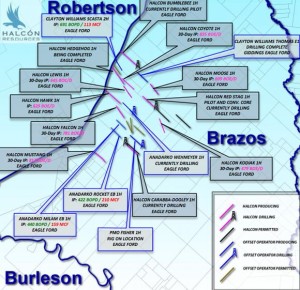
Halcon Eagle Ford Activity Map

Halcon is extending the Eagle Ford north into Brazos and Robertson counties in what the company has deemed the "El Halcon" prospect.

The company unveiled a 50,000 net acre position with plans to expand to 150,000 net acres in and around northern Brazos County.Early well results looking promising. The first two wells produced 859 boe/d and 694 boe/d, respectively. Both wells had a production stream that was 94% oil.

The first few wells have effective lateral lengths of 5,632 ft and were completed with 28 frac stages. Halcon estimates each well will recover 350,000-400,000 boe at a cost of $7-8 million.

“This management team knows a thing or two about the Eagle Ford Shale, and we intend to utilize our extensive knowledge of the formation to exploit this new opportunity to create shareholder value.”
— Floyd C. Wilson, CEO

Halcon's plans in the area are to run 1-3 rigs, with capital spending estimated at $100 million in 2013.

Woodbine Area Targeted And More Being Evaluated

Halcon Resources Eaglebine Map

Halcon also announced the company plans to focus its Woodbine efforts around 220,000 acres in Leon, Madison, Grimes, and Polk counties. The company has confidence in the limits of the Halliday Field and will begin to focus on operational efficiencies.

The results of a 3D seismic survey in Madison, Grimes, and Walker counties should be processed by the end of 2013. The data will allow the company to plan exploration in this less proven area.

Read more in the press release at halconresources.com

Plains All American Planning Cactus Pipeline - McCamey to Gardendale

Plains All American Eagle Ford Assets

Plains All American Pipeline announced a new $350 million pipeline that will move 200,000 b/d of crude oil from the Permian Basin into the Eagle Ford region. The Cactus Pipeline will be a 310-mile, 20-inch crude oil pipeline from McCamey, TX, to the Gardendale Area in La Salle County, TX.The pipeline is supported by a long-term capacity commitment and is expected to be in service in the first quarter of 2015. Plains estimates total costs will come in around $350 to $375 million.

From La Salle County, crude will have access to the Gardendale rail or Plains and Enterprise's Eagle Ford Joint Venture system. The Eagle Ford JV Pipeline provides direct access to Corpus Christi and Three Rivers, as well as access to Houston through Entrprise's South Texas Crude Oil Pipeline. In Corpus Christi, oil has access to marine terminals.

In an oil price environment with large basis differentials, options can create a lot of value. Permian crude will now have access to barges, railroads, and pipelines in South Texas.

Read the full press release at paalp.com

Driving Safety Top Priority for Oil and Gas Industry - Op Ed

Hastings of TXOGA and Garcia of STEER

From Cuero to Carrizo Springs, advances in technology have led to an unprecedented leap in oil and natural gas production in South Texas. Oil and gas activity in the Eagle Ford has generated more than $61 billion in revenuein 2012 and 116,000 full-time jobs, according to research from the University of Texas at San Antonio. In Karnes County, employment in the mining sector, which is mostly oil and gas, jumped 260% and industry wages increased 320%. In Dimmit County, local sales tax revenues recently doubled, apparently thanks to increased oil and gas activity; this is a quadruple-digit increase over two years before.

Without a doubt, increased oil and gas production is turning once sleepy towns into bustling centers for commerce of all kinds. With this increase in commerce, comes an increase in road traffic. While the legislature is wisely considering ways to fund improvements and repairs for roads in South Texas and beyond, oil and gas companies across the board have taken meaningful and pro-active steps to encourage safety behind the wheel. Just as the oil and gas industry takes seriously its responsibility to maintain safe operations and job sites, the industry is committed to promoting safe driving.

Oil & Gas Industry Emphasizes Driving Safety

“Beyond training and equipment, some companies have developed innovative incentive-based programs to help encourage safe driving practices that may include bonuses, raises, or prizes. The point of all of these programs is to establish, maintain and reinforce a focus on road safety for all oil and gas drivers.”

Focus on driving safety isn’t a one-time occurrence. Oil and gas companies provide comprehensive and ongoing training for fleet drivers that incorporate both classroom instruction and practical hands-on training. Instructional programs are often followed by exams to certify that employees and contractors have met necessary standards. Some companies also conduct refresher driver training courses throughout the year and hold weekly safety meetings where they may discuss considerations for driving at night or in hazardous weather. Still others have instituted formal company-wide policies that prohibit cell phone use or texting while driving.

In addition to these courses and company policies, many Texas oil and gas operators utilize the cutting-edge technology to collect and process driver safety data from vehicles including speeding, swerving and hard brake incidents. And, as an added precaution, many also equip fleets with backup cameras, stability controls, anti-lock braking systems, trailer sway control and hands-free devices.

Road Safety Is A Collaborative Effort

Recognizing that keeping the roads safe must be a collaborative effort, the oil and natural gas industry worked closely with the Texas Department of Transportation (TXDOT) to help develop and spread the word about TXDOT’s Be Safe. Drive Smart. campaign. The public education initiative presents common-sense but critical reminders to drivers to always drive at safe speeds; wear seatbelts; pass other vehicles carefully; always stop at red lights and stop signs; and, avoid distractions such as texting or cell phone use while driving.

“When it comes to road safety, every driver on Texas highways and byways has a role to play.”

The Texas Oil & Gas Association is also a proud partner in Safe Hand Texas, a public safety initiative from Texas Mutual Insurance, which provides educational resources and safety reminders for commercial drivers. Both programs are helping raise awareness about ways we can increase safety on our roads by pulling together public and private entities in a positive and collaborative manner.

As oil and gas opportunities draw people into communities across South Texas, there is no doubt the additional activity will mean an increase in cars and trucks on the road. But we must remember that with this increased economic good fortune, comes increased responsibility – something we all share. The Texas oil and gas industry is committed to powering the state forward, working with statewide and community partners, and keeping safety as our collective priority number one.

By Deb Hastings, Texas Oil & Gas Association and Omar Garcia, South Texas Energy & Economic Roundtable

About TXOGA Texas Oil & Gas Association (TXOGA) is a statewide trade association with approximately 5,000 members representing every facet of the Texas oil and gas industry including small independents and major producers. The membership of TXOGA represents over 90 percent of Texas’ crude oil and natural gas production, as well as refining capacity, and is responsible for the vast majority of the state’s pipelines. Founded in 1919, TXOGA is the oldest and largest group in the State representing petroleum interests and continues to serve as the only organization which embraces all segments of the industry.

About STEER The South Texas Energy and Economic Roundtable (STEER) is the leading Eagle Ford Shale resource in the region and is the primary coordinator for communication and public advocacy surrounding the oil and natural gas industry in South Texas. With a focus on South Texas, STEER will serve as the bridge connecting the industry and legislature, academia and the communities throughout South Texas to ensure positive collaboration and communication surrounding the activities associated with the Eagle Ford Shale. For more information about STEER, visit STEER.com.

The article above was published through EagleFordShale.com’s press release distribution service. Learn more about Eagle Ford Advertising Here.

Forest Oil - Schlumberger Eagle Ford Development Agreement Inked

Forest - Schlumberger Eagle Ford Acreage

Forest Oil and Schlumberger have signed an Eagle Ford development agreement in Gonzales County, TX. Schlumberger will pay $90 million in the form of future drilling and completion services, as well as related development capital in order to earn a 50% interest in Forest's Eagle Ford acreage position.

Once the $90 million has been contributed, Forest and Schlumberger will participate in future drilling on a 50/50 basis. Forest expects the drilling carry will contribute to development through 2014.

“We believe that our Eagle Ford position is a valuable oil asset and being aligned and working together cooperatively with a strategic partner such as Schlumberger will greatly enhance the value of this important asset.”
— Patrick R. McDonald, Forest’s CEO

Accelerating Eagle Ford Development

Forest Oil Schlumberger Eagle Ford Development Plan

With the drilling carry, Forest plans to accelerate development by moving to four rigs running in the play by the end of the third quarter. Forest has kept 1-2 rigs running through the past several months. Forest estimates the increased pace of drilling will improve the company's asset value by ~$250 million.

Forest's share of capital expenditures are estimated at $125 million in 2013 and $220 million in 2014. Production projections are flat in 2013 at 2,800 boe/d, but increase from an estimated 3,700 boe/d to 6,500 boe/d in 2014.

Forest now estimates it will hold an aggregate of 55,000 gross (27,500 net) acres in Gonzales County. That's a larger footprint, but a smaller net holding than the 40,000 gross (40,000 net) acres that would have been held under the company's previous development plan.

Based on 80-acre spacing, Forest has a total of 688 gross (344 net) drilling locations identified. Consider an estimated ultimate recovery of 300,000 boe and unrisked resource potential comes in at 100 million boe net to each company.

The agreement affects all wells spud on or after November 28, 2012.

“We are pleased to be part of this exciting opportunity, in which Forest and Schlumberger are fully aligned and committed to the development of Forest’s Eagle Ford unconventional resources.”
— Carl Trowell, President, Schlumberger Production Management

The deal reads well for Schlumberger because the company gets to utilize its expertise, while reinvesting its margin into high quality Eagle Ford assets. The deal values Forest's Gonzales County acreage at a little less than $3,300 per acre.

Read the full announcement at forestoil.com

Eagle Ford Regional Rig Count at 240 on April 12, 2013

Kinder Morgan Galena Park Terminal Photo

The Eagle Ford Shale drilling rig count held flat at 240 running this past week. The region has averaged 240 rigs running for the past seven weeks.

This week, we highlighted Kinder Morgan's plans to expand condensate processing further at its Galena Park Terminal along the Houston Ship Channel. A supply agreement with BP will support development of the facility and expand ultimate processing capacity to 100,000 b/d.

The second facility and additional storage will come with a price tag of $170 million.

You can read more about the announcement in the article Kinder Morgan Plans Second Condensate Facility At Galena Park

Eagle Ford Oil & Gas Rigs

[ic-l]The natural gas rig count fell four to 16 running this past week. That's down from a peak of 124 in October of 2011. Natural gas prices continued to show strength and traded up to $4.24/mmbtu on Friday. While the natural gas rig count and price are headed in two different directions, that won't be the case very long. I suspect we'll see more rigs enter the region targeting the Eagle Ford in areas that produce more natural gas during the summer.

A total of 223 oil rigs are running in the region or four more than last week. WTI crude oil price lost further ground as it traded near $91/bbl Friday afternoon. Eagle Ford light crude traded at $90/bbl on April 11th.

There are 215 horizontal rigs running in the region. An injection well is being drilled in Webb County.

La Salle and Karnes counties lead development with 34 and 31 rigs running, respectively. See the full list of drilling by county at the bottom of the page.

South Texas Oil & Gas News:

Devorah Fox contributed an article highlighting the need for GPS systems that take into account road hazards, as well as reporting weather and road conditions. Read the full article at Truck Drivers - Watch Where You're Going.

Be sure to visit our South Texas Oilfield Job Listings to search openings and come back weekly for updates.

Eagle Ford Rig Count by Operator

What is the Rig Count?

The Eagle Ford Shale Rig Count is an index of the total number of oil & gas drilling rigs running across a 30 county area in South Texas. The South Texas rigs referred to in this article are for ALL drilling reported by SmithBits and not solely wells targeting the Eagle Ford formation. All land rigs and onshore rig data shown here are based upon industry estimates provided by the Baker Hughes Rig Count and/or Smith Service Co's (Schlumberger) Smith Rig Count.

Eagle Ford Shale Drilling by County