
Texas Ghost Towns & Implications for Eagle Ford Shale Counties

Graveyard
Graveyard

It might surprise most of us to learn that there are over 250 ghost towns in Texas. In fact, many communities in South Texas that are now being impacted by the Eagle Ford Shale probably had some concerns about becoming the next ghost town. That is, until unconventional oil and gas exploration techniques changed the landscape entirely. However, as residents of Texas know probably better than anyone else, booms will sooner or later lead to slowdowns, if not outright busts.

This sort of begs the question: Why do communities become ghost towns in the first place? To gain some insight into the issue, UTSA’s Institute for Economic Development examined the cases of Texas communities over the past two centuries that have fallen victim to significant population declines. Interestingly, there is no single factor as to why communities end up as ghost towns. In some instances – clearly applicable to the Eagle Ford Shale – natural resource abundance is the culprit. Typically, the supply of oil, gas, coal or other mining product runs out. In other cases, the commodity being mined falls victim to a steep and extended price decline. The Permian Basin area in West Texas, for example, has seen ups and downs related to the price of crude oil for decades. In other communities, the transition of locomotives from steam to diesel resulted in a drop in demand for coal mined in Texas.

“But the effects of the resource curse are not uniform and clearly vary by country or community – many do in fact end up better off. ”

But a fall-off in natural resource mining/extraction is not the only reason that communities become ghost towns. The mechanization of agriculture during the 20th century resulted in a decrease in rural populations, which in turn caused many small towns to systematically wither away. New railroads or highways that bypassed existing cities often served as a death knell.  In other cases, relocation of the county seat served as a catalyst for population migration away from established city centers. Sometimes the need for military bases ceased to exist, and the local communities followed suit. Drought and flood have been factors from time to time.

In the academic economic development literature, there has been a fair amount of research performed on the Resource Curse or Dutch Disease, which has demonstrated that in many situations, communities with an abundance of natural resources actually end up worse off after the discovery. This might be because competing industries are “crowded out” by the emphasis on natural resource production. In other instances, the temporary windfalls are squandered by local governments and citizens.

But the effects of the resource curse are not uniform and clearly vary by country or community – many do in fact end up better off. A key differentiating factor between those that are successful and those that are not appears to be governance. Several programs at UTSA’s Institute for Economic Development such as the Rural Business Program and the Eagle Ford Shale Community Development Program – in coordination with the College of Public Policy, and the Center for Urban and Regional Planning – have been working to promote just that. Good governance is the key to the long term prosperity of the Eagle Ford Shale communities.

UTSA Is Working To Assist Communities In South Texas

[ic-l]Along those lines, UTSA, with a grant from Royal Dutch Shell has developed a municipal capacity building program aimed at assisting community leaders address the many issues they currently face. In addition, the Institute for Economic Development continues to stress the need for diversification in communities across South Texas. Houston in the late 1970s, for example, was nearly 90% dependent on the energy industry for economic activity, but has since made significant efforts to diversify into other areas such as medical, finance and technology so that it is less dependent on a single economic sector.

For the rural communities in South Texas, the options are more limited. The relatively short list of industries with potential for growth include olives and olive oil processing, spinach and other agricultural products, geothermal energy, tourism, hunting, outdoor recreation, water recycling/desalination, and wine/beer making. In addition, if a robust broadband infrastructure can be put in place, there are prospects for telemedicine, distance learning, and attracting knowledge workers who prefer the lifestyle associated with smaller communities.

Municipal Capacity Building Workshop - Carrizo Springs 2013 | Click to Enlarge

But these potential opportunities cannot be actively pursued yet – they can only be planned at this point. UTSA’s Eagle Ford Shale Community Development Program refers to this approach as “strategically sequenced” economic development. Clearly local mayors, city managers, economic development directors, county judges and commissioners, and other community leaders have their hands full with the pressing needs of infrastructure development right now. That list is long and includes roads, water, wastewater treatment, solid waste treatment, medical facilities, first responders (police, fire, medical emergency), electricity generation, K-12 education, and housing – as well as broadband, improved public amenities and aesthetics that will be needed to improve quality of life. And yet, if the infrastructure in South Texas is incrementally and steadily improved, it can serve as the foundation for attracting other types of industry in future years.

“It is important to stress that long term community sustainability is not guaranteed.”

The Eagle Ford Shale discovery represents a significant opportunity for South Texas. But it is important to stress that long term community sustainability is not guaranteed. The extensive roster of old Texas ghost towns is proof enough of that. So it will be important for community leaders to engage in longer term strategy planning, undertake regional approaches to economic development, establish a skilled local workforce, recruit or nurture strong institutional management, and exercise fiscal discipline. If we can put these pieces together, we will have gone a long way toward ensuring that economic development – which includes job growth, quality of life, and environmental stewardship – will be sustainable for communities across South Texas well into the 21st century and beyond.
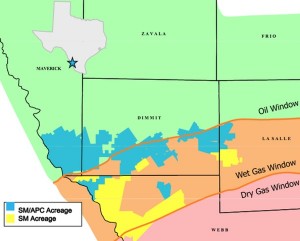
SM Energy Increases Eagle Ford Completion Guidance - Adds Eaglebine Acreage

SM Energy Eagle Ford Acreage Map
SM Energy Eagle Ford Map

SM Energy has raised full-year, company-wide production guidance by 10% to 47.9 mmboe. The increase is largely due to impressive performance in the Eagle Ford.

Operated Eagle Ford production volumes increased 28% from the first quarter to the second quarter. Operated production in the play averaged 66,100 boe/d and non-operated production averaged 17,400 boe/d for a total of 83,500 boe/d net.

SM also increased its Eagle Ford completion guidance from 75 to 95 for the full year. Better yet, the company isn't increasing its planned capital outlay. That means they'll bring 20 wells to production at the same level of investment previously announced. That's the kind of win-win every operator is looking for.

Well costs in the Briscoe area have fallen to $5.4 million per well, or 13% less than 2012.

Expanding East Texas Eagle Ford & Woodbine Position

SM Energy increased its holdings in its Eagle Ford and Woodbine prospect to 195,000 net acres in the quarter. Watch for results from exploratory wells in the second half of the year. The play could provide another growth opportunity for the company.

Read the company's full press release at sm-energy.com

Eagle Ford Regional Rig Count 274 - August 2, 2013

Eagle Ford Well Count Q2 2013

The Eagle Ford Shale drilling rig count grew to average 274 rigs over the past week. That's another 2013 high and the highest number since September of 2012. Oil drilling levels fell further from the high of 241 set two weeks ago to settle at 234 rigs.

The U.S. rig count is up 6 to 1,782, of which 851 are running in Texas. A total of 388 rigs are targeting natural gas and 1,388 are targeting oil in the U.S. The remainder are drilling service wells (e.g. disposal wells, injection wells, etc.).

News this week was highlighted by earnings releases from several major operators in the Eagle Ford, but on Monday we released data from Baker Hughes that shows more than 1,000 wells are drilled per quarter in the Eagle Ford. That's more than 4,000 wells per year at the current pace of drilling. You can read more in the article - Did You Know Drilling Starts On Over 1,000 Eagle Ford Wells Per Quarter?

We covered Anadarko's, Comstock's, Pioneer's, and Chesapeake's earning reports this week. We'll have more for you next week. You can find all four articles linked in the "news" section below.

*Note* Now quoting Baker Hughes. Baker Hughes also releases its own Eagle Ford Rig Count that covers the 14 core counties (~239 rigs). The rig count published here includes a 30 county area impacted by Eagle Ford development. A full list of the counties included can be found in the table near the bottom of this article.

Eagle Ford Oil & Gas Rigs

[ic-l]Seven natural gas rigs were added in the region to bring the total running up to 40 rigs. Natural gas futures were trading near $3.35/mmbtu on Friday afternoon. Cooler summer weather across the country has driven prices down over the past two weeks.

The oil rig count declined by six to 234 rigs running in the region this week. WTI prices have held above $100 per barrel over the past four weeks the benchmark was trading just below $107/bbl on Friday. Eagle Ford light crude traded at $104.25/bbl on August 1st.

A total of 215 rigs are drilling horizontal wells and just 15 rigs are drilling true vertical wells. McMullen & Karnes counties lead development with 36 and 31 rigs running, respectively. See the full list of drilling by county below.

South Texas Oil & Gas News:

Be sure to visit our South Texas Oilfield Job Listings to search openings and come back weekly for updates or sign up for alerts - Daily or Weekly Email Alerts

Eagle Ford Shale Drilling by County

Eagle Ford Operated Rig Count By Company

SmithBits no longer reports its operated rig count, but we'll have updated number for you from a new source soon. Until then, you can reference our numbers from mid-April. There has not been a significant change in the overall rig count since this date:

What is the Rig Count?

The Eagle Ford Shale Rig Count is an index of the total number of oil & gas drilling rigs running across a 30 county area in South Texas. The South Texas rigs referred to in this article are for ALL drilling reported by Baker Hughes and not solely wells targeting the Eagle Ford formation. All land rigs and onshore rig data shown here are based upon industry estimates provided by the Baker Hughes Rig Count and/or Smith Service Co's (Schlumberger) Smith Rig Count.

Chesapeake's Eagle Ford Performance Drives Oil Production Guidance Increase

Chesapeake Energy Oil Gas Production Graph

Chesapeake has increased it oil production guidance for the year by 1 million barrels to 38-40 million barrels as more wells have come online in the Eagle Ford.

The companyconnected 140 wells to sales in the second quarter and averaged production of 190,000 gross (85,000 net) boe/d. Approximately 66% or almost 57,000 b/d of the production stream is crude oil. The number of wells brought to sales is up from 111 in the first quarter and production is up 14% from that period.

“We are raising our full-year 2013 oil production guidance by 1 million barrels (mmbbls) to 38 – 40 mmbbls, representing a growth rate of 22 to 28% year over year, due to good well performance,an accelerated pace of well completions in the Eagle Ford Shale and timing of asset sales.”
— Steve Dixon, COO

Chesapeake is running 15 rigs in the Eagle Ford currently, but plans to reduce it's rig count to 10 by the end of they year. The average time from spud to spud (drilling start to drilling start) in the Eagle Ford has fallen to 16 days from 21 a year ago. After the completion of the sale of acreage to EXCO, most of Chesapeake's acreage is held by production. Now, the company will shift to more efficient pad drilling across the play.

Chesapeake & EXCO Reach Eagle Ford Deal Worth $680 Million

Chesapeake Has Drilled Almost 1,000 Wells To Date

Chesapeake has drilled 963 wells as of the end of the second quarter.

  • 795 wells are producing
  • 144 wells are in some stage of completion
  • 24 wells are waiting for pipeline connection

The average well brought online in the second quarter produced an average of 900 boe/d.


Pioneer's Eagle Ford Growth Back Weighted - Drilling 2-6 Well Pads

Pioneer Eagle Ford Production Chart

Pioneer Natural Resources brought on 58 Eagle Ford wells in the first half of the year and expects to bring on 78 wells in the second half. Production growth will be weighted to fourth quarter due to a shift from single-well to multiple-well pad drilling.

Only 45% of wells drilled in 2012 were drilled from pads, but that will grow to 80% in 2013. Wells drilled from pads take longer to bring to production, so the shift has delayed production growth. It takes Pioneer 100-120 days from the time of first spud to production from a three well pad.

Pad drilling saves time and costs, but it results in more lumpy production growth. Pad drilling saves $600,000-700,000 per well and will allow Pioneer to drill at a level similar to 2012 with two fewer rigs.

Production growth slowed in the second quarter, but will pick up again in the second half of the year. Production grew to an average of 38,000 boe/d in the second quarter from 37,000 boe/d in the first quarter.

Watch for results from Pioneer in regard to testing 40-acre pilot wells and 10,000 ft horizontal laterals in certain areas.

The company continues to expand the use the white-sand proppants and now publicizes a savings of $1.1 million per well compared to wells completed with ceramic proppant.

Read the full press release at pxd.com