Penn Virginia Grows Eagle Ford Position to 80,000 Net Acres in 2013

Penn Virginia Eagle Ford Acreage Map

Penn-Virginia's Eagle Ford Shale proved reserves increased by 189% in 2013 to 75.6 mmboe (89% oil and NGLs). That's ~55% of the company's estimated total proved reserves.

The year-over-year increase in proved reserves was partially tied to a $401 million dollar deal in April 2013, when the company acquired ~40,600 gross (19,000 net) acres from Magnum Hunter Resources.

Read more: Penn Virginia & Magnum Hunter Deal Worth $401 Million

Overall, Penn-Virginia's Eagle Ford position grew 19% to 80,000 net acres in 2013. The company now has an estimated ~1,125 drilling locations.

“We continue to increase our core Eagle Ford Shale position through leasing at a cost of approximately $2,800 per net acre since early November. Our stated goal of 100,000 net acres in the Eagle Ford Shale remains intact and we remain confident this is achievable at attractive acquisition costs. As a result of [] successful downspaced drilling, we have increased our estimated drilling inventory by about 26 percent from 895 just a few months ago to the current estimate of approximately 1,125 drilling locations.”
— CEO, Baird Whitehead

Penn Virginia Fourth Quarter 2013 Eagle Ford Production

Penn Virginia had record oil production in the fourth-quarter of 11,139 b/d. Total production for the quarter was 13,111 boe/d. That's up ~5% from 12,489 boe/d.

During the quarter, the company decreased completion costs per well and increased productivity.

“Our well costs per frac stage decreased again, while our well productivity per stage increased as a result of pumping additional proppant and the continued use of multi-well pads and ‘zipper fracs.’ We will continue to implement advanced techniques to further optimize our well results and economics.”
— Whitehead

The peak average rate of production for 23 gross (12.3 net) of the company's most recent wells was 1,582 boe/d. 86% of production was oil. The average lateral length for these 23 operated wells 5,722 feet.

179 gross (116.7 net) wells were producing at the end of 2013. 13 gross (10.1 net) operated wells were being completed or awaiting completion at the end of the year. Two gross (0.9 net) outside operating wells were being completed. Six (4.2 net) operated wells being drilled.

Read more at PennVirginia.com
Exterran Acquires Eagle Ford Gas Compression Assets from Chesapeake in $360 Million Deal

MidCon Compression Operations Map

Exterran Partners will spend $360 million to acquire natural gas compression assets from MidCon Compression, a subsidiary of Chesapeake Energy. These assets will be used by Exterran to provide contract services in the Eagle Ford and other domestic plays.

Included in the deal are 334 compression units, with a total horsepower of ~440,000.

“With this transaction, we continue to deliver on our strategy of growing our core contract operations business,” said Exterran Partners CEO Brad Childers. “Because the units we are acquiring are highly standardized and average less than five years in age, the acquisition is also consistent with our strategy to modernize and standardize our existing fleet.”

rior to the deal, MidCon was the service provider for Access MLP Operating, a subsidiary of Access Midstream Partners, in the Eagle Ford, Permian, Barnett, Anadarko, Mississippi Lime, Granite Wash, Woodford, Haynesville and Niobrara Basins.

At the closing of the deal, Exterran will enter a seven year operations agreement with Access Midstream Partners.

“We are particularly pleased to establish this significant customer relationship with Access, and we look forward to servicing their contract compression needs for many years to come.”
— Exterran Partners Sr. VP, Rob Rice

Exterran Deal Highlights

  • Exterran acquires natural gas compression assets in $360 million deal from MidCon, a subsidiary of Chesapeake
  • Exterran enters seven year operations services agreement with Access at close of deal
  • Service area for acquired assets extends to the Eagle Ford, Permian, Barnett, Anadarko, Mississippi Lime, Granite Wash, Woodford, Haynesville and Niobrara Basins
  • Included in the deal are 334 compression units, with a total horsepower of ~440,000


Eagle Ford Rig Count - 266 - EOG's Eagle Ford Resource Potential Increased by 1 Billion BOE in 2013

EOG Resources Eagle Ford Acreage Map

The Eagle Ford Shale rig count increased by 2 to 266 rigs running over the past week.

In recent news, EOG Resource’s Eagle Ford resource potential went up 45% to 3.2 billion boe from 2.2 billion boe in 2013. In 2014, EOG will be focusing a large portion of its $8.1 – $8.3 billion capital budget in the Eagle Ford Shale. This decision comes on the heels of increased well productivity and initial production rates in the play in 2013.

Read more: EOG Resources Increases Eagle Ford Resource Potential by 1 Billion BOE in 2013

The U.S. rig count decreased by 2 to 1,769 running over the past week. A total of 335 rigs are targeting natural gas (7 less than last week) and 1,430 are targeting oil in the U.S. (5 more than last week). The remainder are drilling service wells (e.g. disposal wells, injection wells, etc.). 844or ~48% of rigs active in the U.S. are running in Texas.

Baker Hughes rig count is quoted here. Baker Hughes also releases its own Eagle Ford Rig Count that covers the 14 core counties (221 rigs). The rig count published on EagleFordShale.com includes a 30 county area impacted by Eagle Ford development. A full list of the counties included can be found in the table near the bottom of this article.

Eagle Ford Oil & Gas Rigs

The natural gas rig count increased by one rig to 36 running this past week. Average rig counts for natural gas production in 2012 were around 82 and then dropped to around 41 in 2013. Over the past week, natural gas decreased to $4.61/mmbtu on Friday afternoon.

The oil rig count increased by 1 to 230 rigs running. WTI oil prices stayed relatively flat, trading at ~$102/bbl by the end of the week. Eagle Ford light crude traded at $99.00/bbl on February 26th.

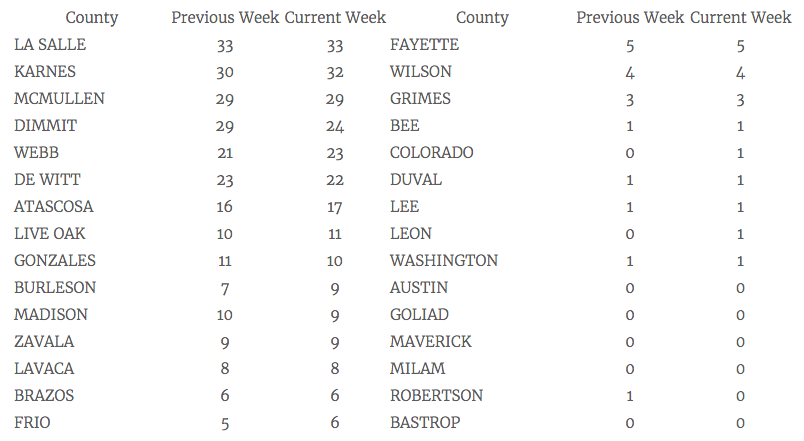
A total of 233 rigs are drilling horizontal wells, 19 rigs are drilling directional wells, and 14 rigs are drilling true vertical wells. Karnes, La Salle, Dimmit and McMullen counties each have at minimum 24 rigs running. LaSalle County has the highest rig count this week at 33. See the full list below in the Eagle Ford Shale Drilling by County:

South Texas Oil & Gas News:

Be sure to visit our South Texas Oilfield Job Listings to search openings and come back weekly for updates.

Eagle Ford Shale Drilling by County

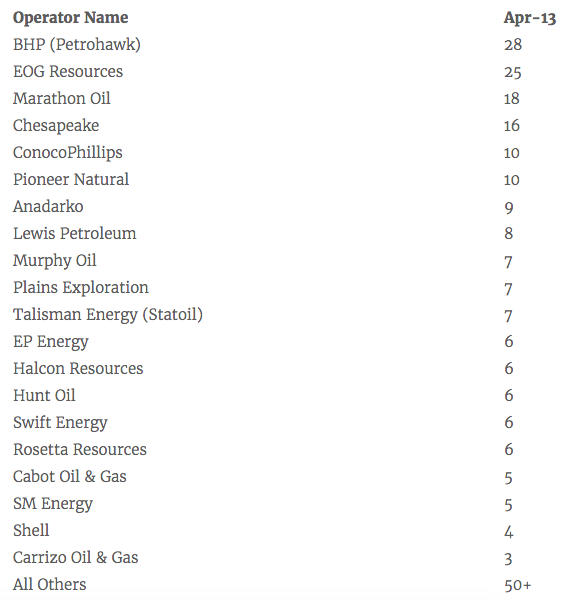
Eagle Ford Operated Rig Count By Company

SmithBits no longer reports its operated rig count, but we'll have updated number for you from a new source soon. Until then, you can reference our numbers from mid-April. There has not been a significant change in the overall rig count since this date:

What is the Rig Count?

The Eagle Ford Shale Rig Count is an index of the total number of oil & gas drilling rigs running across a 30 county area in South Texas. The South Texas rigs referred to in this article are for ALL drilling reported by Baker Hughes and not solely wells targeting the Eagle Ford formation. All land rigs and onshore rig data shown here are based upon industry estimates provided by the Baker Hughes Rig Count and/or Smith Service Co's (Schlumberger) Smith Rig Count.

Forest Oil Eagle Ford Drilling Shifting Gears in 2014 Due to Faulting

Forest Oil Eagle Ford Acreage Map Year-end 2013

Forest Oil is shifting gears in the Eagle Ford, after three gross (1.5 net) wells hit a fault line in the company's southern acreage during the fourth-quarter.

In 2013, Forest reported results on 44 gross (22 net) wells, with a 30-day average gross production rate of 408 boe/d. By contrast, 17 gross (8.5 net) wells drilled during the fourth-quarter had a 30-day average gross production of 304 boe/d. That's about ~25% less for the fourth-quarter, compared to the full year. Both gross production rates included the results from three gross (1.5 net) wells impacted by faulting.

The company had plans for 2014 to more than double its oil production in the Eagle Ford; however, due to faulting's negative impact on production in the fourth-quarter, the company is pulling back the reins.

77% of the company's $290-310 million capital budget was slated for the Eagle Ford, but new estimates have been set at 36%. Forest is re-allocating its budget to liquids-rich opportunities in the Ark-La-Tex, where it has a high degree of confidence in the geology.

Read more: Forest Oil Will Double Oil Production in 2014 - Securing Eagle Ford Acreage

“We are electing to defer Eagle Ford drilling activity as we complete the reprocessing and interpretation of 3D seismic data and also evaluate the success of recent well completion designs. Importantly, we maintain a balanced portfolio of projects that provides attractive risk-adjusted rate-of-return opportunities. This will enable us to reallocate capital to our liquids-rich opportunities in the Ark-La-Tex to maintain a consistent level of drilling activity in 2014. This decision will result in lower oil growth for 2014; however, we believe this is a prudent capital allocation decision”

Forest Oil Eagle Ford Outlook 2014

While seismic is being reprocessed and optimal well design is being evaluated, Forest will reduce the pace of drilling in the Eagle Ford. The company plans to drill 48 gross (24 net) wells, and expects that the net capital allocated to the Eagle Ford for drilling and completion activities in 2014 will total $95 million.

Forest Oil Eagle Ford Highlights

  • Faulting in southern Eagle Ford acreage impacts Forest Oil's allocation of 2014 capital budget and production plans
  • Eagle Ford capital budget slashed from ~$220 million to $95 million in 2014
  • 48 gross (24 net) wells to be drilled in the Eagle Ford in 2014
  • Forest shifting focus in 2014 from Eagle Ford to Ark-La-Tex
  • 25% less 30-day average gross production in Q4 compared to full year 2013
  • Net sales volumes in Q4 2013 of 2,950 boe/d

Read more at ForestOil.com

Lonestar Resources Acquires Eagle Ford Acreage in $71.3 Million Deal

Lonestar Eagle Ford Acreage Acquisition

Lonestar Resources acquired 15,232 gross (13,156 net) Eagle Ford acres for $71.3 million in late February 2014. With the acquisition, the company now holds 23,079 net acres in the Eagle Ford Shale.

The acreage assets included in the deal had a net production of 664 boe/d at the end of 2013, and are located in LaSalle, Frio, Wilson, Brazos and Robertson Counties.

There are many deals like this one taking place in the Eagle Ford. In 2013, approximately $9 billion was spent on acreage deals in the play.

Read more: Eagle Ford Deal Value Leads the U.S. in 2013

Lonestar's Drilling Inventory

Almost all of the acreage will be operated by Lonestar, which will increase the company's Eagle Ford Shale drilling inventory to seven years. Prior to this deal, Lonestar's drilling inventory was five years.

“In keeping with [our] core strategy, roughly 90% of the Eagle Ford locations are on leasehold which is operated by Lonestar. This feature, in combination with the fact that roughly two-thirds of the 13,156 net acres being acquired are already held by production (HBP), means that Lonestar will be able to largely dictate the pace of capital spending, which has always been critical to our ability to grow without stretching our available liquidity.”
— Lonestar's Managing Director, Frank Bracken

Lonestar's Eagle Ford Reserves

Lonestar Resource's proved reserves will increase by 7.4 million BOE and the company's proved PV-10* will increase by $138.3 million to $566.4 million. The deal increases Lonestar’s overall reserves (proved and probable) to 36 million BOE.

PV10 - Present value of estimated future oil and gas revenues, net of estimated direct expenses, discounted at an annual discount rate of 10%. This nomenclature is most commonly used in the energy industry, and is used to estimate the present value of a company's proved oil and gas reserves.

Read more at lonestarresourcesinc.com