
Eagle Ford Shale Rig Count Decreases by One to 271

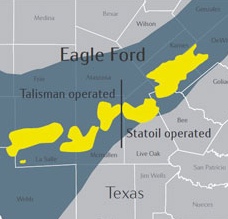
Statoil and Talisman Eagle Ford Acreage Map

The Eagle Ford Shale rig count decreased by one to 271 rigs running across our coverage area by the end of last week.

In recent news, Talisman Energy Inc. and Statoil ASA have tabled plans to to sell their joint venture in the Eagle Ford Shale after offers came in lower than expected, Bloomberg reported in early July of 2014. The companies were seeking around $4-billion for a 50-50 partnership, according to Bloomberg, which cited unidentified sources knowledgeable on the matter.

Read more: Statoil - Talisman Sale of Eagle Ford JV Tabled

The U.S. rig count increased by one to 1,875 rigs running by the end of last week. A total of 311 rigs were targeting natural gas (flat from the previous week) and 1,563 were targeting oil in the U.S. (one more than the previous week). The remainder were drilling service wells (e.g. disposal wells, injection wells, etc.). 898or ~48% of rigs active in the U.S. were running in Texas.

Baker Hughes rig count is quoted here. Baker Hughes also releases its own Eagle Ford Rig Count that covers the 14 core counties (218 rigs). The rig count published on EagleFordShale.com includes a 30 county area impacted by Eagle Ford development. A full list of the counties included can be found in the table near the bottom of this article.

Eagle Ford Oil & Gas Rigs

The natural gas rig count decreased by three to nine rigs running by the end of last week. Average rig counts for natural gas production in 2012 were around 82 and then dropped to around 41 in 2013. Natural gas prices fell slightly from the previous week to $4.14/mmbtu on Friday afternoon.

The oil rig count increased by one to 262 rigs running by the end of last week. WTI oil prices decreased by nearly $3 from the previous week, trading at $100.76/bbl on Friday afternoon. Eagle Ford light crude traded at $97.25/bbl on July 11th.

A total of 241 rigs are drilling horizontal wells, 11 rigs are drilling directional wells, and 19 rigs are drilling vertical wells. Karnes, La Salle, and De Witt each have at minimum 29 rigs running. La Salle County has the highest rig count this week at 31. See the full list below in the Eagle Ford Shale Drilling by County below

South Texas Oil & Gas News:

Be sure to visit our South Texas Oilfield Job Listings to search openings and come back weekly for updates.

Eagle Ford Shale Drilling by County

What is the Rig Count?

The Eagle Ford Shale Rig Count is an index of the total number of oil & gas drilling rigs running across a 30 county area in South Texas. The South Texas rigs referred to in this article are for ALL drilling reported by Baker Hughes and not solely wells targeting the Eagle Ford formation. All land rigs and onshore rig data shown here are based upon industry estimates provided by the Baker Hughes Rig Count and/or Smith Service Co's (Schlumberger) Smith Rig Count.

Statoil - Talisman Sale of Eagle Ford JV Tabled

Statoil and Talisman Eagle Ford Acreage Map

Talisman Energy Inc. and Statoil ASA have tabled plans to to sell their joint venture in the Eagle Ford Shale after offers came in lower than expected, Bloomberg reported in early July of 2014.

The companies were seeking around $4-billion for a 50-50 partnership, according to Bloomberg, which cited unidentified sources knowledgeable on the matter. Bids fell short in part because the venture produces especially light condensate, rather than crude oil, which commands more money, the article noted.

In June of 2013, our site reported (via Reuters) that Talisman Energy had retained the Royal Bank of Canada to determine if buyers were interested in the company’s Eagle Ford acreage. Talisman has approximately 70,000 net acres in the play according to a company spokesman.

Read more: Talisman Energy Shopping for Eagle Ford Buyers

Talisman said in March it plans to sell $2-billion of assets in 18 months to re-direct its focus on a smaller number of areas. In July of 2014, the company announced plans to unload its Australian operations.

Talisman and Statoil entered their joint venture in 2010. Last year, Statoil took over operations of the eastern portion of the JV. Statoil has approximately 73,000 net acres in the play.

Read more: Statoil - Talisman JV buys Enduring Resources Eagle Ford Acreage

Recent Eagle Ford Deal Closings

Recently, several other notable deals have closed as early Eagle Ford players cashed out on their investments in South Texas. Encana closed its acquisition of ~45,000 net Eagle Ford acres from Freeport McMoran on June 20, 2014 for $3.1 billion. Sanchez Energy also closed its $639 million deal with Shell for 106,000 net Eagle Ford acres on June 30th. Earlier this year, Devon Energy closed on its $6 billion Eagle Ford acreage acquisition with Geo Southern.

Read more: Eagle Ford Deal Closings

Read more: Devon Banking on High Returns from Eagle Ford Investment

U.S. is World's Largest Oil Producer

U.S. Oil Production
U.S. Oil Production

The U.S. is now the world's largest producer of oil, surpassing Russia and Saudi Arabia, according to Bank of America Corp. (BAC), as reported in Bloomberg.

U.S. crude oil output in the first quarter surpassed 11-million b/d, which was the highest volume produced by the country in 24 years. The U.S. is expected to hold the top spot through the end of the year, BAC officials said.

Most of that production is coming from Texas and North Dakota, which produced nearly half (48%) of all U.S. oil in April of 2014, according to the Energy Information Administration (EIA). Texas alone produced nearly 3-million b/d in the same month, thanks largely to the Eagle Ford Shale, reaching production levels not seen since the 70s.

Read more: Texas Oil Production Reaches Levels Not Seen Since the 70s

According to the International Energy Agency (IEA), U.S. oil output will increase to 13.1 million b/d in 2019 and plateau. Most analysts agree the Eagle Ford and Bakken Shale plays, which are largely responsible for production in Texas and North Dakota, will peak around this time, and begin to decline.

Oil Inventories Stacking Up

With the glut of oil being produced in the U.S., crude inventories on the U.S. Gulf Coast (USGC) have recently climbed to record levels according to the EIA, hitting 207.2 million bbl on April 11, 2014. The EIA says the USGC region has about 275 million bbls of current capacity, but more midstream projects pushing oil to the USGC have been scheduled.

To accommodate the influx of oil into the region, several crude oil storage projects are expected along the USGC through 2016. Recently, Haddington Ventures LLC, a midstream oil and gas investment firm, was identified in a Wall Street Journal (WSJ) blog as the designer/builder for a major crude oil storage project in Houston, TX.

Read more: Crude Supply Creates Demand for Storage Projects on USGC

Overall, the challenges that have come and will continue to come with the oil & gas renaissance in the U.S. seem to be outweighing most of the negative impacts. Namely, U.S. energy independence is the most favorable outcome, with tensions growing in Russia and unrest in the Middle East. The EIA predicts the U.S. will be energy independent by 2035.

Flare Gas Measurement Package Brings Oil & Gas Companies into Compliance with Federal Mandate - Press Release

Reliable, Low Cost Flare Gas Metering for Emissions Reporting

Pennsylvania-based Thermal Instrument Company, a 55 year old designer and manufacturer of industrial precision made thermal mass flow meters, has recently launched its flare gas flow measurement system for use in the upstream oil & gas exploration areas. This flare gas flow metering package brings companies into mandated monitoring compliance on flared emissions as stated by state and federal regulatory agencies. This Greenhouse Gas (GHG) Reporting Rule, 40 CFR Part 98, Subpart W is pertinent to reporting requirements and data collection for the upstream oil & gas exploration industry.

In March, 2014, the U.S. EPA published some proposed revisions to this 40 CFR Part 98, Subpart W to include general applicability, revised calculation methods and reporting requirements for specified emission sources within the source category, and some other changes to monitoring standards. Additionally, a Subpart OOOO (Quad O) has become another EPA standard for upstream & midstream gas exploration emissions compliance that must be met.

There are a small handful of oil & gas exploration companies taking the proactive approach early on to engineer the flow monitoring instrumentation onto the well pad site for monitoring the mass flow exiting the flare. At this point, the EPA has defined January 1, 2015 as a technically feasible date when the proposed revisions will be effective for this mandated monitoring and recording of flow exiting the flares at oil & gas exploration well sites.

In cooperation with a major gas exploration company in the Texas area of the Eagle Ford Shale formation, Thermal Instrument Company enhanced and completed their total flow monitoring system. Even with changes in gas composition, the flow monitoring system from Thermal Instrument Company was very repeatable and accurate and the customer was amazed at the less than five minute start-up time. The system can vary from just the flow measurement design to the whole package including solar panels, totalization module, and battery management hardware.

For more information on this flare gas flow system, contact Thermal Instrument Company at (215) 355-8400.

Oil Boom Plucks Engineering Professors from the Classroom

Pump Jack Image
Pump Jack Image

Researchers at The University of Texas at San Antonio (UTSA) predict the Eagle Ford Shale will support 117,000 jobs by 2021. And of those opportunities, many will be available in engineering.

Young engineers are being recruited in droves by oil & gas companies as the experienced, but aging workforce, nears retirement. For petroleum engineering students on the verge of graduating, job prospects are plentiful, but the staff at colleges and universities needed to train the next wave is waning.

Higher Education Needs a Lift from Qualified Engineers

The U.S. Bureau of Labor Statistics (BLS) calculates the median pay for Petroleum Engineers is 130,280 per year, with a job outlook growth rate of 26% through 2022. Due to attractive job prospects and high pay, classes at colleges and universities have been filling up quickly with students seeking degrees in the discipline; however, retaining qualified staff to teach these students has become a serious issue for colleges and universities. The reason: lucrative pay from the private sector is luring many professors away from their teaching jobs.

According to the Houston Chronicle, enrollment in petroleum engineering programs has nearly tripled at Texas A&M (1,100 students) and doubled at Texas Tech (500 students) since 2004. At The University of Houston, their program is outpacing its current five member staff, with 800 undergraduates and 120 masters degree students.

As colleges and universities grapple with recruitment challenges for staff, some industry experts worry the quality of the education the students are receiving will suffer because of the teacher to student ratio. To combat this, many colleges and universities are working with industry to recruit talent for teaching positions, pitching private sector employees take a sabbatical from their job to teach. Creative recruiting techniques like this are becoming more common because most universities and colleges simply can't afford to pay competitive salaries for teaching staff compared to the industry.