Cabot Grabs More Eagle Ford Acreage in Oil Window

Cabot Eagle Ford & Pearsall Shale Map

Houston-based Cabot Oil & Gas Corp. has agreed to pay $210-million for approximately 30,000 net acres in the heart of the Eagle Ford Shale oil window from an undisclosed seller. 17,000 net acres included in the transaction are directly adjacent to Cabot's Buckhorn operating area, which covers parts of Frio, La Salle and Atascosa Counties. The acquisition increases the company's total Buckhorn leasehold position to 60,000 net acres, and its total Eagle Ford position to 83,000 net acres.

Cabot is currently testing 300-foot downspacing across its existing Buckhorn position, which company officials say will add an additional 45 net locations on the acquired leasehold. As a result of this recent transaction, Cabot has added a fourth operated rig in the Eagle Ford to begin drilling on the newly acquired properties. In May, the company indicated it would expand its Eagle Ford drilling program in the third quarter of this year.

Read more: Cabot Oil & Gas to Expand Eagle Ford Drilling Program

“In addition to the number of new locations, this acreage will allow synergies in our operations on many fronts including infrastructure and facility utilization.”
— Cabot President and CEO, Dan O. Dinges.


According to Cabot officials. the assets are producing approximately 1,600 boe/d (92% liquids). Based on the company's current spacing configuration of 400 fteet between laterals, Cabot has identified 191 net locations on the additional Buckhorn area acreage with an average lateral length of over 6,500 feet.

The transaction is expected to close in October 2014.

Read more at cabotog.com

Eagle Ford Shale Rig Count Increases by One to 264

Oil Tanker Leaving Port of Corpus Christi

The Eagle Ford Shale rig count increased by one to 264 rigs running across our coverage area by the end of last week.

In recent news, the Environmental Protection Agency (EPA) has given a subsidiary of Conneticut-based Castleton Commodities International the green light for the construction of new petroleum process facilities near Corpus Christi, TX. The EPA issued the final greenhouse gas and prevention of significant deterioration construction permit to the subsidiary, CCI Corpus Christi, LLC, on Sept. 15th.

The company plans to build two fractionation units, capable of producing a combined 100,000 b/d and a bulk petroleum terminal. The terminal will include storage tanks and barge loading operations that can handle 500,000 barrels a day of crude condensate for export.

Read more: EPA Grants Permit for $500 Million Corpus Christi Condensate Splitter

The U.S. rig count stayed flat at 1,931 rigs running by the end of last week. A total of 329 rigs were targeting natural gas (nine less than the previous week) and 1,601 were targeting oil in the U.S. (9 more than the previous week). The remainder were drilling service wells (e.g. disposal wells, injection wells, etc.). 900 or ~48% of rigs active in the U.S. were running in Texas.

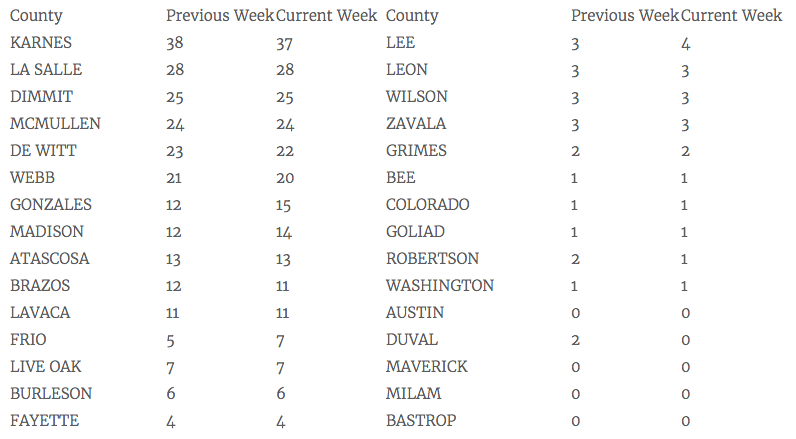
Baker Hughes rig count is quoted here. Baker Hughes also releases its own Eagle Ford Rig Count that covers the 14 core counties (205 rigs). The rig count published on EagleFordShale.com includes a 30 county area impacted by Eagle Ford development. A full list of the counties included can be found in the table near the bottom of this article.

Eagle Ford Oil & Gas Rigs

The natural gas rig count increased by one to 12 rigs running by the end of last week. Average rig counts for natural gas production in 2012 were around 80 and then dropped to around 40 in 2013. Natural gas prices stayed relatively flat from the previous week at $3.84/mmbtu on Friday afternoon.

The oil rig count stayed flat at 252 rigs running by the end of last week. WTI oil prices stayed relatively flat from the previous week, trading at $92.48/bbl on Friday afternoon. Eagle Ford light crude traded at $89.00/bbl on Sept. 19th.

A total of 246 rigs are drilling horizontal wells, eight rigs are drilling directional wells, and ten rigs are drilling vertical wells. Karnes, La Salle, and Dimmit each have at minimum 25 rigs running. Karnes County has the highest rig count this week at 37. See the full list below in the Eagle Ford Shale Drilling by County below

South Texas Oil & Gas News:

Be sure to visit our South Texas Oilfield Job Listings to search openings and come back weekly for updates.

Eagle Ford Shale Drilling by County

What is the Rig Count?

The Eagle Ford Shale Rig Count is an index of the total number of oil & gas drilling rigs running across a 30 county area in South Texas. The South Texas rigs referred to in this article are for ALL drilling reported by Baker Hughes and not solely wells targeting the Eagle Ford formation. All land rigs and onshore rig data shown here are based upon industry estimates provided by the Baker Hughes Rig Count.

Eagle Ford Sand Grab Underway

Frack Sand Storage
Frack Sand Storage

At the onset of the Eagle Ford boom, the biggest priority was getting skin in the game. Now, rather than a land grab, the next big thing may be a sand grab.

Next month, the EIA predicts the Eagle Ford will reach oil production of $1.5-million bbls/d, but according to the Houston Chronicle, 95% of the oil and gas is left behind, despite the high production numbers. With those statistics, operators are motivated to find ways to recover these hydrocarbons. One method already being applied is the use of copious amounts of sand in well completions, in order to further stimulate the well during the fracking process.

The use of sand in well completions stands to greatly benefit companies that supply sand to operators. Sand miner US Silica Holdings Inc. said its demand could triple over the next five years, according to Reuters. Thousands of tons of sand are used to frack just one well.

Texas GLO Adds $1.26-Billion to Fund for Public Schools

Wellhead Image
Wellhead Image

The Texas General Land Office (GLO) said this week $1.26-billion generated from the state's oil and gas activity will go to a fund to help support K-12 public education, according to a report in the San Antonio Express News. Texas draws this revenue from state-owned lands, which are leased to companies that conduct oil & gas operations on these properties.

Three primary areas (the Permian Basin, Barnett Shale and Eagle Ford Shale) are responsible for the recent oil & gas activity, but the funds won't be re-injected wholly into communities in these development areas. The way it works is the Permanent School Fund, currently valued at $34-billion, generates interest, and only the interest is allowed to be distributed to schools. According to the Texas GLO website, funds are doled out by the State Board of Education on a per-pupil basis across the state. Many Eagle Ford area school districts have benefited more directly from income drawn from other sources of revenue, including state tax revenue and municipal property taxes.

The problem several school districts in the Eagle Ford region are facing isn't necessarily a lack of state or local funds, but overcrowding, as workers chasing Eagle Ford oil jobs, along with their families, add to the population of cities and towns in the region. Another issue un-related to schools, and perhaps a more concerning one for many locals in certain areas of the Eagle Ford region, is a lack of funding from the state for adequate road repairs.

Read more:Eagle Ford Boom Bad News for County Roads - KENS-TV - video

Ultimately, the modern Texas oil boom has brought the entire state of Texas many good things, but all of it hasn't been good, and sometimes for local communities feeling the greatest impact of the boom, it hasn't always been fair. As with most things in life, people learn to take the good with the bad.

Read more at expressnews.com

Buckeye Partners Closes Deal for Eagle Ford Assets

Trafigura Terminals Eagle Ford Port in Corpus Christi

Buckeye Partners, L.P. has closed its $860-million transaction with Trafigura AG's South Texas Eagle Ford midstream assets.

The transaction creates a new joint venture - Buckeye Texas Partners. The new company will own and operate the divested Trafigura assets, but Trafigura will retain a 20% interest and have joint ownership of the new company. Both companies announced the acquisition and divestiture agreement earlier this month.

Read more: Buckeye Buys Eagle Ford Facilities - $860 Million

Buckeye Texas Partners will invest appoximately $240-million – $270-million on improvements to the system, increasing its liquid petroleum products storage capacity to 5.6-million barrels. A 50,000 barrel per day condensate splitter is currently under construction and is anticipated to be completed by mid-2015.

“Once the initial phase of expansion is complete, these assets will form an integrated system with connectivity from the production in the field to the marine terminal infrastructure in Corpus Christi, creating a logistics platform with significant flexibility and optionality.”
— Buckeye Partners CEO, Clark Smith

Read more at buckeye.com