
Anadarko Reduces 2015 Spending by 30%

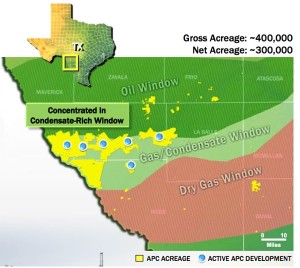
Anadarko Eagle Ford Shale Map

Anadarko released its initial capital expectations for 2015 that includes a 30% spending cut from last year and plans to reduce its Eagle Ford rig count.

Read more about Anadarko in the Eagle Ford

During 2014, Anadarko increased total sales volumes by 16%, generated $150 million in free cash flow, grew its production base by 11%, and posted a reserve replacement ratio of 161%. The company also reported average sales volumes increased by more than 90,000 BOEs per day over 2013.

“Our operational performance in 2014 was outstanding and Anadarko’s employees delivered a tremendous year across the board. Our U.S. onshore operations were nothing short of incredible, led by the Wattenberg field and the Eagle Ford shale resulting in full year volumes growth of 16%.”
— CEO, R.A. Walker

As Anadarko moves into 2015, they are making strategic and crucial decisions to remain strong. "In the current market," said Walker, "we believe it is prudent to reduce capital investments and position the company for the future, rather than to pursue year-over-year growth.”

  • Anticipates approximately 5% oil sales-volume growth
  • Improved 2015 liquids product mix of approximately 50%
  • Net resources of more than 1 billion BOE in the Wolfcamp Shale
  • More than $700 million of asset monetizations to date in 2015
  • Reduce our short-cycle U.S. onshore rig activity by 40 percent
  • Defer approximately 125 onshore well completions.

Anadarko considers the Eagle Ford to be one of the strongest parts of its portfolio and reported making more than 20 percent rates of return in this activity in 2014. The company expects production to continue to rise in the Eagle Ford even exceeding the 250,000 BOE per day in 2014. Due to low oil prices, they will reduce running rigs by half. The company plans to drill another 200 wells but will defer the completion on many until prices stabilize.


Eagle Ford Rig Count Falls to 163

EFS Rigs Decrease
EFS Rigs Decrease

The Eagle Ford Shale rig count decreased by 11 to 163 rigs running across our coverage by midday Friday.

In recent Eagle Ford news, it is predicted that several states will face a serious economic fallout from the drastic drop in prices. As the largest oil producing state in the country, Texas surely will feel the effects. But, exactly how are low oil prices affecting the Texas economy? As it turns out, Texas may not be as vulnerable as first imagined.

Read more: Low Oil Prices and the Texas Economy

The U.S. rig count fell another 72 to 1192 rigs running as of today. A total of 268 rigs were targeting natural gas (down 12 from the previous week) and 922 were targeting oil in the U.S. (64 less than the previous week). The remainder were drilling service wells (e.g. disposal wells, injection wells, etc.).501 of the rigs active in the U.S. were running in Texas.

Baker Hughes reports its own Eagle Ford Rig Count that covers the 14 core counties. The rig count published on EagleFordShale.com includes a 30 county area impacted by Eagle Ford development. A full list of the counties included can be found in the table near the bottom of this article.

Eagle Ford Oil & Gas Rigs

Natural gas rigs declined by one to 21 rigs by midday Friday. Natural gas prices decreased by $.09 from the previous week at $2.72/mmbtu on Friday afternoon.

The oil rig count declined by 11 to 163 rigs running by midday. WTI oil prices decreased by $4.37 from the previous week, trading at $44.81/bbl on Friday afternoon and EF light ended at $41.25. A total of 152 rigs are drilling horizontal wells, two rigs are drilling directional wells, and vertical rigs lost were at 9.  Karnes (29), LaSalle (20), DeWitt (19), and Webb (19) have the highest rig counts this week. See the full list below in the Eagle Ford Shale Drilling by County below.

Eagle Ford Shale Drilling by County

Eagle Ford Shale News

Eagle Ford Production Expected to Decline

Sanchez Energy CFO Steps Down

Abraxas Reports Best Year on Record

What is the Rig Count?

The Eagle Ford Shale Rig Count is an index of the total number of oil & gas drilling rigs running across a 30 county area in South Texas. The South Texas rigs referred to in this article are for ALL drilling reported by Baker Hughes and not solely wells targeting the Eagle Ford formation. All land rigs and onshore rig data shown here are based upon industry estimates provided by the Baker Hughes Rig Count.

For more information visit bakerhughes.com

Eagle Ford Production Expected to Decline

Eagle Ford Production to Dip in April

2014 was a record breaking year as shale oil production across the United States surged, but a new report suggests that trend may be shifting.

U.S. gains increased at least 100,000 barrels per day for 10 of the last 16 months. The Eagle Ford saw the same surges, as production increased from approximately 1,2 million barrels daily in 2014 and to over 1.7 million last month.

Related: Six Eagle Ford Counties Rank as Top U.S. Oil Producing Areas

Even the weekly loses of oil rigs since October hasn’t stopped production from soaring into numbers that have contributed significantly to a worldwide surplus. But this record streak may be coming to an end.

The U.S. Energy Information Administration (EIA) released a report on Monday that predicts oil production in the Eagle Ford Shale will dip in April, and possibly usher in a new trend of slower production. EIA analysts say that the Eagle Ford will produce 1.72 million barrels daily of crude oil and other liquids in April, down from an average of 1.73 million barrels daily this month.

Across the country, production from the six largest shale plays will hit 5.6 million barrels per day in April, which will be the smallest increase since February 2011.

This anticipated decline hasn't changed the fact that reserves are still very high. EIA reports that stockpiles grew by 4.5 million barrels last week brining the U.S. reserves to 449 million barrels of oil in storage.  It has been at least 80 years since the level has been this high.

Read more at eia.org

Sanchez Energy CFO Steps Down

Sanchez CFO Steps Down

Michael G. Long, the Executive Vice President and CFO of Sanchez Energy plans to step down from his position within the next 45 days.

This news came one week after the company reported record revenues and production for 2014. After Monday’s announcement, Sanchez stock fell -7.05%. 

Related: Sanchez Energy Ends Year Strong

Long joined Sanchez in 2008 and helped take the company public in 2011.

“Mike has contributed significantly to the formation, management and growth of Sanchez Energy since its IPO in 2011. Today the company is well positioned to continue its track record of success with strong liquidity, a solid capital structure and an asset base with an attractive and deep inventory. Mike has had a long and successful career dedicated to the energy industry, and we wish him and his family all the best as he plans this next phase of his life.”
— Tony Sanchez, III, President and Chief Executive Officer of Sanchez Energy

While the company searches for a permanent replacement, Gleeson Van Riet will serve as interim co-CFO, effective immediately. Van Riet is the senior vice president of capital markets and investor relations

Sanchez Energy is heavily invested in the Eagle Ford play. Since its latest acquisition in June 30, 2014, the company holds approximately 226,00 acres in the Eagle Ford with operations in various stages of development.

Related: Sanchez Nearly Doubles Eagle Ford Acreage

Find out more at sanchezenergy.com

Low Oil Prices and the Texas Economy

Texas State Flag
Texas State Flag

Since June 2014, the price of crude has dropped by over half, causing energy producers to tighten their belts, slash future budgets and reduce operating rig counts.

While this pricing environment has been good for consumers at the gasoline pump, it is predicted that several states will face a serious economic fallout from the drastic drop in prices.

Read more: Low Crude Prices Not Good for All

As the largest oil producing state in the country, Texas surely will feel the effects. But, exactly how are low oil prices affecting the Texas economy? As it turns out, Texas may not be as vulnerable as first imagined.

“States that host large oil production operations but derive a modest share of revenue from oil production, like California, Colorado, and Texas, benefit from significant economic diversity and losses in oil revenue will likely be offset by boosts in consumer-driven tax revenue.”
— Analyst Robert Fitch (via Texas Monthly)

In Texas, oil and gas taxes are only 9 percent of the state's general fund, vastly lower than that of other energy states such as Alaska (79%) North Dakota (46%) and Wyoming (40%). The energy industry has always been a dominant force in Texas, but since a similar crisis in the 80s, we have worked to build a much more diverse economy that no longer relies solely on oil to thrive.

The following overview gives the latest statistics for how Texas compares to the rest of the country on some key economic indicators (updated 3/6/15).

Jobs

  • UNITED STATES: 257,000 nonfarm jobs added in January 2015 and the unemployment rate was 5.6%.
  • TEXAS: Nonfarm employment increased by 41,100 jobs during December 2014. During 2014 total nonfarm employment increased by 457,900 jobs or 3.886%t. Texas unemployment rate was 4.6% for December 2014, down from 6.0% in December 2013 and has been at or below the national rate for 96 consecutive months.

Confidence Index

  • The U.S. consumer confidence index was 96.4 in February 2015, down 7.1% from January 2015
  • The Texas region's consumer confidence index was 117.0 in February 2015, up 0.3% percent from January 2015, and 4.7 percent higher than one year ago.

Taxes

  • Sales tax collections in fiscal 2015 through January were 11.2%  above collections for the same period in fiscal 2014.
  • Texas motor vehicle sales and rental tax collections for January 2015 were up 15.9% from January 2014