
Talisman Energy Cuts Jobs

Talisman Cuts Jobs
Talisman Cuts Jobs

Talisman Energy Inc., with extensive holdings in the Eagle Ford shale play, announced this week that it is cutting its workforce due to the continuing drop in crude prices.

Related: Energy Giants Announce Layoffs

Layoffs will affect between 150-200 employees and contractors from Talisman’s head office in Calgary. These cuts coincide with the company’s plans to trim its 2015 capital program to $2.1 billion, a 30 percent drop from 2014. So far, the company has not announced any job cuts in its Texas operations.

“Our decision to reduce our workforce numbers is based on the decline in global commodity prices, which has meant a reduced capital spending program for us this year. The impacts of the reductions are hitting all functions supporting all parts of the organization.”
— Talisman spokesperson, Brent Anderson

Oil prices have fluctuated since the first of the year. After a short move upwards, the price has hovered around the mid forties for the past two weeks.

In February, Talisman Energy shareholders finalized the sale of the company to Repsol and expected to close in the second quarter of 2015. The company announced that job cuts are unrelated to this acquisition.

Read more: Repsol to Aquire Talisman Energy

Talisman’s interests in the Eagle Ford shale play are located in southeast Texas, where the Company now holds approximately 59,000 net acres of land in the following counties:

Eagle Ford Rig Count Down 10

Mineral Owners May be Losing Money

The Eagle Ford Shale rig count decreased by 10 to 153 rigs running across our coverage by midday Friday.

In recent Eagle Ford news, mineral owners are finding they must be extra vigilant to make sure their interests are protected. A four year statute of limitations to correct royalty payment errors has many mineral owners scrambling to make sure they are being treated fairly.

Read more: Mineral Owners Race the Clock in Texas

The U.S. rig count fell another 56 to 1069 rigs running as of today. A total of 242 rigs were targeting natural gas (down 15 from the previous week) and 825 were targeting oil in the U.S. (41 less than the previous week). The remainder were drilling service wells (e.g. disposal wells, injection wells, etc.)465 of the rigs active in the U.S. were running in Texas.

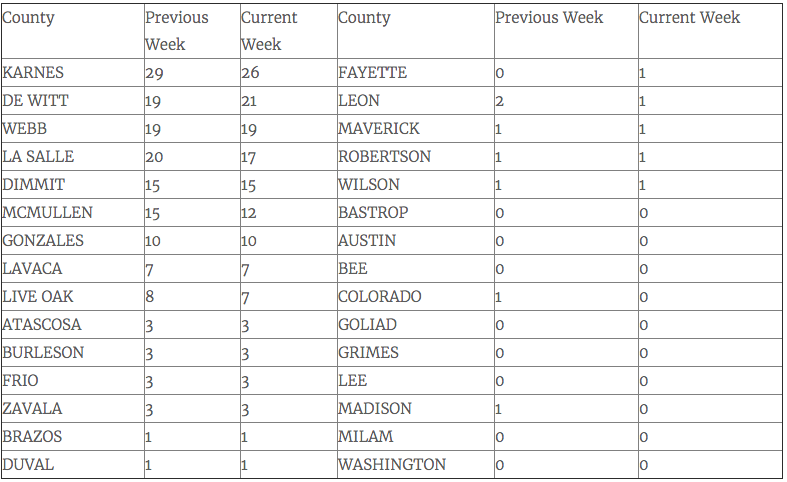
Baker Hughes reports its own Eagle Ford Rig Count that covers the 14 core counties. The rig count published on EagleFordShale.com includes a 30 county area impacted by Eagle Ford development. A full list of the counties included can be found in the table near the bottom of this article.

Eagle Ford Oil & Gas Rigs

Natural gas rigs declined by one to 16 rigs by midday Friday. Natural gas prices increased $.06 from the previous week at $2.79/mmbtu on Friday afternoon.

The oil rig count declined by 15 to 137 rigs running by midday. WTI oil prices increased $.91 from the previous week, trading at $45.72/bbl on Friday afternoon and EF light ended up $1.00 at $42.25. A total of 145 rigs are drilling horizontal wells, two rigs are drilling directional wells, and vertical rigs were at six.  Karnes (26), LaSalle, DeWitt (21), and Webb (19) have the highest rig counts this week. See the full list below in the Eagle Ford Shale Drilling by County below.

Eagle Ford Shale Drilling by County

Eagle Ford Shale News

Halcón Announces 2014 Earnings

Chesapeake Lawsuit Adds to Legal Trouble

Anadarko Reduces 2015 Spending by 30%

What is the Rig Count?

The Eagle Ford Shale Rig Count is an index of the total number of oil & gas drilling rigs running across a 30 county area in South Texas. The South Texas rigs referred to in this article are for ALL drilling reported by Baker Hughes and not solely wells targeting the Eagle Ford formation. All land rigs and onshore rig data shown here are based upon industry estimates provided by the Baker Hughes Rig Count.

Read more at bakerhughes.com

Chesapeake Lawsuit Adds to Legal Trouble

White Tail Deer at Center of Lawsuit

Legal trouble continues to haunt Chesapeake Energy as mineral owners dispute royalty payments and contracts. This week, white tailed deer are at the center of another lawsuit that is now in a San Antonio court.

A recent lawsuit filed in January, claims that a Chesapeake employee hunted, killed and removed the white-tailed deer that roamed the Dimmett County property of James Birkner. Birkner’s lease with Chesapeake dates from 2010 and does not authorize hunting by Chesapeake employees on this land. Once the allegations were made, the company abruptly ended negotiations to renew its lease and vanished from the property. The claims against Chesapeake include negligence, trespass and breach of contract.

The company has other legal trouble. In January, the company agreed to pay $119 million to settle a class action suite from 2013 that included thousands of royalty owners involving possibly 10,000 wells. And, most recently, a group of landowners in  Bradford County, PA filed a suit alleging that Chesapeake and Williams Partners violated antitrust laws by conspired to restrain trade in the market for gas gathering services.

In February, Chesapeake filed a lawsuit against American Energy Partners alleging that ex CEO Aubrey McClendon stole confidential documents including maps of oil and gas prospects before leaving the company in 2013. Read more here

With more and more Texas lease holders scrutinizing their royalty statements the company may have more to worry about. 

Read more:  Mineral Owners Race the Clock in Texas

Chesapeake is active all across the Eagle Ford including Atascosa County, Dimmit County, Duval County, Frio County, Goliad County, LaSalle County, McMullen County, Washington County, Webb County and Zavala County.

© Nicolaselowe | Dreamstime.com - White-tailed Deer Photo

Halcón Announces 2014 Earnings

Halcon Resource's Eagle Ford Acreage Map

Halcón Resources announced its 2014 results that included a net income for of $71.7 million and record production for its Eagle Ford operations.

Related: Halcón Resources Reduces 2015 Budget | Bakken Shale

Halcón operations in the Eagle Ford saw a production growth of 136% year-over-year. The company operated an average of three rigs in El Halcón during the fourth quarter, but currently have only one rig running. For 2015 El Halcón drilling program will focus on capturing leases and holding acreage. Foremost, the company will focus on ways to reduce completed well costs.

Other 2014 highlights include:

  • Q4 revenues of $239.5 million
  • Revenues for the full year 2014 totaled $1,148.3 million, an increase of 15% compared to the full year 2013
  • Q4 production was 46,076 barrels of oil equivalent per day (Boe/d) and 42,107 Boe/d, respectively
  • Production was comprised of 81% oil, 9% natural gas liquids (NGLs) and 10% natural gas for the quarter and 83% oil, 7% NGLs and 10% natural gas for the year.
  • Q4 operating costs per unit decreased by 23% compared to the same period of 2013
  • Total operating costs per unit for the full year were $24.14 per Boe, representing a decrease of 17%
“We’ve reduced our 2015 drilling completion budget several times over the past few months. Service costs have come down significantly and continue to come down since the beginning of the year. Companywide, we currently have 26 operated wells being completed or waiting on completion. We’re operating three rigs, two in the Williston and one at El Halcón in East Texas.”
— Floyd C. Wilson, Chairman & CEO

Halcón expects that completed well costs will decline by an additional 10% to 20% by midyear. In addition to across-the-board service cost reductions, they also plan to bring certain tasks in-house in order to reduce middlemen cost.

Read more at halconresources.com

Mineral Owners Race the Clock in Texas

Mineral Owners May be Losing Money

Mineral Owners May be Losing Money

The oil and gas boom has made many Texans rich since 2008, but some mineral owners may not be getting what they deserve. A four year statute of limitations to correct payments errors has many owners scrambling to make sure they are being treated fairly.

Read more about mineral rights in Texas

Texas has a provision that allows mineral owners to request an audit if they have a dispute with an operators, which might involve royalty payment discrepancies, lease issues, drilling provisions or surface obligations. During an audit, production information, check stubs and other data is scrutinized to make sure operators have held up to their commitments in the lease.

If an owner suspects a problem, they have a four year time limit (from the time of infraction) to request an audit. This may seem like plenty of time, but it is not always clear what operators are doing and sometimes a problem isn’t obvious until it is too late.

Texas case law has laid a heavy burden on mineral owners to make sure energy companies pay what is owed. In 2012, the Texas Supreme Court issued a decision in Shell v Ross that requires owners to do their own exhaustive audits to find out if payments are correct.

“Readily accessible and publicly available information could have led the Rosses to discover that Shell was underpaying royalty before the limitations period expired,” the Texas Supreme Court ruled. “We hold that evidence conclusively established that Shell’s alleged fraud could have been discovered by the Rosses through the exercise of reasonable diligence.”

This increased responsibility for mineral owners can be overwhelming and, in some cases, impossible if they don't have access to the proper information. Owners must be extra vigilant about all parts of the process, especially making sure they have a good lease that gives them the authority to inspect an operator’s books, accounts, reports or other accounting records.

Connect with other mineral owners at MineralRightsForum.com