Sabine Files Chapter 11

Chesapeake Cuts Budget for 2015
Sabine Energy Files Bankruptcy

Sabine Oil & Gas Corp. became the largest U.S. oil producer to file for Chapter 11 bankruptcy protection this week, making it the sixth producer to take this action since the first of the year.

This decision follows months of speculation as Sabine struggled to pay creditors.

Related: Repsol Moves into the Eagle Ford

Since the decline in oil prices, there have been mergers, acquisitions and layoffs, but not as many bankruptcies as expected. But some analysts warn that this is just the tip of the iceberg and are forecasting more bankruptcies later in the year.

Operations have been significantly impacted by the recent and dramatic decline in oil prices, the continued low prices of natural gas, and general uncertainty in the energy market. Sabine continues to evaluate and discuss alternatives with its stakeholders and believes that its in-court financial restructuring will position Sabine for profitability and long-term success.
— Sabine

Other U.S producers who have filed bankruptcy include American Eagle Energy, Quicksilver Resources, BPZ Resources, WBH Energy and Walter Energy.

In May, Sabine reported first quarter increase of 116% for oil production over the same time last year as well as completing 15 wells across Texas. In the Eagle Ford, the company completed two wells in the Shiner Area in northern DeWitt County and southern Lavaca County which together averaged an IP30 of over 1,300 BOEPD, with 39% oil and 70% liquids.


Frac Sand Shipment Largest on Record

Speed Limits For Crude by Rail
Record Frac Sand Transport

Three Eagle Ford Companies have broken a national oil industry record by moving a massive amount of frac sand by rail.

Related: Supply Chain Initiative Launched for Bakken

Unimin Energy Solutions, Union Pacific Railroad and Twin Eagle Sand Logistics moved 14,000 tons of frac sand on July 4th weekend. The 140 cars measured 6,200 feet long and were powered by four diesel engines. The shipment was certified by Union Pacific as the largest single frac sand rail delivery in the United States.

This event is significant because it shows the continued improvements in all aspects of the oil and gas industry, including supply chain efficiency.

Twin Eagle Senior Vice President Jason Jennaro told the San Antonio Business Journal that it is a challenging market but the number of sand unit trains that have landed at the company's terminals have doubled or tripled so far in 2015. 

We believe this is emblematic of oil companies’ continued drive towards supply-chain efficiency. Further, we see this trend continuing next year into what is likely to be a more normalized market environment,” Jennaro said.

Getting the sand to its final destination is another logistics feat. Company officials said it takes four to five 18-wheelers at least 94 truck trips to haul enough sand to a drilling site.

Eagle Ford Company Beats Giant

Chesapeake Before Texas High Court
Eagle Ford Company Takes on Dept. of Labor

Small Eagle Ford company wins “David v Goliath” battle with the  U.S. Department of Labor.

Related: Eagle Ford Family Wants Their Day in Court

Bert Steindorf, the owner of Gate Guard Services, won a victory last week in his two-year battle to retrieve attorneys fees from a 2013 case he won over the Department of Labor

The trouble started when the Labor Department claimed Gate Guard owed $6.2 million in back pay, including minimum wage and overtime for employees it classified as independent contractors. Senior U.S. District Judge John Rainey sided with the company and classified the workers as employees and awarded Steindorf $565,000, which amounts to $125 an hour.

Stendorf appealed and the 5th Circuit of Appeals found examples of ‘bad faith’ and said that the Department of Labor was rife with misconduct. This ruling opens the door for Steindorf to potentially receive compensation that is closer to the actual fees he paid out during the trial. The final dollar amount is expected to be awarded later this month, but the government agency may now have to pay up to $1 million.

Gate Guard Services is a small Corpus Christie-based company that provides security services to oil fields in the Eagle Ford Shale. The company is fortunate it had the resources necessary to continue to fight.

Not many small service companies in the energy sector can afford to fight. They simply do not have the the financial wherewithal in a prolonged legal battle.
— Defense attorney, Daniel Pipitone

Fracking Uses 16% of Eagle Ford Water

Water Usage Increases in Eagle Ford

Researchers from the University of Austin say that water usage in the Eagle Ford has expanded exponentially over the last five years thanks to fracking.

Related: Eagle Ford Shale Water Use and Concerns

The study, conducted by Bridget Scanlon, Robert Reedy and Jean Philippe Nicot,  originated from concerns about potential water constraints that might limit oil and gas production using hydraulic fracturing in shale plays, particularly in semiarid regions and during droughts.

Fracking relies on massive amounts of water to break the shale rock to extract oil or gas. Scientis tracked Eagle Ford water usage for hydraulic fracturing between 2009 and 2013 and found that the 18 billion gallons used represent ~ 16% of the total water consumption in the area for 2012.

The study concluded that the regional impact is relatively small, saying “The comprehensive analysis of Eagle Ford water issues and comparison with other semiarid plays indicates that, with proper management, water should not constrain hydraulic fracking in these semiarid regions.”

The biggest area of concern noted in the study is that the Carrizo Wilcox Aquifer in the western part of the Eagle Ford has been declining for decades due to agricultural pumping in the area. Researchers go on to advise that producers should consider using brackish water as a way to avoid clashing with agricultural interests.

Related: South Texas Water Supply Sufficient

Read the full text of the UT study here.

Eagle Ford Rig Count Drops to 115

Eagle Ford Rig Count
Eagle Ford Rigs Decrease

The Eagle Ford Shale rig count fell by five this week to 115 rigs running across our coverage area by midday Thursday

In recent Eagle Ford news, the temporary housing market for oilfield workers in the Eagle Ford is hanging on despite slower demand. New numbers by the Comptroller’s Office show lodging providers in the Eagle Ford took in $63 million in revenue in the first quarter of the year, down 11 percent from the previous quarter, but a $5.1 million increase over 2014.

Read more: Eagle Ford Hotels: Down But Not Out

The U.S. rig count increased slightly, ending with 863 rigs running by midday Friday.  A total of 217 rigs were targeting natural gas (two less than the previous week) and 645 were targeting oil in the U.S. (five more than the previous week). The remainder were drilling service wells (e.g. disposal wells, injection wells, etc.)368 of the rigs active in the U.S. were running in Texas.

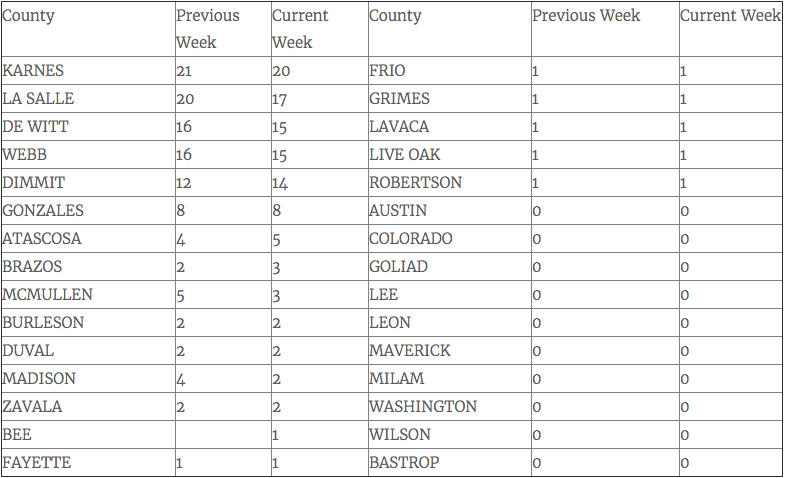
Baker Hughes reports its own Eagle Ford Rig Count that covers the 14 core counties. The rig count published on EagleFordShale.com includes a 30 county area impacted by Eagle Ford development. A full list of the counties included can be found in the table near the bottom of this article.

Eagle Ford Oil & Gas Rigs

Natural gas rigs in the Eagle Ford fell to 25 this week and natural gas prices traded at $2.77/mmbtu, an decrease of  $.04 from the previous week.

The oil rig count fell by four to 90 as WTI oil prices dropped to $52.74, a decrease of $3.98. A total of 105 rigs are drilling horizontal wells, zero are drilling directional wells, and 10 are vertical rigs. Karnes leads development this week running 20 rigs, with LaSalle (17), DeWitt (15) and Webb (15) follow closely. See the full list below in the Eagle Ford Shale Drilling by County below.

Eagle Ford Shale Drilling by Count

Eagle Ford Shale News

Oil Export Ban: No Fans in Texas

Texas Railroad Commission Available 24/7

Texas Drilling Still Sluggish

What is the Rig Count?

The Eagle Ford Shale Rig Count is an index of the total number of oil & gas drilling rigs running across a 30 county area in South Texas. The South Texas rigs referred to in this article are for ALL drilling reported by Baker Hughes and not solely wells targeting the Eagle Ford formation. All land rigs and onshore rig data shown here are based upon industry estimates provided by the Baker Hughes Rig Count. Read more at bakerhughes.com