Penn Virginia Pearsall Well Test Drilling as Eagle Ford Reserves Surge

Penn Virginia Eagle Ford Acreage Map

Penn Virginia Corp grew Eagle Ford reserves 161% in 2012 from 10 mmboe to 26.1 mmboe. Reserves received a boost as the company's production grew to 6,900 boe/d in the fourth quarter of 2012, which represents growth of 600 boe/d over third quarter volumes of 6,300 boe/d.

Penn Virginia has plans to spend 88% or ~$335 million of its $360-400 million budget in the Eagle Ford.

H. Baird Whitehead, CEO, concluded, “Our steadily improving results have been driven primarily by our oily Eagle Ford Shale play where we significantly increased our acreage and drilling inventory during 2012. Building on this success, we plan to commit approximately 88 percent of estimated 2013 capital expenditures to the Eagle Ford Shale, drilling approximately 38 (28.8 net) wells and focusing on expanding our Eagle Ford Shale position.”

The company also expects estimated ultimate recovery (EUR) for Eagle Ford wells with full-length laterals in Gonzales County are approximately 400,000 boe and in Lavaca County EURs are approximately 500,000 boe. A recently completed Eagle Ford well, the Technik #1H in Lavaca County, was completed with 18 frac stages and tested at an initial rate of 1,136 b/d and 1.9 mmcfd on a 25/64th inch choke at flowing casing pressure of approximately 2,350 psi.

In January, PVA had 66 (55.1 net) Eagle Ford Shale wells on line, with one (0.9 net) well waiting on completion, two wells being drilled in the Eagle Ford Shale in Lavaca County and one horizontal test well being drilled in the Pearsall Shale in Gonzales County.

Currently, the company has approximately 40,000 gross ( 32,000 net) acres targeting the Eagle Ford Shale. In the fourth quarter, the company added approximately 2,000 net acres at a cost of approximately $4.9 million

Gonzales County Pearsall Well Being Tested

The company should begin completion of it's Pearsall test in Gonzales County late in the first quarter. The company completed a vertical well and a core test in 2012. Watch for well results as this will be one of the first publicized Pearsall wells in the area. EOG is testing other formations in the area, but has yet to comment on its exploration program publically.
 

Sanchez Energy Drills & Completes 19 Wells in 2012

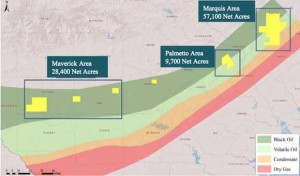
Sanchez Energy Eagle Ford Shale Map

Sanchez Energy drilled and completed 19 wells, while growing production 170% to over 468,000 boe in 2012. The company also has 17 wells in the process of being drilled or completed. Ten of the 17 are located in the Palmetto Area and seven are awaiting completion in the Marquis Area.

Tony Sanchez, III, CEO, commented: "The operational momentum we established late last year is continuing and improving. We exited 2012 with outstanding reserve growth and a growing backlog of wells which will be completed and added to our production stream over the next several months."

Developments underway or completed late in the year include:

  • 20,000 b/d and 30 mmcfd of takeaway capacity at Palmetto
  • Gathering system construction in the Marquis Area that will allow for full development
  • Added 7,500 net acres in the Marquis Area near the Prost wells
  • Shifting to pad drilling

Plans in 2013 are for the drilling of 33.5 net wells and strong well performance at the end of 2012 has added confidence.

The Prost B#1, our third well in the Marquis area, has exhibited high production performance as a result of optimized completion techniques and flowback management.  This well achieved an IP of 1,114 BOE/d on a 14/64" choke in addition to 30- and 60-day average flow rates of 936 and 808 BOE/d, demonstrating a significantly shallower decline profile as compared to our initial two wells in this immediate area.

Sanchez realized oil prices of more than $101/bbl and natural gas prices near $2.50/mmbtu.

Read the full press release at sanchezenergy.com

Fuel Saving Tips in the Eagle Ford

Fuel Saving Tips - Truck Stop

Fuel prices have been steadily increasing making it harder for all carriers to be profitable. This includes drivers working in the Eagle Ford Shale. The national average of diesel is well over $4.00. This affects trucking companies and consumers more than many people might realize. With over 75 percent of all United States communities relying solely on trucks to bring their commodities, the prices of groceries and necessities increase every time the price of diesel goes up because the cost of transporting cargo gets passed on to the consumer.

There’s no magic wand to wave and decrease the cost of fuel. However, there are quite a few things that drivers can do to get the most out of their fuel consumption. Economy driving tips will help you keep a few more dollars in your pocket.

Economy Driving Techniques

[ic-r]The most productive way to reduce your fuel consumption is to keep your speed down when it is possible. Speeding uses a lot fuel. Try and reduce your speed to a safe and manageable speed that will allow you to be on time. Though you might think you’re saving time, speeding doesn’t get you there all that much faster. For example, if you drive 100 miles at 55 mph, you will travel for one hour and 49 minutes. Increasing your speed to 60 mph will save you only five minutes. Meanwhile, you burn a lot more fuel. A 2011 study by the European Economic Agency stated that complying with speed limits can save two to three percent and possibly as much as 12 to 18 percent. According to Overdrive magazine, reducing speed just one mph below 55 reduces fuel consumption 2.2 percent.

Progressive shifting is a very effective way to reduce fuel consumption. Today’s engines are much stronger and efficient. They are designed to use fewer rpm to get up to the ideal speed. Developing a habit of using progressive shifting will save you a lot of money.

Trip planning can also save you money on fuel consumption. Try to avoid highly congested areas during peak traffic times so you don’t waste fuel going nowhere in traffic jams. Plan your trip around rush hour traffic when possible.

Upgrade to a later model vehicle if you can. Newer engines are designed to use less fuel and require a lower rpm to get to efficient operating speeds.

Idling uses a lot of fuel.  Try and develop a good habit of shutting your engine down when possible. Many states have very strict laws about idling but even if it’s not required by law, this simple habit could save you big.

The weight distribution of your load can also be causing you to use more fuel than needed. Inspect your load carefully to make sure it is evenly distributed.

Make sure your vehicle is in tip top shape. Vehicle maintenance is crucial to your daily operation and can save you money in fuel consumption as well as major repairs. Make sure you are inspecting your vehicle thoroughly to avoid any hazards on the road. Improper tire inflation can cause you to get terrible fuel mileage.  Always have a tire gauge handy and inspect every time you do your pre-and post-trip inspections.

Every Little Bit Counts

No single economy driving tip will have a major impact. However, try utilizing several of them. You should be able to notice the difference in your fuel consumption.

New Water Management Solutions Decrease Oil & Gas Impact - Press Release

Bosque Systems
Bosque Systems

Water is an essential component for oil and natural gas production during both the drilling and hydraulic fracturing processes.  Most of the water used comes from surface water sources such as area lakes, ponds, rivers and municipal supplies. Historically, the water used in drilling and hydraulic fracturing has been a one-time use.  With recent droughts, oil and natural gas operators have been seeking alternative sources of water to be used in aiding their production to minimize their ecological impacts.

Typical Oil & Gas Well Water Usage

“Having mobile water treatment units allows us to integrate with the frac crew and move seamlessly from job to job”, explains Peter Pappas. “We have treated millions of barrels of both fresh and produced water. Our cost-effective solution has better efficacy than traditional biocides, and is an environmentally friendly solution.”

In order to frac a well, operators use 500,000 to 1,000,000 gallons of water for each stage, and a well may need up to 20 stages. With local regulations being reinforced and public concerns, water is now thought as the most critical resource operators utilize when producing oil and gas in all regions. Until recently, produced water, which includes water produced during the initial flowback process, was an undesirable and costly byproduct of oil and gas production. It is also one of the "continually produced" substances during the oil and gas production that poses environmental risks. With Bosque System's technology, operators can now re-use the produced and flowback water for hydraulic fracturing operation, thus reducing the amount of fresh water and in some cases, water trucked to the producing zone.

Water recycling is an important topic because of the increase in oil and gas production in North America coupled with fresh water shortages. Bosque Systems has contracts with major operators across oil and gas plays to treat their water for re-use in the hydraulic fracturing process.

Multiple Solutions Needed To Tackle Water Treatment

Bosque Systems has patents or patents pending on several technologies. One technology employed by Bosque Systems, according to Robert Mitchell, is a mobile water recycling unit, which precipitates solids in the water and extracts them. He said Bosque has mobile units dedicated to different regions of the country, including the Permian Basin, the Mid-Continent, the Eagle Ford Shale in South Texas, and the Bakken Shale in North Dakota.

“Being a service provider, we believe safety and results are the two most important components for our customers. As such, we continually test and monitor the quality of the water we treat in order to report and validate our results to operators”, Peter Pappas added. “We are a full solution provider.”

“Recognizing the needs early on for water management within the new types of oil and gas production methods, Bosque Systems is well ahead of its competition.”
— Clane LaCrosse, CEO and president of Bosque Systems.

Headquartered in Fort Worth, TX, Bosque Systems, LLC has seen this challenge for many years and developed technologies to reduce the impact of operators on water resources. The company is involved in working with operators to provide customized water management solutions.

Bosque Systems is a solutions-based company that specializes in designing complex turnkey solutions to solve operators' water management needs from inception to completion, with expert project management teams able to design, engineer, and provide support for oil and gas operators’ water challenges. Our solutions include water treatment, saltwater disposal, gathering systems and specialized custom solutions designed to meet specific customer requirements. “Bosque enjoys multiple advantages as compared to competitors. We do not push one technology in particular but rather design solutions around each customer’s location, water quality and economic needs”, said Peter Pappas, vice president of growth and business development.

“Water from fracturing operations is exposed to millions of naturally occurring microbial contaminants which can cause souring; corrosion; plugging in pipelines and injection wells, pumps, and filters; and emulsion problems”, said Robert Mitchell, director of technology for Bosque Systems. “Partnering with oil and gas operators, Bosque has identified a need for an environmentally safe, effective and cost-efficient solution for treating water being used for hydraulic fracturing”, he continued.

About Bosque Systems, LLC

Bosque Systems, LLC provides full water management services to oil and natural gas operators. We are a solutions-based company that specializes in designing complex turnkey solutions to solve operators' water management needs from inception to completion, with expert project management teams able to design, engineer, and provide support for oil and gas operators’ water challenges. Our solutions include water treatment, saltwater disposal, gathering systems and specialized custom solutions designed to meet specific customer requirements.

For media contact or more information: Marc Bellanger [email protected]www.bosquesystems.com

The article above was published through EagleFordShale.com’s press release distribution service. Learn more about Eagle Ford Advertising Here.

Eagle Ford Shale Consortium Conference 2013

Eagle Ford Consortium

The Eagle Ford Shale Consortium Conference was held in San Antonio on March 7-8 and about 800 people attended. Leaders from around the area join to share how the Eagle Ford has changed their business to date and what they expect in the future.

Highlights include:

  • The Three Rivers Refinery (operated by Valero) was close to being mothballed before the Eagle Ford
  • Now, Dairy Queen is paying a signing bonus in Three Rivers
  • Marathon CEO - The Eagle Ford is the "best" unconventional play in North America and maybe the world
  • Operators have been playing catch up building pipelines and gathering systems
  • Rents and Eagle Ford Housing prices have doubled and tripled across most of the area
  • 911 calls have doubled in South Texas
  • McMullen County has seen an increase in wrecks of 400%, with no EMS service
  • Healthcare is the next area in need of growth
  • Demand is surging for primary care, treatment of diseases, treatment for joint & back problems
  • Other industries are having trouble keeping employees from jumping into oilfield jobs

You can read more in the following articles from mysa.com, and two from Here and Here from caller.com