Abraxas Raises Eagle Ford Cap-Ex Budget by $35 Million

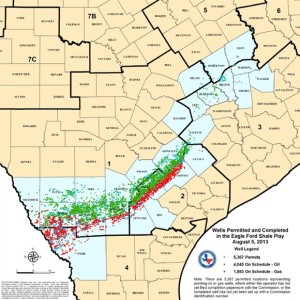
Abraxas Eagle Ford Acreage Map

San Antonio-based Abraxas Petroleum announced in June it will spend an additional $35-million in the Eagle Ford in 2014, raising the company's total cap-ex budget for the year to $160-million. Due to the increase in capital, Abraxas raised its total production guidance for the year to 5500 - 5700 boe/d from 5,200 - 5,300 boe/d.

The newly approved capital funds will be directed to the drilling of three additional Eagle Ford wells, two of which will be drilled in McMullen County, TX. In April of 2014, the company released strong initial production figures for one of its recently completed wells in the area.

Read more: Abraxas Petroleum Operations Update Reveals Strong Initial Production (IP) Rate for McMullen County Well

“The incremental capital will go directly to drilling three long lateral wells in the Eagle Ford, which will drive additional production and cash flow growth.”
— Bob Watson, President and CEO of Abraxas

Company officials say the increased capital program will be funded by increased cash flows from operations and borrowings under the company's credit facility.

At the end of 2013, Abraxas Petroleum sold some of its Eagle Ford acreage and production in the company’s WyCross area in McMullen County for $73 million. The deal included ~1,200 net acres from a 25% working interest in 5,986 gross (4,809.5 net) acres and net production of 655 boe/d (~90% oil). Proved reserves on the property were estimated at 3.7 million boe. A portion of the proceeds from the sale were used to pay down company debt, which has fallen to $38 million from $140 million in 2012.

Read more: Abraxas Petroleum Sells Eagle Ford Acreage in McMullen County to Redman Resources - $73 Million

In addition to its Eagle Ford operations, Abraxas is also active in North Dakota's Bakken Shale play, and the Delaware Basin in West Texas.

Read more at abraxaspetroleum.com

Eagle Ford Shale Rig Count Increases by Two to 271

Eagle Ford Shale Well Map

The Eagle Ford Shale rig count increased by two to 271 rigs running across our coverage area by the end of last week.

In recent Eagle Ford news, the oil and gas research and consulting firm Wood Mackenzie predicts the Eagle Ford will reach two-million b/d of crude and condensate production by 2020.

Read more: WoodMac: Eagle Ford to  Hit Two-Million b/d Mark by 2020

The U.S. rig count increased by nine to 1,860 rigs running by the end of last week. A total of 320 rigs were targeting natural gas (six less than the previous week) and 1,536 were targeting oil in the U.S. (flat from the previous week). The remainder were drilling service wells (e.g. disposal wells, injection wells, etc.). 896or ~48% of rigs active in the U.S. were running in Texas.

Baker Hughes rig count is quoted here. Baker Hughes also releases its own Eagle Ford Rig Count that covers the 14 core counties (214 rigs). The rig count published on EagleFordShale.com includes a 30 county area impacted by Eagle Ford development. A full list of the counties included can be found in the table near the bottom of this article.

Eagle Ford Oil & Gas Rigs

The natural gas rig count increased by four to 15 rigs running by the end of last week. Average rig counts for natural gas production in 2012 were around 82 and then dropped to around 41 in 2013. Natural gas prices stayed relatively flat from the previous week at $4.72/mmbtu on Friday afternoon.

The oil rig count decreased by two to 256 rigs running by the end of last week. WTI oil prices stayed relatively flat from the previous week, trading at $102.85/bbl on Friday afternoon. Eagle Ford light crude traded at $99.25/bbl on June 6th.

A total of 238 rigs are drilling horizontal wells, 13 rigs are drilling directional wells, and 20 rigs are drilling vertical wells. Karnes, La Salle, De Witt, Dimmit and Webb counties each have at minimum 25 rigs running. De Witt County has the highest rig count this week at 31. See the full list below in the Eagle Ford Shale Drilling by County below

South Texas Oil & Gas News:

Be sure to visit our South Texas Oilfield Job Listings to search openings and come back weekly for updates.

Eagle Ford Shale Drilling by County

What is the Rig Count?

The Eagle Ford Shale Rig Count is an index of the total number of oil & gas drilling rigs running across a 30 county area in South Texas. The South Texas rigs referred to in this article are for ALL drilling reported by Baker Hughes and not solely wells targeting the Eagle Ford formation. All land rigs and onshore rig data shown here are based upon industry estimates provided by the Baker Hughes Rig Count and/or Smith Service Co's (Schlumberger) Smith Rig Count.

Devon Subsidiary Constructing New Eagle Ford Oil Pipeline

Victoria Express Pipeline

Victoria Express Pipeline LLC (VEX), a subsidiary of Devon Energy, is constructing a 56.4 mile long pipeline from the Blackhawk central delivery point in DeWitt County, Texas to the inlet of Devon Gas Services's terminal at the Port of Victoria. The 12-inch pipeline is expected to come online July 1, 2014, with an ultimate capacity of 100,000 b/d.

In late 2013, Devon Energy agreed to pay GeoSouthern $6-billion for 82,000 net acres in the Eagle Ford Shale play. In the first quarter of 2014, the company said its net daily production in the Eagle Ford was 64,000 boe/d. In the second quarter, the company anticipates it will average between 65,000 and 70,000 boe/d, with more than 100,000 boe/d by next year.

Eagle Ford producers need to continuously think about how they will get their production to the refining market as activity in the play continues to grow. Wood Mackenzie recently released information stating production from the Eagle Ford Shale will reach 2-million b/d by 2020.

Read more: Devon Banking on High Returns from Eagle Ford Investment

VEX is currently conducting a binding open season to attract companies for long term commitments in exchange for access to priority capacity. The open season will end on June 19, 2014.

VEX is also constructing an additional receipt point eight miles north of Victoria in Victoria County, Texas. The company may add an additional destination point at Point Comfort in Calhoun County, Texas.

WoodMac: Eagle Ford to Hit Two-Million b/d Mark by 2020

Eagle Ford Shale Well Map

According to the oil and gas research and consulting firm Wood Mackenzie, the Eagle Ford will reach two-million b/d of crude and condensate production by 2020. Compared to the next most significant liquids-rich shale play in the U.S., the Bakken Shale, in North Dakota, the Eagle Ford is expected to produce 16% more crude and condensate production during the same year combined.

The Eagle Ford Shale is really on a roll. In June of 2014, analysts at the Bentek Energy Benposium Conference, in Houston, TX, said the Eagle Ford had the highest internal rate of return (IRR) among all other U.S. Shale plays. According to Bentek Energy Senior Analyst Catherine Bernardo, the Eagle Ford is sitting at just over 70% IRR.

Read more: Eagle Ford Rate of Return Higher than Other U.S. Shale Plays

Potential for Eagle Ford Production Constraints

Currently, there aren't  any production constraints in the Eagle Ford. That's due to a number of factors, but namely an already existing midstream infrastructure in Texas, the completion of multiple midstream projects since the boom began and the Gulf Coast refining markets ramping up to accommodate Eagle Ford production.

At Benposium, analysts predicted the Eagle Ford market would not see a lot of production constraints near the end of the decade; however that could change if Eagle Ford production reaches a certain threshold.

“If the Eagle Ford reaches two-million b/d by 2019, there would be production constraints in the play.”
— Bentek Energy Sr. Analyst, Erika Coombs

Should Eagle Ford production reach two-million b/d of crude and condensate production by 2020, that means industry players essentially have a one-year pad to accommodate for the anticipated increase.

Eagle Ford Rate of Return Higher than Other U.S. Shale Plays

Eagle Ford Shale Well Map

At the annual Benposium Conference in Houston, TX, in early June of 2014, the Eagle Ford ranked highest for internal rate of return* (IRR) among all other U.S. Shale plays. According to Bentek Energy Senior Analyst Catherine Bernardo, the Eagle Ford is sitting at just over 70% IRR. Compare that to a 20% IRR, which Bernardo said is generally the rate at which producers move rigs into plays.

As development in the Eagle Ford continues, drilling efficiency is a primary goal for producers. According to Bernardo, the average number of drilling days has decreased 34% from 23 days to 15 days between 2010 - 13.

Small Eagle Ford Producers May Feel the Pinch by End of the Decade

The Eagle Ford is a very oily play, and with the price of oil over the $100/bbl mark, drilling is very active in the area. EagleFordShale.com tracks activity in the Eagle Ford, and currently, there are 269 rigs running across our coverage area. In the years to come however, small producers in the Eagle Ford Shale may feel the pinch as the price of oil begins to fall.

Read more: Eagle Ford Shale Rig Count Increases by Seven to 269

“Bentek predicts the price of crude oil will fall to $82 by 2018 - 19... That will have some cash flow impact on the smaller producers from being as low as that.”
— Catherine Bernardo

Bernardo continued, saying that its not until oil falls between $80 and $60 dollars does it become uneconomic for some producers.

Tight Oil vs. Shale Gas

While the Eagle Ford Shale is proving to be very lucrative for producers, unconventional gas plays like the Haynesville Shale in Louisiana, are not seeing as much activity, with an IRR of just over 20%. The primary reason is attributable to the price of natural gas, which is around $4.50/mmbtu.

Producers will need to see gas prices go up and stabilize in order to have confidence in re-entering U.S. shale gas plays. Between 2010 - 11, the rig count in the Haynesville Shale was close to 140; however, the price of natural gas at that time was around $12/mmbtu.

Bentek’s annual Benposium conference is held in Houston each Spring.

internal rate of return (IRR)* - IRR calculations are used to evaluate the desirability of investments or projects. The higher a project's IRR, the more desirable it is to undertake the project.